
AI Search Engines vs. Google: What’s Actually Different and Why It Changes Everything About SEO
Search is evolving faster than most marketers realize.
For over two decades, businesses optimized websites primarily for Google’s ranking algorithms. Keywords, backlinks, metadata, technical SEO, and search intent became the foundation of digital visibility.
But now, AI-powered search engines like ChatGPT, Perplexity, Gemini, Claude, and Microsoft Copilot are changing how people discover information online.
Instead of showing a list of links, AI search engines generate direct answers. That single shift changes everything about SEO.
Brands that understand this transition early will dominate future visibility. Brands that ignore it may slowly disappear from the discovery layer of the internet.
Want to Master AI Search Optimization?
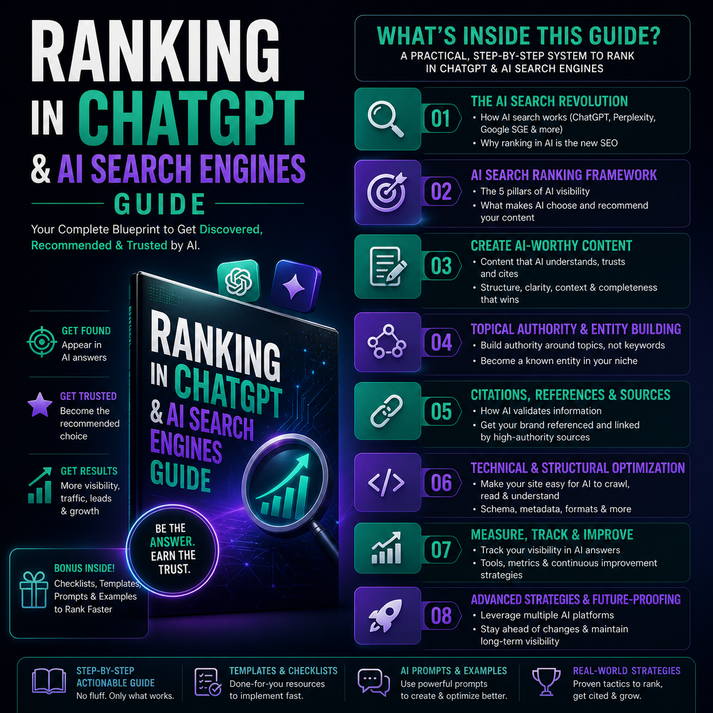
Learn the complete framework behind modern AI visibility, generative engine optimization, and conversational search rankings inside the RANKING IN CHATGPT & AI SEARCH ENGINES GUIDE.
Why Traditional Google SEO Is No Longer Enough
Traditional SEO was built around rankings.
Your goal was simple:
- Rank on page one
- Earn clicks
- Drive website traffic
- Convert visitors
Google’s ecosystem rewarded websites with strong authority, optimized content, quality backlinks, and user engagement metrics.
AI search engines operate differently.
Instead of simply ranking pages, they synthesize information from multiple sources and generate conversational responses instantly.
That means users may never click through to your website at all.
The competition is no longer just about ranking pages. It’s about becoming the trusted source AI systems reference when generating answers.
Google Search vs. AI Search Engines: The Core Difference
Google Search
Google primarily acts as a discovery engine.
Users search for information, and Google provides ranked webpages based on relevance and authority signals.
The user still needs to click, read, compare, and interpret information manually.
AI Search Engines
AI search engines act as answer engines.
Instead of displaying ten blue links, they summarize information directly within the interface.
This changes user behavior dramatically:
- Fewer clicks
- More conversational searches
- Higher emphasis on context
- Entity-based understanding
- Greater trust in summarized answers
In many cases, AI platforms choose only a handful of sources to generate answers. If your brand isn’t included, your visibility disappears entirely.
How AI Search Engines Evaluate Content Differently
AI systems are designed to understand relationships, concepts, expertise, and contextual authority.
This means old-school SEO tactics like keyword stuffing or thin affiliate content are becoming increasingly ineffective.
AI search visibility depends more on:
- Topical authority
- Entity recognition
- Content depth
- Trustworthiness
- Structured information
- Semantic relevance
- Brand mentions across the web
AI models prioritize sources that consistently demonstrate expertise and clarity within a specific niche.
That’s why modern SEO is moving toward topical ecosystems instead of isolated blog posts.
The Rise of Generative Engine Optimization (GEO)
Generative Engine Optimization (GEO) is rapidly becoming the next evolution of SEO.
Instead of optimizing solely for search rankings, GEO focuses on optimizing content for AI-generated responses.
This includes:
- Creating context-rich content
- Structuring information clearly
- Building semantic relationships between pages
- Strengthening topical authority
- Using conversational query optimization
- Improving AI readability
Businesses that adapt early can gain a massive competitive advantage before AI search optimization becomes mainstream.
The SEO Playbook Is Changing Fast
Discover advanced AI search ranking strategies, entity optimization systems, GEO frameworks, and future-proof visibility tactics inside the RANKING IN CHATGPT & AI SEARCH ENGINES GUIDE.
Common Mistakes Businesses Make With AI Search Optimization
1. Treating AI SEO Like Traditional SEO
AI systems require contextual authority, not just keyword optimization.
2. Publishing Thin AI-Generated Content
Low-value content lacks expertise signals and often fails to become a trusted source for AI systems.
3. Ignoring Brand Authority
AI search engines heavily favor recognized brands, expert citations, and trusted publishers.
4. Failing to Build Topic Clusters
Single standalone articles rarely establish sufficient topical depth.
Practical Ways to Improve AI Search Visibility
- Create comprehensive topic clusters around core themes
- Answer conversational search queries naturally
- Use structured headings and semantic formatting
- Build entity relationships within your niche
- Publish original insights and frameworks
- Strengthen author credibility and expertise signals
- Focus on clarity, trust, and contextual depth
AI search optimization is not about gaming algorithms.
It’s about becoming the most understandable, trustworthy, and authoritative source within your industry.
What You’ll Learn Inside the Full Product
The complete guide from Lywire goes far beyond basic SEO theory.
Inside the full framework, you’ll learn:
- How AI search engines actually process content
- Advanced GEO implementation strategies
- Entity-based optimization systems
- Topical authority frameworks
- How to structure AI-friendly content ecosystems
- Prompt-driven visibility optimization
- Future-proof SEO strategies for conversational search
Whether you’re a creator, marketer, agency, ecommerce brand, SaaS founder, or publisher, understanding AI search visibility is becoming essential for long-term growth.
Conclusion
The future of search is no longer just about rankings.
It’s about becoming the source AI trusts.
As AI-powered search continues reshaping how users discover information, businesses that adapt now will build a significant visibility advantage over competitors still relying solely on traditional SEO tactics.
The shift has already started.
The only question is whether your brand will be part of the AI-generated answer ecosystem — or left outside of it.
Ready to Future-Proof Your SEO Strategy?
Access the complete RANKING IN CHATGPT & AI SEARCH ENGINES GUIDE and learn how to dominate the next generation of AI-powered search visibility.
Frequently Asked Questions
What is AI search optimization?
AI search optimization focuses on improving visibility within AI-powered search engines and conversational answer systems like ChatGPT, Perplexity, Gemini, and Copilot.
How is AI SEO different from traditional SEO?
Traditional SEO focuses on webpage rankings and clicks, while AI SEO focuses on becoming a trusted source that AI systems reference when generating answers.
Will Google SEO still matter in the future?
Yes, but SEO strategies are evolving. Businesses now need both traditional search optimization and AI visibility optimization to remain competitive.
What is Generative Engine Optimization (GEO)?
GEO is the process of optimizing content for AI-generated search experiences and conversational search systems.
Can small businesses rank in AI search engines?
Absolutely. Small businesses can gain visibility by building strong topical authority, publishing expert-level content, and structuring information clearly.
What’s the best way to learn AI search ranking strategies?
Comprehensive frameworks and implementation systems provide the fastest learning path, especially as AI search algorithms evolve rapidly.