

Content Ecosystem & Topical Authority: The Modern Content Mapping Strategy That Drives Organic Growth
Why Most Content Strategies Fail in 2026
Publishing random blog posts is no longer enough to rank on Google.
Search engines have evolved beyond simple keyword matching. Today, Google prioritizes brands that demonstrate deep topical expertise, semantic relevance, and strong content relationships across an entire website.
This is where the concept of Content Ecosystem & Topical Authority becomes a game-changing SEO advantage.
Instead of creating isolated content pieces, modern brands are building interconnected content systems that reinforce expertise, improve crawlability, and dominate search intent clusters.
For creators, marketers, agencies, ecommerce brands, and digital entrepreneurs, mastering this strategy can dramatically improve:
- Organic traffic growth
- Keyword rankings
- Internal linking power
- User engagement metrics
- AI search visibility
- Long-term SEO scalability
Want to master the complete system behind Content Ecosystem & Topical Authority Content Mapping Strategy?
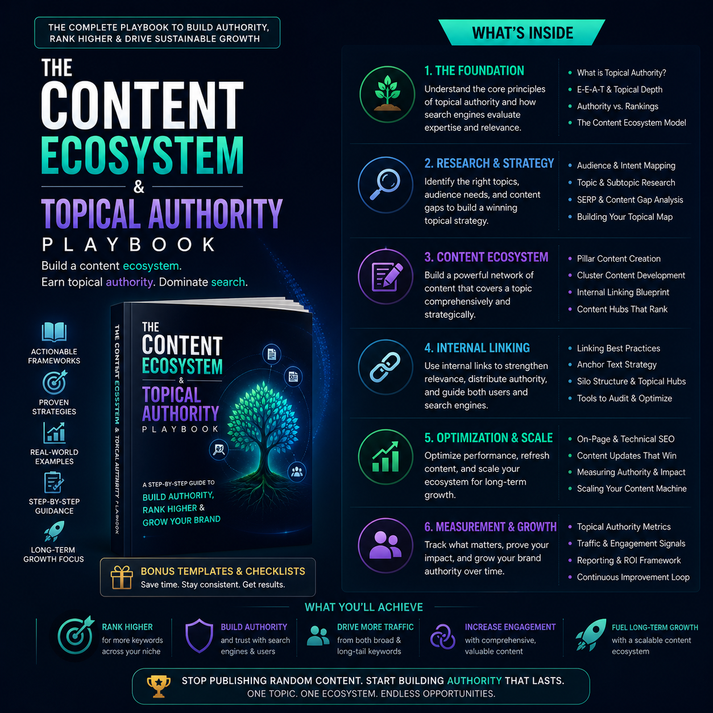
Access the full The Content Ecosystem & Topical Authority Playbook and learn how elite marketers build scalable authority-driven content systems.
What Is a Content Ecosystem?
A content ecosystem is a strategically connected network of content assets designed to support a central topical theme.
Instead of treating content as individual articles, a content ecosystem organizes pages into logical clusters that strengthen semantic relevance and authority.
Think of it as building an entire digital knowledge base around a topic rather than publishing disconnected posts.
Core Components of a High-Performance Content Ecosystem
- Pillar pages
- Topic clusters
- Supporting articles
- Semantic keyword coverage
- Strategic internal linking
- Search intent mapping
- Entity optimization
- Content depth hierarchy
When properly implemented, this structure helps search engines understand that your website is a trusted authority within a specific niche.
Understanding Topical Authority in SEO
Topical authority is the process of becoming the most trusted and comprehensive source on a subject.
Google increasingly rewards websites that demonstrate:
- Comprehensive coverage of a topic
- Semantic depth
- Consistent publishing around related themes
- Strong contextual linking
- Clear expertise signals
This is why smaller niche websites often outrank larger brands for specialized topics. Their content ecosystem is tightly focused and deeply interconnected.
In simple terms:
Keyword SEO ranks pages.
Topical Authority ranks entire websites.
How Content Mapping Strengthens Organic Rankings
Content mapping is the strategic planning process behind a successful content ecosystem.
It ensures every article serves a specific SEO purpose while supporting broader authority goals.
Effective Content Mapping Includes:
- Primary keyword targeting
- Search intent categorization
- Semantic keyword relationships
- Internal linking pathways
- User journey alignment
- Conversion-focused content positioning
Without mapping, content often becomes fragmented, repetitive, and cannibalized.
With proper mapping, every page strengthens the authority of the entire website.
The Biggest Mistakes Brands Make
1. Publishing Without Topic Clusters
Many brands create random content based solely on trending keywords. This weakens semantic consistency and limits authority growth.
2. Ignoring Internal Linking Strategy
Internal links distribute authority across your site. Poor linking structures reduce crawl efficiency and weaken topical relationships.
3. Creating Thin Content
Google favors comprehensive, experience-driven content. Surface-level articles rarely build lasting authority.
4. Over-Optimizing Keywords
Modern SEO is semantic-first. Keyword stuffing damages readability and weakens trust signals.
5. Lack of Content Hierarchy
Without pillar pages and structured clusters, search engines struggle to understand topic relevance.
Most websites don’t fail because they lack content.
They fail because they lack structure.
Discover the complete ecosystem-building framework inside The Content Ecosystem & Topical Authority Playbook.
Practical Ways to Build Topical Authority Faster
Start With a Core Topic Universe
Choose one broad niche and break it into related subtopics. Build content depth before expanding horizontally.
Create Pillar Pages First
Pillar pages act as central authority hubs that connect supporting articles together.
Use Semantic SEO Optimization
Include entities, related concepts, NLP terms, and contextual relevance naturally throughout content.
Focus on Search Intent
Align content with informational, navigational, commercial, and transactional intent stages.
Build Internal Link Loops
Every supporting article should strengthen other pages within the ecosystem.
Why Content Ecosystems Matter for AI Search Engines
AI-driven search systems are rapidly reshaping SEO.
Platforms like ChatGPT search integrations, generative search experiences, and AI-powered discovery engines rely heavily on contextual understanding and semantic relationships.
Websites with strong topical ecosystems are more likely to:
- Appear in AI-generated answers
- Gain citation visibility
- Improve knowledge graph relevance
- Increase trust signals
- Strengthen long-tail discoverability
This makes topical authority one of the most future-proof SEO strategies available today.
What You’ll Learn Inside the Full Product
Inside The Content Ecosystem & Topical Authority Playbook:
- Advanced content mapping systems
- Topical authority frameworks
- Semantic SEO strategies
- Internal linking blueprints
- Content cluster structures
- Authority-building workflows
- AI search optimization techniques
- Scalable organic growth systems
The playbook is designed for creators, agencies, niche site owners, ecommerce brands, and marketers who want sustainable organic growth instead of short-term SEO hacks.
Ready to build a scalable authority-driven content system?
Get instant access to The Content Ecosystem & Topical Authority Playbook and learn how to structure content like elite SEO brands.
Conclusion
The future of SEO belongs to brands that build interconnected, semantically rich content ecosystems.
Random blogging is becoming obsolete.
Modern search visibility requires strategic authority building, intelligent content mapping, and ecosystem-level optimization.
Whether you're growing a niche website, scaling a digital brand, or building long-term organic traffic, mastering Content Ecosystem & Topical Authority can become your competitive edge.
And the brands that implement these systems early will dominate search visibility for years to come.
Want the exact frameworks used to build scalable topical authority?
Explore the complete system inside The Content Ecosystem & Topical Authority Playbook.
Frequently Asked Questions
What is topical authority in SEO?
Topical authority is the process of building comprehensive expertise around a specific subject through interconnected, high-quality content.
How does a content ecosystem improve rankings?
A content ecosystem improves rankings by strengthening semantic relevance, internal linking structure, and overall authority signals across a website.
What is content mapping?
Content mapping is the strategic organization of content based on keywords, search intent, topic clusters, and user journey stages.
Can small websites build topical authority?
Yes. Smaller websites often build authority faster by focusing deeply on a single niche instead of covering unrelated topics.
How long does it take to build topical authority?
Results vary, but most websites begin seeing measurable improvements within several months of consistently publishing structured topical content.
Is topical authority important for AI search engines?
Absolutely. AI-driven search systems rely heavily on contextual understanding and semantic relationships, making topical authority increasingly important.