
Future-Proof Your SEO Right Now: 7 Advanced AEO Strategies Nobody Is Talking About Yet
SEO is changing faster than most businesses are prepared for.
The old model of ranking pages through backlinks and keyword density is slowly being replaced by AI-powered answer engines capable of generating direct responses instantly.
Search engines are evolving into intelligent systems that summarize, recommend, and interpret information instead of simply displaying links.
That shift is exactly why ANSWER ENGINE OPTIMIZATION is becoming one of the most important digital marketing strategies for the next generation of organic visibility.
Brands that adapt early will dominate AI search ecosystems. Brands that ignore this evolution will struggle to remain visible.
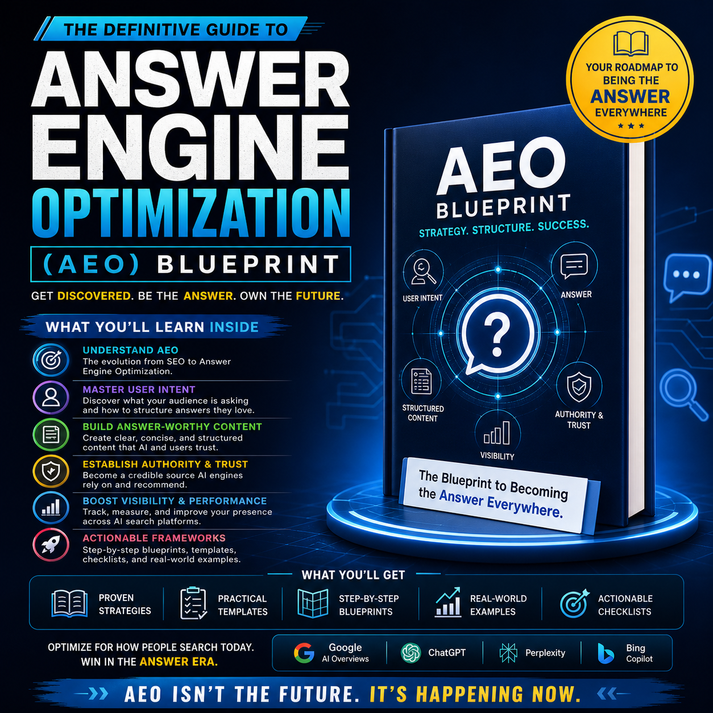
Want to master the complete AI search optimization framework? Explore the full ANSWER ENGINE OPTIMIZATION (AEO) BLUEPRINT by Lywire and learn how to build future-proof visibility across modern answer engines.
What Is Answer Engine Optimization?
Answer Engine Optimization (AEO) is the process of structuring and optimizing content so AI-driven search systems can easily understand, extract, summarize, and recommend your information.
Unlike traditional SEO, which focuses heavily on rankings and clicks, AEO focuses on becoming the best possible answer source.
Modern AEO Targets Include:
- Google AI Overviews
- ChatGPT search experiences
- Bing Copilot
- Voice assistants
- AI-generated search summaries
- Conversational search interfaces
This is no longer theoretical. AI-driven discovery is already reshaping how users find information online.
7 Advanced AEO Strategies Smart Brands Are Implementing Right Now
1. Build Intent-Based Content Ecosystems
Most websites still publish isolated blog posts targeting disconnected keywords.
Advanced AEO strategies focus on building complete intent ecosystems around user questions, search journeys, and semantic relationships.
Instead of publishing one article about “AI SEO,” high-authority brands create interconnected content around:
- How AI search works
- How answer engines rank information
- ChatGPT optimization strategies
- Voice search visibility
- Generative engine optimization
This creates stronger topical authority signals and helps AI systems understand your expertise more clearly.
2. Optimize Content for AI Extraction
AI systems prefer content that is easy to interpret and summarize.
That means your content structure matters more than ever.
Use:
- Short paragraphs
- Direct answers
- Clear subheadings
- Bullet lists
- Simple contextual explanations
- Entity-rich language
Your content should feel “extractable” by AI models.
If an answer engine cannot quickly interpret your page, your visibility potential decreases significantly.
The brands dominating tomorrow’s search landscape are already implementing advanced AI visibility systems today.
Inside the ANSWER ENGINE OPTIMIZATION (AEO) BLUEPRINT, Lywire breaks down the exact frameworks used to optimize content for modern answer engines and AI search experiences.
3. Use Conversational Search Language
Search behavior has become more natural and conversational.
Users are no longer typing robotic keyword phrases. Instead, they ask complete questions like:
- “How do I optimize my website for AI search?”
- “What are the best AEO strategies for 2026?”
- “How does ChatGPT choose website information?”
Your content should naturally mirror these conversational patterns.
This improves relevance for voice search, AI summaries, and natural language search systems.
4. Strengthen Entity SEO Signals
Modern search engines rely heavily on entities instead of isolated keywords.
Entities help AI systems understand relationships between brands, concepts, industries, products, and expertise areas.
To improve entity recognition:
- Maintain consistent brand terminology
- Create strong internal linking structures
- Publish semantically related content clusters
- Use structured data extensively
- Build authority around specific expertise areas
The stronger your entity presence becomes, the more likely AI systems are to trust and reference your content.
5. Create “Answer-First” Content Structures
Traditional introductions often delay value.
AEO-optimized content immediately addresses the user’s core question near the beginning of the page.
This improves:
- Featured snippet opportunities
- AI answer extraction
- User engagement metrics
- Voice assistant compatibility
Modern search systems reward clarity and speed of relevance.
6. Use Schema Markup Aggressively
Schema markup helps answer engines understand content context more effectively.
For advanced AEO, structured data should become a standard part of your publishing workflow.
Essential Schema Types for AEO
- FAQ Schema
- Article Schema
- How-To Schema
- Organization Schema
- Product Schema
- Breadcrumb Schema
The easier your content is for machines to process, the stronger your AI visibility potential becomes.
7. Optimize Beyond Traditional Google Rankings
Future-proof SEO requires diversification.
Organic discovery now happens across:
- ChatGPT
- Perplexity AI
- Google AI Overviews
- Bing Copilot
- YouTube search
- Voice search platforms
Brands that optimize only for traditional Google rankings are limiting their future visibility potential.
If you want to future-proof your digital visibility before the majority catches up, explore the complete ANSWER ENGINE OPTIMIZATION (AEO) BLUEPRINT from Lywire and learn advanced systems built specifically for the AI-first era of search.
Common AEO Mistakes Businesses Still Make
- Publishing shallow content without semantic depth
- Over-optimizing keywords unnaturally
- Ignoring conversational search intent
- Neglecting structured data implementation
- Creating disconnected content without topical authority
- Failing to optimize for AI readability
The future belongs to brands that create context-rich, entity-driven, deeply helpful content ecosystems.
What You’ll Learn Inside the Full AEO Blueprint
- Advanced Answer Engine Optimization systems
- AI-powered search ranking strategies
- Generative engine optimization frameworks
- Topical authority building models
- ChatGPT and AI visibility tactics
- Entity SEO implementation systems
- Future-proof content architecture
- AI-first organic growth workflows
Conclusion
SEO is entering a completely new era.
The brands that win over the next decade will not simply rank pages — they will become trusted answer sources across AI-powered search ecosystems.
That transition has already started.
Businesses implementing advanced Answer Engine Optimization strategies today are positioning themselves for long-term organic dominance tomorrow.
Ready to build an AI-proof SEO strategy and dominate the future of search?
Get instant access to the ANSWER ENGINE OPTIMIZATION (AEO) BLUEPRINT by Lywire and learn the complete framework behind modern AI search visibility.
Frequently Asked Questions
What is Answer Engine Optimization?
Answer Engine Optimization is the process of optimizing content so AI-driven search systems can understand, summarize, and recommend your information more effectively.
Why is AEO important for modern SEO?
As AI-powered search experiences become more common, traditional SEO alone is no longer enough. AEO helps brands remain visible in conversational and generative search environments.
Can AEO improve visibility in ChatGPT and AI search engines?
Yes. Properly structured, semantically rich content increases the likelihood of being surfaced in AI-generated search responses and answer engines.
Is schema markup necessary for AEO?
Schema markup significantly improves machine readability, making it easier for AI systems and search engines to interpret and classify your content accurately.
Who should use Answer Engine Optimization?
AEO is valuable for bloggers, ecommerce brands, SaaS companies, agencies, publishers, and any business seeking long-term organic visibility.
What is the biggest benefit of AEO?
The biggest benefit is future-proof visibility across AI-powered search systems, helping businesses stay discoverable as search technology evolves.