
How to Actually Measure Your AI Search Performance (Because You Can't Improve What You Can't Track)
Traditional SEO metrics are no longer enough.
Your brand might rank #1 on Google and still remain invisible inside ChatGPT, Perplexity, Gemini, Claude, and other AI-driven search engines.
That’s the uncomfortable reality many businesses are discovering in 2026.
AI search has fundamentally changed how users discover information. Instead of browsing multiple blue links, users now receive direct AI-generated answers — often without ever clicking a website.
Which raises a critical question:
How do you measure your visibility inside AI search engines if traditional analytics tools weren’t built for this ecosystem?
If you cannot track your AI search performance, you cannot optimize it.
This is exactly why modern brands are shifting toward Generative Engine Optimization (GEO) and AI visibility tracking systems.
Why AI Search Tracking Matters More Than Ever
AI search engines do not rank websites the same way Google traditionally does.
Instead, they evaluate:
- Topical authority
- Entity trust signals
- Citation consistency
- Brand mentions across the web
- Structured information quality
- Content clarity and semantic relationships
In other words, ranking inside AI systems is less about “keyword placement” and more about becoming a trusted source AI models repeatedly reference.
The problem?
Most marketers are still using outdated SEO dashboards that cannot accurately measure AI-generated exposure.
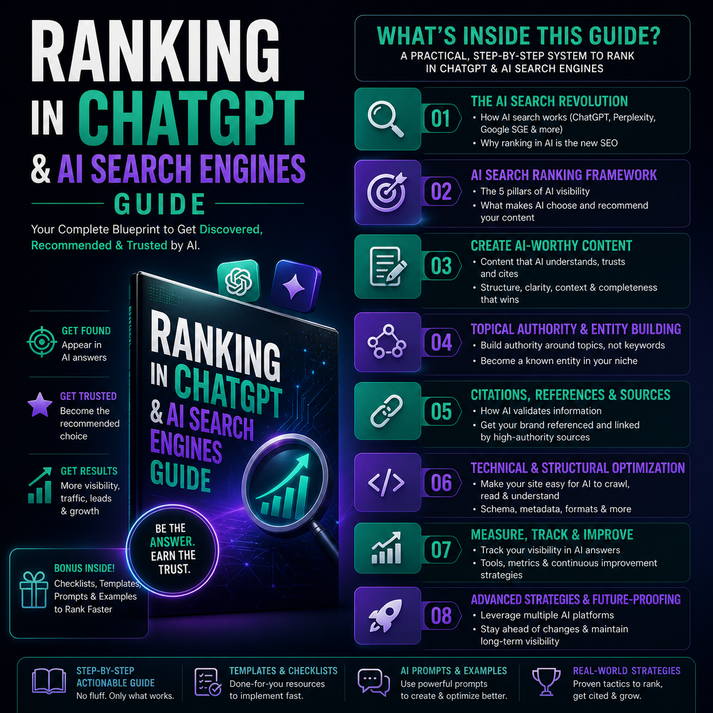
Want to master the complete system behind AI visibility tracking and optimization? Access the full RANKING IN CHATGPT & AI SEARCH ENGINES GUIDE and learn the exact frameworks modern brands are using to dominate AI search ecosystems.
The Core Metrics You Should Actually Track
1. AI Citation Frequency
One of the most important metrics in AI search optimization is how often your brand gets referenced inside AI-generated responses.
This includes:
- ChatGPT recommendations
- Perplexity citations
- Gemini answer references
- AI-generated summaries
If AI systems repeatedly surface your brand as a source, your authority compounds over time.
Think of this as the new version of backlinks — except now the “link” is an AI mention.
2. AI Referral Traffic
Many businesses overlook this entirely.
AI platforms increasingly send referral traffic through citations, embedded browsing, plugins, and source links.
Inside your analytics platform, monitor:
- Traffic from ChatGPT
- Perplexity.ai referrals
- Bing Copilot traffic
- Gemini ecosystem referrals
- AI browser sessions
Brands that actively optimize for AI search are already seeing significant high-intent traffic from these sources.
3. Topic-Level Authority Signals
AI systems evaluate expertise at the topic level — not just page-level keyword targeting.
That means your content ecosystem matters more than isolated blog posts.
You should track:
- Semantic coverage depth
- Interlinked content clusters
- Entity relationships
- Knowledge graph consistency
- Brand-topic association strength
This is where topical authority becomes a major competitive advantage.
Common AI Search Tracking Mistakes
Focusing Only on Google Rankings
Google rankings alone no longer represent your true digital visibility.
AI-generated discovery layers are becoming independent traffic channels.
Ignoring Brand Mentions
AI systems learn from repeated brand associations across multiple trusted sources.
If your brand is rarely mentioned externally, AI visibility becomes difficult.
Tracking Keywords Instead of Conversations
AI search operates more like conversational intent mapping than exact keyword matching.
Brands that optimize for questions, context, and semantic depth outperform those relying on outdated keyword stuffing tactics.
Modern AI SEO is about becoming the most contextually trusted answer — not simply ranking for isolated keywords.
Practical Ways to Improve AI Search Visibility
- Create deeply interconnected topical clusters
- Build consistent entity-based branding
- Use structured data markup aggressively
- Publish high-authority educational content
- Earn citations from trusted platforms
- Answer conversational search intent clearly
- Optimize for semantic completeness
The businesses winning inside AI search are treating content like a scalable knowledge system — not isolated articles.
If you want the complete AI search optimization framework used to improve AI rankings, visibility, topical authority, and citation frequency, explore the full RANKING IN CHATGPT & AI SEARCH ENGINES GUIDE from Lywire.
What You’ll Learn Inside the Full Product
- Advanced GEO (Generative Engine Optimization) frameworks
- AI citation optimization systems
- Topical authority architecture
- AI-focused content ecosystem strategies
- ChatGPT ranking methodologies
- Entity optimization techniques
- AI search analytics frameworks
- Future-proof SEO systems for AI-driven discovery
The complete guide was built for creators, marketers, agencies, SaaS brands, ecommerce businesses, and digital entrepreneurs who want to stay ahead of the AI search revolution.
Conclusion
AI search is rapidly becoming one of the most important discovery channels online.
But unlike traditional SEO, success inside AI ecosystems depends heavily on measurable authority, contextual trust, and structured visibility.
The brands that learn how to properly track and optimize their AI search performance today will dominate tomorrow’s search landscape.
Ready to build a future-proof AI visibility strategy? Access the complete RANKING IN CHATGPT & AI SEARCH ENGINES GUIDE and discover the advanced systems modern brands are using to rank inside ChatGPT and AI-powered search engines.
Frequently Asked Questions
How do I know if my website appears in AI search results?
You can monitor AI citations, AI-generated mentions, referral traffic from AI platforms, and branded conversational queries across systems like ChatGPT and Perplexity.
What is Generative Engine Optimization (GEO)?
GEO is the process of optimizing content and digital authority signals so AI search engines can better understand, trust, and surface your brand in generated responses.
Can traditional SEO tools track ChatGPT rankings?
Most traditional SEO tools were not designed for AI search visibility. AI search tracking requires citation monitoring, entity optimization analysis, and conversational query evaluation.
Why is topical authority important for AI search?
AI systems prioritize comprehensive expertise. Brands with deep topical ecosystems are more likely to be trusted and cited by AI models.
Does AI search optimization replace traditional SEO?
No. AI SEO builds on traditional SEO foundations but expands into semantic authority, structured trust signals, and conversational search optimization.
Who should learn AI search optimization?
Content creators, SEO professionals, agencies, ecommerce brands, SaaS companies, and digital marketers can all benefit from learning AI search optimization strategies.