
How to Build a Technical AEO Framework Without Being a Developer (Step-by-Step Guide)
Search is changing faster than most websites can adapt.
Traditional SEO is no longer enough when AI-powered search engines, answer engines, and generative search systems are becoming the primary way users discover information online.
Today, brands that win visibility are not simply ranking pages — they are engineering answers.
That’s where ANSWER ENGINE OPTIMIZATION becomes critical.
The good news? You do not need to be a developer to build a powerful technical AEO framework.
With the right systems, structured content methods, and implementation strategies, marketers, creators, bloggers, and business owners can optimize their websites for AI search visibility without writing complex code.
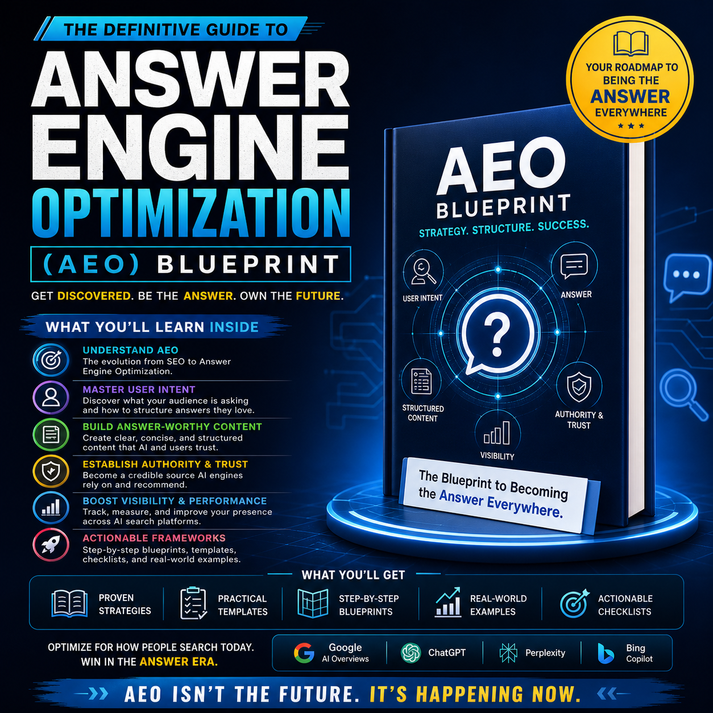
Want to master the complete system behind technical ANSWER ENGINE OPTIMIZATION? Explore the full ANSWER ENGINE OPTIMIZATION (AEO) BLUEPRINT and learn advanced AI search ranking frameworks.
Why Traditional SEO Alone Is No Longer Enough
Search behavior is evolving rapidly due to AI-generated answers, voice assistants, conversational search interfaces, and large language models.
Instead of clicking through ten blue links, users increasingly receive direct answers from platforms like AI assistants, generative search engines, and voice search systems.
This creates a new challenge:
- How do you structure content for answer engines?
- How do AI systems interpret your expertise?
- How can your website become a trusted citation source?
- How do you improve machine readability without coding?
The solution lies in building a scalable technical AEO framework.
What Is a Technical AEO Framework?
A technical AEO framework is a structured optimization system designed to help answer engines understand, extract, and surface your content in AI-generated responses.
Unlike traditional SEO that focuses heavily on rankings, ANSWER ENGINE OPTIMIZATION focuses on:
- Semantic clarity
- Structured information architecture
- Entity optimization
- Question-answer formatting
- Schema markup implementation
- Machine-readable content systems
- Contextual topical authority
The objective is simple: Make your content easier for AI systems to interpret and trust.
Step 1: Build Content Around Questions, Not Keywords
Most websites still create content around isolated keywords.
Modern answer engines prioritize intent-driven questions because users now search conversationally.
Instead of targeting:
“AEO strategies”
Structure content around:
- What is ANSWER ENGINE OPTIMIZATION?
- How does AEO work?
- How do AI search engines rank answers?
- Can small businesses optimize for AI search?
This improves your chances of being surfaced in AI-generated responses and featured snippets.
Step 2: Use Structured Content Architecture
You do not need advanced coding knowledge to structure content effectively.
Most modern CMS platforms already support clean formatting.
Focus on:
- Clear heading hierarchy (H1, H2, H3)
- Short paragraphs
- Bullet lists
- Direct answer blocks
- Definition-style introductions
- FAQ sections
- Semantic topic clustering
Answer engines extract information more efficiently from highly structured pages.
Pro Insight
The easier your content is for humans to scan, the easier it becomes for AI systems to parse and interpret.
Step 3: Implement Schema Markup Without Coding
Schema markup helps search engines understand context, entities, and relationships within your content.
Many people assume schema implementation requires development expertise.
It does not.
You can use plugins, schema generators, or CMS integrations to implement:
- FAQ Schema
- Article Schema
- How-To Schema
- Organization Schema
- Product Schema
These structured data layers significantly improve visibility in AI-powered search ecosystems.
Most creators stop at basic SEO and miss the technical systems driving AI search visibility. Learn the complete implementation process inside the ANSWER ENGINE OPTIMIZATION (AEO) BLUEPRINT.
Step 4: Create Topical Authority Clusters
Answer engines reward comprehensive expertise.
Instead of publishing disconnected blog posts, build interconnected topic ecosystems.
For example:
- Main pillar: ANSWER ENGINE OPTIMIZATION
- Supporting content: schema markup
- Supporting content: AI search ranking signals
- Supporting content: conversational search optimization
- Supporting content: featured snippet frameworks
- Supporting content: semantic SEO systems
This creates stronger contextual relevance across your domain.
Common AEO Mistakes Most Websites Make
1. Over-Optimizing Keywords
Keyword stuffing weakens readability and reduces trust signals.
2. Ignoring Search Intent
AI systems prioritize useful answers, not repetitive keyword placement.
3. Poor Content Structure
Walls of text reduce extractability for answer engines.
4. Weak Entity Signals
Many websites fail to establish expertise, authority, and contextual depth.
5. No Schema Implementation
Without structured data, your content becomes harder for AI systems to classify.
Practical Benefits of Building an AEO Framework
- Higher visibility in AI-generated search results
- Better featured snippet opportunities
- Improved voice search discoverability
- Enhanced topical authority
- More organic traffic from conversational search
- Future-proof search optimization strategy
- Stronger brand credibility in AI ecosystems
What You’ll Learn Inside the Full Product
The complete ANSWER ENGINE OPTIMIZATION (AEO) BLUEPRINT goes far beyond surface-level SEO advice.
Inside the system, you’ll discover:
- Advanced AI search optimization frameworks
- Entity-based SEO systems
- Content engineering strategies
- Semantic SEO implementation methods
- Topical authority architecture
- AI search visibility models
- Answer extraction optimization tactics
- Scalable AEO workflows for businesses and creators
Ready to position your content for the future of search? Access the complete ANSWER ENGINE OPTIMIZATION (AEO) BLUEPRINT and build a scalable AI search optimization system today.
Conclusion
The future of search belongs to structured, machine-readable, authoritative content.
Businesses that adapt early to ANSWER ENGINE OPTIMIZATION will gain a significant competitive advantage as AI-driven search continues to reshape online discovery.
You do not need to be a developer to build a technical AEO framework.
You simply need the right systems, implementation roadmap, and strategic structure.
That is exactly what modern AI search optimization demands.
Want the full blueprint for dominating AI-powered search ecosystems? Explore the complete ANSWER ENGINE OPTIMIZATION (AEO) BLUEPRINT and start building future-proof organic visibility.
Frequently Asked Questions
What is ANSWER ENGINE OPTIMIZATION?
ANSWER ENGINE OPTIMIZATION (AEO) is the process of optimizing content so AI-powered search engines and answer engines can understand, extract, and surface information directly in search responses.
Do I need coding skills to implement AEO?
No. Most modern CMS platforms, plugins, and schema tools allow non-developers to implement structured optimization systems effectively.
How is AEO different from traditional SEO?
Traditional SEO focuses on rankings and traffic, while AEO focuses on becoming the best direct answer source for AI-driven search systems.
Does schema markup help AI search visibility?
Yes. Structured data improves machine readability and helps answer engines better understand content context and relationships.
Can small businesses benefit from ANSWER ENGINE OPTIMIZATION?
Absolutely. AEO creates opportunities for smaller brands to compete through topical authority and high-quality structured content.
Why are topical authority clusters important for AEO?
Topical clusters help search engines understand expertise depth, semantic relevance, and contextual authority across your website.