

How To Build Your Technical Foundation in Voice SEO
Voice search is no longer a futuristic trend. It’s rapidly becoming one of the most important search behaviors shaping how people discover content online.
From smartphones and smart speakers to AI assistants and conversational search engines, users are asking questions differently — and search engines are evolving to understand natural language at scale.
That means traditional SEO alone is no longer enough.
To compete in modern search environments, brands need a strong Voice SEO foundation that supports conversational queries, fast-loading experiences, structured data, and AI-friendly content architecture.
Want to master the complete system behind Voice SEO?
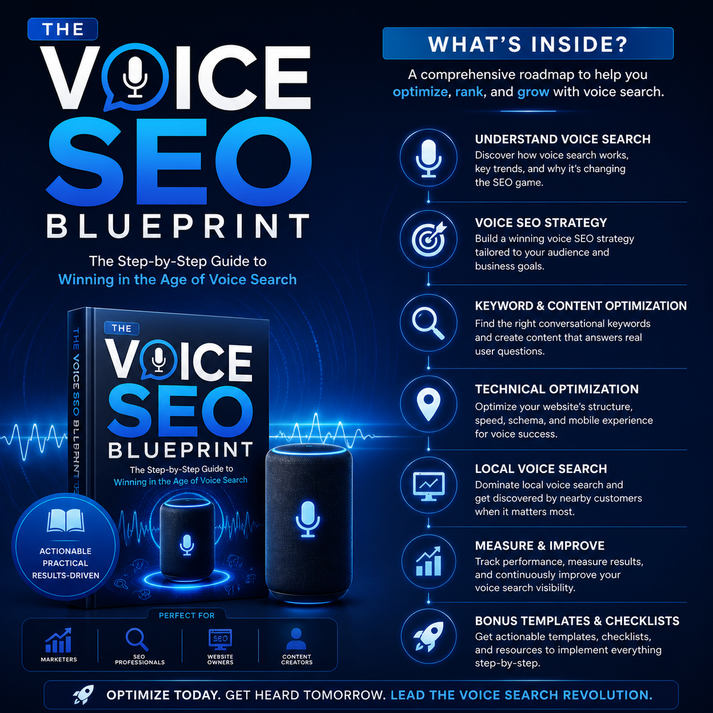
Access the full The Voice SEO Blueprint
Why Technical Foundations Matter in Voice SEO
Most businesses focus only on keywords when optimizing for voice search. But Voice SEO is deeply technical.
Search engines prioritize websites that can quickly interpret, structure, and deliver accurate answers for spoken queries.
Without the right technical setup, even high-quality content may struggle to appear in voice search results.
Voice search optimization depends heavily on:
- Structured data and schema markup
- Mobile-first performance
- Page speed optimization
- Semantic content structure
- Natural language query alignment
- Technical crawlability
- AI-readable site architecture
The Core Pillars of a Strong Voice SEO Foundation
1. Prioritize Mobile-First Performance
Voice searches happen primarily on mobile devices. If your website isn’t optimized for mobile usability, your Voice SEO efforts will suffer immediately.
Your pages should load quickly, display cleanly on smaller screens, and eliminate unnecessary friction.
- Use responsive design
- Compress large media files
- Reduce JavaScript bloat
- Improve Core Web Vitals
- Minimize redirect chains
Google heavily rewards fast, frictionless experiences because voice users expect instant answers.
2. Implement Structured Data Correctly
Schema markup is one of the most overlooked components of Voice SEO.
Structured data helps search engines understand your content contextually, making it easier to surface your information in featured snippets, voice assistants, and AI-generated responses.
Key schema types for Voice SEO include:
- FAQ Schema
- How-To Schema
- Article Schema
- Product Schema
- Organization Schema
- Local Business Schema
The more clearly search engines understand your content, the more likely they are to trust and surface it in conversational search experiences.
3. Optimize for Conversational Search Queries
Voice searches sound different from typed searches.
Users ask complete questions like:
- “What’s the best way to optimize for voice search?”
- “How do I improve Voice SEO rankings?”
- “Which schema markup helps voice assistants?”
Your content structure should mirror natural human conversation.
This means:
- Using question-based subheadings
- Creating concise answer blocks
- Writing naturally and conversationally
- Targeting long-tail search intent
- Building semantic topical relevance
Common Technical Voice SEO Mistakes
Ignoring Site Speed
Slow websites create poor voice experiences. Voice assistants prioritize fast-loading pages because users expect immediate responses.
Over-Optimizing Keywords
Traditional keyword stuffing damages readability and weakens conversational relevance.
Modern Voice SEO requires natural language optimization, not robotic repetition.
Weak Internal Linking
Search engines rely on internal links to understand topical relationships.
Without strong content architecture, your authority signals weaken dramatically.
Skipping Featured Snippet Optimization
Many voice search responses pull directly from featured snippets.
Failing to optimize concise answer sections reduces visibility opportunities significantly.
Most businesses only scratch the surface of Voice SEO.
The complete The Voice SEO Blueprint reveals advanced frameworks for conversational optimization, AI search visibility, schema deployment, topical authority building, and modern search ranking systems.
Practical Voice SEO Implementation Tips
Create Question-Focused Content Hubs
Build pages around real conversational search intent instead of isolated keywords.
This increases semantic relevance and improves AI understanding.
Use Clear Heading Hierarchies
Proper H1, H2, and H3 structures help search engines extract information efficiently for voice responses.
Focus on Entity-Based SEO
Modern search engines understand topics through entities and contextual relationships.
Build comprehensive topical clusters instead of publishing disconnected articles.
Improve Crawl Efficiency
Technical crawlability directly affects indexing and discoverability.
- Fix broken links
- Optimize XML sitemaps
- Improve internal navigation
- Reduce duplicate content
- Strengthen canonicalization
What You’ll Learn Inside The Voice SEO Blueprint
The full product goes far beyond beginner-level advice.
Inside The Voice SEO Blueprint, you’ll discover:
- Advanced Voice SEO frameworks
- AI search optimization systems
- Conversational content architecture
- Schema deployment strategies
- Topical authority building techniques
- Voice search ranking models
- Featured snippet optimization methods
- Modern semantic SEO systems
- AI-first search visibility tactics
Whether you're a content creator, SEO professional, business owner, affiliate marketer, or digital entrepreneur, building a technical Voice SEO foundation can become a major competitive advantage in the AI-driven search era.
Ready to future-proof your search visibility?
Get instant access to The Voice SEO Blueprint and learn the exact frameworks used to optimize for modern conversational search environments.
Conclusion
Voice search is transforming how users interact with search engines, AI assistants, and digital platforms.
Brands that invest early in technical Voice SEO foundations position themselves for long-term visibility, authority, and organic traffic growth.
The future of SEO is increasingly conversational, semantic, and AI-driven.
And the businesses that adapt now will dominate tomorrow’s search landscape.
If you want a complete roadmap for mastering modern Voice SEO systems, structured optimization, conversational ranking strategies, and AI search visibility, The Voice SEO Blueprint provides the full framework.
Frequently Asked Questions About Voice SEO
What is Voice SEO?
Voice SEO is the process of optimizing websites and content for voice-based search queries made through smartphones, smart speakers, and AI assistants.
Why is technical SEO important for voice search?
Technical SEO helps search engines understand, crawl, and deliver your content efficiently during conversational and spoken search interactions.
Does schema markup improve Voice SEO?
Yes. Structured data helps search engines interpret content contextually, increasing the chances of appearing in featured snippets and voice responses.
How do I optimize content for conversational search?
Use natural language, answer-focused formatting, question-based headings, and semantic keyword variations that reflect real user conversations.
Is mobile optimization necessary for Voice SEO?
Absolutely. Most voice searches happen on mobile devices, making mobile-first performance essential for rankings and usability.
Can small businesses benefit from Voice SEO?
Yes. Local businesses especially benefit from Voice SEO because many voice searches are location-based and intent-driven.