
How to Optimize Your Content for ChatGPT, Perplexity, and Other AI Language Models
The Future of Search Is No Longer Just Google
Traditional SEO is evolving faster than most marketers realize.
Today, millions of users are searching through AI-powered systems like ChatGPT, Perplexity, Gemini, Claude, and other large language models instead of relying solely on traditional search engines. These platforms don’t just list websites — they generate direct answers.
That changes everything about how content gets discovered.
If your content is not optimized for AI-driven search experiences, you risk becoming invisible in the next era of digital visibility.
This is where Answer Engine Optimization becomes critical.
Instead of optimizing only for rankings, Answer Engine Optimization (AEO) focuses on making your content understandable, trustworthy, structured, and highly retrievable for AI language models.
Want to master the complete system behind AI search visibility?
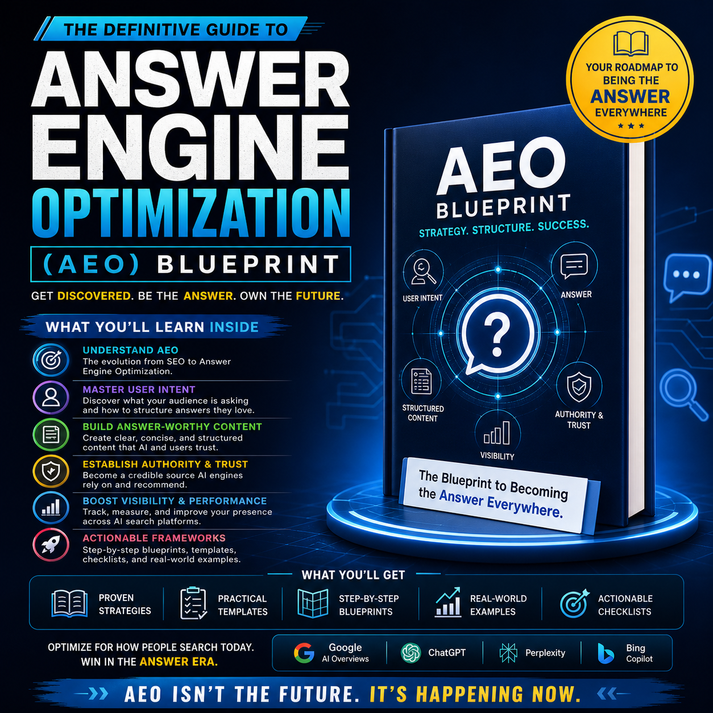
Access the full ANSWER ENGINE OPTIMIZATION (AEO) BLUEPRINT and learn the advanced frameworks used to optimize content for modern AI search engines.
Why Most Content Fails Inside AI Search Engines
Many websites still publish content designed exclusively for old-school keyword ranking systems.
But AI language models evaluate content differently.
They prioritize:
- Contextual clarity
- Entity relationships
- Semantic depth
- Concise answers
- Topical authority
- Trust signals
- Structured information
If your content lacks these elements, AI systems are less likely to reference or surface your brand in generated responses.
In simple terms: ranking on Google no longer guarantees visibility inside AI-generated answers.
What Is Answer Engine Optimization?
Answer Engine Optimization (AEO) is the process of optimizing content so AI systems can easily interpret, extract, and present your information directly within generated responses.
Unlike traditional SEO, which focuses heavily on rankings and clicks, AEO focuses on becoming the source AI models trust when generating answers.
Core Goal of AEO
Make your content the most reliable, structured, and semantically clear answer available for a given query.
How AI Language Models Process Content
To optimize effectively, you first need to understand how AI models evaluate information.
Platforms like ChatGPT and Perplexity analyze:
- Topic relevance
- Semantic relationships
- Natural language patterns
- Authority and credibility
- Structured formatting
- Question-answer relevance
- Content comprehensiveness
AI systems prefer content that mirrors how humans naturally ask questions.
That means conversational, intent-driven, deeply informative content performs significantly better than keyword-stuffed articles.
7 Powerful AEO Strategies to Optimize Your Content
1. Structure Content Around Questions
AI systems thrive on question-answer formats.
Instead of generic headings, use search-intent-driven questions such as:
- What is Answer Engine Optimization?
- How does ChatGPT retrieve information?
- Why is AEO important for SEO?
This increases retrieval potential inside conversational AI systems.
2. Build Topical Authority
One article is no longer enough.
AI systems reward brands that demonstrate deep expertise across an entire subject ecosystem.
Create interconnected content clusters covering:
- AEO strategies
- Generative search optimization
- AI search visibility
- Semantic SEO
- Entity optimization
- Conversational search behavior
3. Use Clear Semantic Formatting
Organized content improves machine readability.
Use:
- Proper heading hierarchy
- Bullet points
- Short paragraphs
- Definitions
- Tables and summaries
Clean formatting helps AI models extract information more efficiently.
4. Optimize for Entities, Not Just Keywords
Modern AI systems understand entities and relationships.
Instead of repeating the same keyword excessively, include related concepts naturally throughout your content.
For example, Answer Engine Optimization connects closely with:
- Generative AI search
- Semantic SEO
- AI content optimization
- Knowledge retrieval systems
- Natural language search
5. Create Direct, Concise Answers
AI systems often extract short answer blocks.
Your content should include concise, high-confidence explanations that can easily be referenced in generated responses.
This improves featured snippet and AI citation potential.
6. Improve Content Trust Signals
Trustworthiness matters more than ever.
Include:
- Original insights
- Accurate information
- Updated data
- Expert positioning
- Authoritative tone
AI systems prioritize credible sources when generating answers.
7. Focus on Conversational Search Intent
Users increasingly search in natural language.
Instead of targeting robotic phrases, optimize for conversational queries users actually ask AI assistants.
This aligns your content with real-world AI interactions.
Common AEO Mistakes to Avoid
- Overusing keywords unnaturally
- Publishing thin AI-generated content
- Ignoring semantic relationships
- Using poor formatting structures
- Creating surface-level articles
- Neglecting topical authority building
- Failing to answer user intent directly
The future belongs to content that is useful, contextual, and deeply informative.
What You’ll Learn Inside the Full ANSWER ENGINE OPTIMIZATION (AEO) BLUEPRINT
The complete framework goes far beyond basic optimization tips.
Inside the blueprint, you’ll discover:
- Advanced AI search optimization systems
- Entity-based SEO frameworks
- Content structuring models for AI retrieval
- How to build AI-friendly topical authority
- Semantic optimization strategies
- Prompt-driven search behavior insights
- Future-proof visibility techniques for AI search ecosystems
Ready to future-proof your digital visibility?
Explore the full ANSWER ENGINE OPTIMIZATION (AEO) BLUEPRINT and learn how modern brands are optimizing for ChatGPT, Perplexity, Gemini, and the next generation of AI search engines.
Conclusion
Search is no longer limited to search engine result pages.
AI-generated answers are becoming the new gateway to information discovery.
Brands that adapt early to Answer Engine Optimization will gain a major visibility advantage as AI search continues to evolve.
The key is simple: create content that is deeply helpful, semantically rich, structurally clear, and aligned with conversational search intent.
Those who master AEO today will dominate the visibility landscape tomorrow.
Want the complete roadmap to AI search dominance?
Access the full ANSWER ENGINE OPTIMIZATION (AEO) BLUEPRINT and discover the exact frameworks, systems, and optimization methods used to rank inside modern AI-driven search ecosystems.
Frequently Asked Questions
What is Answer Engine Optimization?
Answer Engine Optimization (AEO) is the process of optimizing content for AI-powered search systems like ChatGPT, Perplexity, Gemini, and voice assistants so they can retrieve and present your information in generated answers.
How is AEO different from traditional SEO?
Traditional SEO focuses primarily on rankings and clicks, while AEO focuses on making content understandable, retrievable, and trustworthy for AI systems generating direct answers.
Why is optimizing for AI language models important?
AI search platforms are rapidly changing how users discover information online. Optimizing for AI models helps increase brand visibility in conversational and generative search environments.
Can ChatGPT and Perplexity cite my website?
Yes. Well-structured, authoritative, semantically optimized content has a higher chance of being referenced or surfaced by AI-powered answer engines.
What type of content performs best for AEO?
Question-driven, comprehensive, semantically rich, and clearly structured content performs best for Answer Engine Optimization.
Is AEO the future of SEO?
AEO is becoming a major evolution of SEO as AI-generated search experiences continue to grow across digital platforms and user behaviors.