

How to Scale Your Pinterest Traffic While Working Less — The Automation System Serious Creators Use
The New Reality of Pinterest Traffic Growth
For years, creators treated Pinterest like a social media platform — posting manually, designing endless pins, and hoping for viral spikes.
But serious marketers now understand something different: Pinterest traffic is a search engine game.
And once you approach it like an evergreen discovery engine instead of a daily content grind, everything changes.
The creators driving millions of monthly impressions and consistent website traffic are not spending all day pinning manually. They’re using streamlined systems, automation frameworks, SEO optimization, and scalable workflows that compound over time.
That’s the difference between random Pinterest activity and a true Pinterest traffic system.
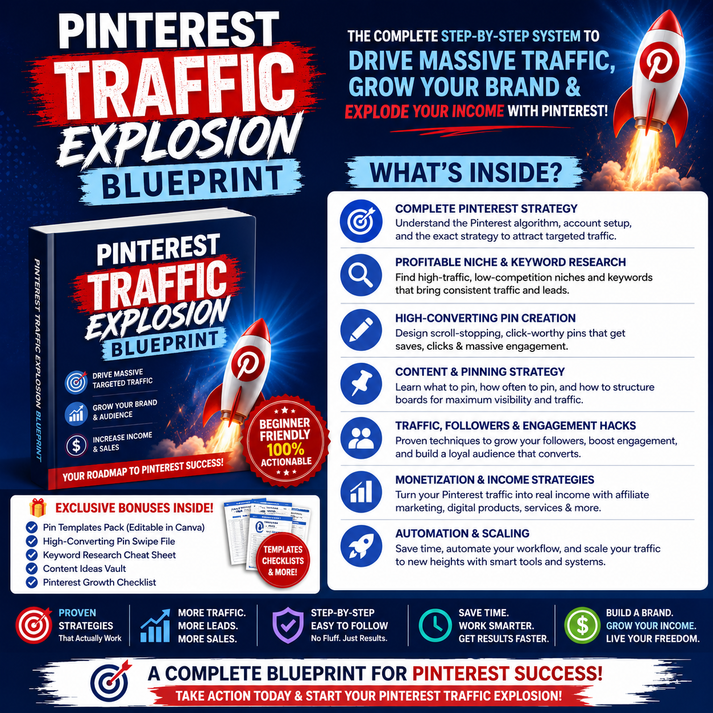
Want to master the complete automation framework behind scalable Pinterest traffic growth? Access the full PINTEREST TRAFFIC EXPLOSION BLUEPRINT and learn the exact systems serious creators use to generate long-term traffic consistently.
Why Most Pinterest Strategies Fail
Most Pinterest users unknowingly create unsustainable workflows.
They:
- Design pins manually every day
- Post inconsistently
- Ignore Pinterest SEO
- Fail to optimize boards properly
- Target broad, low-converting keywords
- Depend entirely on trends instead of evergreen traffic
The result?
Temporary spikes followed by traffic crashes.
The problem is not Pinterest itself. The problem is the lack of a scalable system.
The Automation System Serious Pinterest Creators Use
High-performing Pinterest marketers treat the platform like a content distribution machine.
Instead of constantly creating from scratch, they build repeatable workflows that continue driving Pinterest traffic for months — sometimes years.
1. Evergreen Content Mapping
The foundation starts with evergreen content.
Instead of chasing short-lived trends, smart creators focus on topics people search year-round:
- How-to guides
- Checklists
- Templates
- Productivity systems
- Marketing tutorials
- Business growth frameworks
Evergreen content compounds over time and creates stable Pinterest traffic without daily effort.
2. Pinterest SEO Optimization
Pinterest is heavily keyword-driven.
That means your:
- Pin titles
- Descriptions
- Board names
- Image text overlays
- Profile optimization
all influence discoverability.
Advanced creators perform keyword clustering and search intent optimization to align their content with what users are actively searching for.
This dramatically improves Pinterest traffic consistency over time.
3. Batch Pin Creation
Instead of designing pins daily, serious creators batch weeks of content in advance.
This reduces creative fatigue and allows them to focus on strategy rather than repetitive tasks.
A single blog post can generate:
- 5–15 pin variations
- Different hooks and headlines
- Multiple visual styles
- Fresh testing opportunities
This multiplies traffic potential without constantly creating new content.
4. Smart Scheduling Automation
Automation tools and scheduling systems are the real game-changer.
Instead of manually posting every day, creators use optimized scheduling frameworks to maintain consistent distribution automatically.
Consistency is one of the strongest Pinterest ranking signals.
A structured automation workflow allows creators to:
- Maintain daily activity
- Increase content velocity
- Test multiple pin variations
- Scale traffic while reducing workload
What Makes Pinterest Different From Other Platforms?
Unlike traditional social media, Pinterest content has an extremely long shelf life.
A single optimized pin can continue generating clicks for months or even years.
That’s why automation combined with Pinterest SEO creates powerful compounding traffic growth.
The Biggest Benefits of Pinterest Traffic Automation
More Traffic With Less Daily Work
Automation eliminates constant manual posting and repetitive content tasks.
Instead of spending hours every day on Pinterest, creators build systems that continue distributing content automatically.
Scalable Organic Growth
Pinterest traffic compounds over time when properly optimized.
Unlike paid ads that stop when spending ends, Pinterest can continue driving visitors long-term.
Higher Content ROI
One blog post or product can generate traffic repeatedly through multiple optimized pins.
This increases the lifetime value of every piece of content you publish.
Common Pinterest Traffic Mistakes to Avoid
- Posting inconsistently: Pinterest rewards consistency over bursts of activity.
- Ignoring keyword research: Great visuals alone are not enough.
- Creating only one pin per URL: Multiple variations improve testing and reach.
- Overcomplicating design: Simple, readable pins often outperform cluttered graphics.
- Not tracking analytics: Pinterest data reveals what topics and visuals scale best.
If you want a complete step-by-step Pinterest growth framework — including automation workflows, keyword systems, traffic scaling strategies, and proven pin structures — explore the full PINTEREST TRAFFIC EXPLOSION BLUEPRINT.
Actionable Tips to Start Scaling Pinterest Traffic Today
- Create 5–10 pin variations for every piece of content
- Use keyword-rich board names and descriptions
- Schedule content consistently instead of posting randomly
- Focus on evergreen search-driven topics
- Study top-performing pins in your niche for hook inspiration
- Optimize pin headlines for curiosity and click-through rate
What You’ll Learn Inside the Full Product
The PINTEREST TRAFFIC EXPLOSION BLUEPRINT goes far beyond basic Pinterest tips.
Inside the complete system, you’ll discover:
- Advanced Pinterest SEO frameworks
- Automation systems for scaling traffic efficiently
- Pin design psychology and CTR optimization
- Evergreen content mapping strategies
- Traffic monetization frameworks
- Content batching and scheduling workflows
- Scalable Pinterest growth systems for creators and businesses
Whether you're a blogger, creator, marketer, ecommerce brand, or digital product seller, these frameworks are designed to help you build sustainable Pinterest traffic without constant manual effort.
Final Thoughts
Pinterest remains one of the most underrated organic traffic platforms available today.
But the creators seeing massive growth are not relying on luck or endless manual posting.
They use systems.
They optimize for search intent.
And most importantly, they automate intelligently.
When you combine Pinterest SEO, evergreen content, and scalable automation workflows, traffic growth becomes significantly more predictable and sustainable.
Ready to build a scalable Pinterest traffic machine instead of guessing your way through growth? Access the complete PINTEREST TRAFFIC EXPLOSION BLUEPRINT and learn the exact systems serious creators use to drive long-term organic traffic and conversions.
Frequently Asked Questions
How long does Pinterest traffic take to grow?
Pinterest traffic growth typically takes several weeks to months depending on content quality, keyword optimization, consistency, and niche competition. Evergreen strategies usually compound over time.
Can Pinterest traffic work for digital products?
Yes. Pinterest is highly effective for promoting ebooks, templates, courses, guides, and digital downloads because users actively search for educational and actionable content.
Is Pinterest automation safe?
Pinterest-approved scheduling and automation workflows are commonly used by professional creators and marketers to maintain consistency and scale content distribution efficiently.
Do I need a blog to generate Pinterest traffic?
While blogs work exceptionally well on Pinterest, creators can also drive traffic to ecommerce stores, landing pages, digital products, and lead generation funnels.
How many pins should I publish daily?
Quality and consistency matter more than volume. Many successful creators use automated systems to publish optimized pins consistently without overwhelming their workflow.
What is the biggest Pinterest SEO factor?
Keyword relevance combined with engagement signals plays a major role in Pinterest discoverability. Proper optimization across titles, descriptions, boards, and pin visuals is essential.