

Traditional SEO is no longer enough.
Today, millions of users are discovering websites, brands, and products through AI systems like ChatGPT, Google AI Overviews, Gemini, Perplexity, and other generative search engines.
Instead of clicking through ten blue links, users now receive direct answers generated by AI.
The real question is:
Is your content being selected, quoted, cited, and recommended by AI systems?
Most websites are invisible inside AI search experiences because their content is not structured for machine understanding, retrieval optimization, semantic authority, or conversational answer generation.
Brands that adapt early will dominate the next era of organic visibility.
This is where modern RANKING IN CHATGPT & AI SEARCH ENGINES strategies become critical.
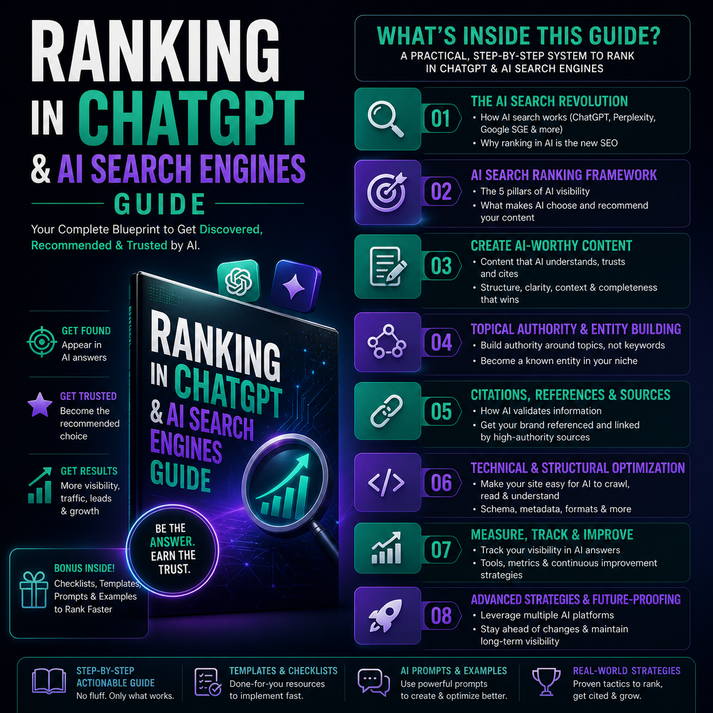
Why AI Search Engines Choose Certain Content
AI models prioritize content differently compared to traditional search engines.
Instead of simply ranking pages by backlinks or keyword density, AI systems evaluate:
- Topical depth
- Semantic relevance
- Entity relationships
- Trust signals
- Structured information
- Clear answer formatting
- Contextual authority
- User intent alignment
Content that performs well inside AI search environments is typically:
- Highly educational
- Easy to extract answers from
- Structured logically
- Rich in semantic relevance
- Focused on solving user intent directly
The Core Framework Behind AI-Citable Content
If you want ChatGPT and AI search engines to reference your content, you need to think beyond old-school SEO tactics.
Modern AI optimization revolves around three major principles:
1. Semantic Topic Coverage
AI systems prefer content that thoroughly covers a topic ecosystem rather than isolated keywords.
For example, an article about AI SEO should naturally include related concepts like:
- Generative Engine Optimization (GEO)
- Answer Engine Optimization (AEO)
- Conversational search
- Entity optimization
- Retrieval augmented generation
- AI search visibility
This helps AI models understand topical authority more effectively.
2. Structured Answer Formatting
AI engines extract concise answers from content that is easy to interpret.
High-performing content often includes:
- Clear headings
- Bullet points
- Definitions
- Step-by-step frameworks
- FAQ sections
- Direct explanations
The easier your information is to parse, the more likely AI systems are to cite it.
3. Topical Authority Signals
AI search engines reward websites that consistently publish interconnected high-value content around a specific niche.
Random disconnected articles no longer build meaningful authority.
Instead, brands need complete content ecosystems.
Want to master the complete system behind AI search visibility, GEO, and modern Answer Engine Optimization?
Access the full RANKING IN CHATGPT & AI SEARCH ENGINES GUIDE from Lywire.
Common Mistakes That Prevent AI Visibility
Many websites unknowingly sabotage their AI search potential.
Here are the most common mistakes:
- Writing overly generic content
- Publishing shallow AI-generated articles
- Ignoring semantic optimization
- Using weak heading structures
- Failing to answer real user intent
- Creating disconnected content silos
- Over-optimizing keywords unnaturally
AI systems are becoming increasingly sophisticated at identifying valuable content versus low-quality filler.
Practical Ways to Increase Your Chances of Being Quoted by ChatGPT
If you want your content to appear inside AI-generated answers, implement these strategies consistently:
Create Definition-Driven Sections
AI models frequently pull concise definitions directly into responses.
Use clear formatting like:
Answer Engine Optimization (AEO) is the process of optimizing content so AI systems and answer engines can easily retrieve and present it in conversational responses.
Use Entity-Rich Writing
Mention relevant tools, concepts, technologies, industries, and contextual relationships naturally throughout your content.
This improves machine understanding dramatically.
Build Content Clusters
One article alone rarely builds AI authority.
You need interconnected topical assets that reinforce expertise across an entire subject area.
Focus on Experience-Based Insights
AI systems increasingly prioritize original insights, frameworks, case studies, and practical expertise.
Surface-level rewritten content is losing visibility rapidly.
What You’ll Learn Inside the Full Product
The complete guide from Lywire goes far beyond basic SEO theory.
Inside the full system, you’ll discover:
- How AI search engines retrieve and prioritize content
- Advanced GEO frameworks
- Conversational search optimization systems
- AI citation optimization techniques
- Prompt-aware content structuring
- Authority-building content ecosystems
- AI visibility scaling strategies
- Future-proof SEO systems for generative search
Ready to position your brand for the future of AI-driven search?
Explore the complete RANKING IN CHATGPT & AI SEARCH ENGINES GUIDE and learn the exact frameworks used to increase AI visibility and authority.
Conclusion
AI search is rapidly changing how users discover information online.
Brands that understand how ChatGPT and AI search engines retrieve, evaluate, and recommend content will gain a massive visibility advantage over competitors still relying solely on traditional SEO methods.
The future belongs to content that is:
- Semantically rich
- Structurally optimized
- Authority-driven
- Designed for AI understanding
The sooner you adapt, the stronger your position becomes inside the next generation of search experiences.
Want the complete blueprint for dominating AI search engines, ChatGPT visibility, and generative search optimization?
Access the full RANKING IN CHATGPT & AI SEARCH ENGINES GUIDE from Lywire today.
Frequently Asked Questions
How do I optimize content for ChatGPT?
Focus on semantic relevance, structured formatting, topical authority, entity optimization, and direct answer clarity. AI systems prioritize content that is easy to interpret and highly informative.
What is GEO in SEO?
GEO stands for Generative Engine Optimization. It involves optimizing content for AI-driven search engines and conversational answer systems.
Can AI search engines replace traditional Google SEO?
AI search is evolving rapidly alongside traditional search. Businesses that combine SEO, GEO, and AEO strategies are likely to achieve the strongest long-term visibility.
Why is structured content important for AI search?
Structured content helps AI systems extract, understand, summarize, and cite information more accurately within generated answers.
How can brands build topical authority for AI search engines?
By consistently publishing interconnected, high-value, semantically rich content around a focused niche or subject ecosystem.
What makes the Lywire guide different?
The guide focuses specifically on AI search visibility, modern GEO systems, conversational optimization, and practical frameworks designed for the future of generative search.