

Internal Linking Architecture: Building Your Content Web for Long-Term SEO Authority
Why Most Websites Fail to Build True SEO Authority
Publishing more blog posts does not automatically increase rankings anymore. Modern SEO is no longer about isolated articles competing for random keywords. Google now rewards websites that demonstrate depth, contextual relevance, and semantic relationships between topics.
That’s where internal linking architecture becomes one of the most underrated SEO growth systems available today.
When your pages are strategically connected, you create a powerful content web that helps search engines understand your expertise, improves crawlability, distributes authority, and increases engagement across your entire website.
This is the foundation of a successful Content Ecosystem & Topical Authority strategy.
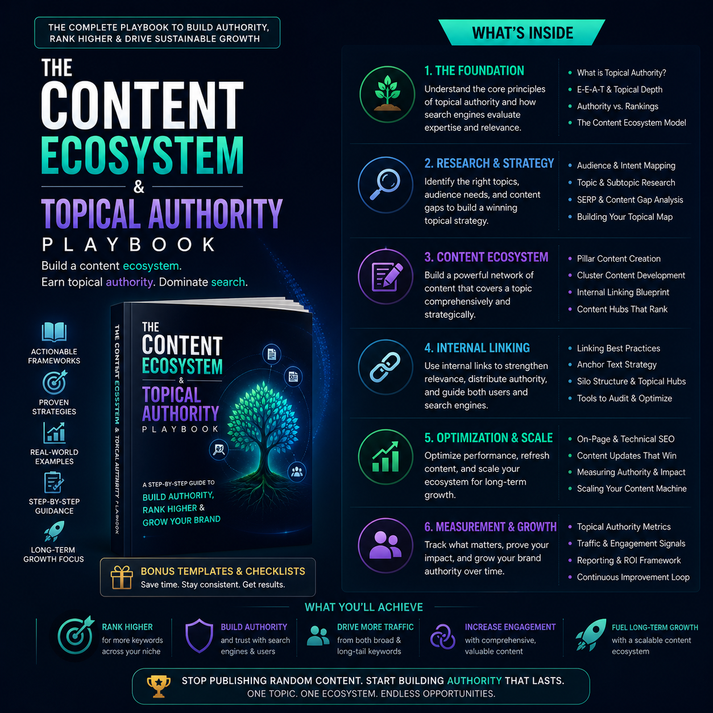
Want to master the complete system behind Internal Linking Architecture: Building Your Content Web? Access the full The Content Ecosystem & Topical Authority Playbook and learn the advanced frameworks used to build scalable SEO authority.
What Is Internal Linking Architecture?
Internal linking architecture refers to the strategic structure of links connecting pages within your website.
Instead of treating every article like an isolated piece of content, you create interconnected topic clusters that guide both users and search engines through your expertise.
Think of it as building roads between your most important SEO assets.
Core Goal of Internal Linking
- Help Google understand topical relationships
- Increase authority distribution across pages
- Improve indexing and crawl efficiency
- Boost user engagement and session duration
- Create stronger semantic SEO signals
- Support topical authority growth
Without proper internal linking, even excellent content struggles to perform consistently in competitive search results.
How a Content Web Builds Topical Authority
Google increasingly evaluates websites based on expertise across entire topic ecosystems rather than single-page optimization.
This means your website should behave like a knowledge network.
For example, if your niche is SEO, your content should naturally connect topics like:
- Topical authority
- Semantic SEO
- Content clustering
- Entity optimization
- Internal linking
- Search intent mapping
- Content hierarchy
When these pages link contextually to one another, Google begins understanding your site as a trusted source within that ecosystem.
That is how authority compounds over time.
Common Internal Linking Mistakes That Hurt Rankings
1. Random Linking Without Strategy
Many websites add internal links randomly without considering topical relevance.
Every internal link should strengthen semantic relationships between pages.
2. Overusing Exact Match Anchor Text
Using identical anchor text repeatedly can look manipulative. Natural variations improve readability and SEO trust signals.
3. Orphan Pages
Pages with no internal links become difficult for search engines to discover and rank effectively.
4. Ignoring Hierarchical Structure
Your pillar pages should receive the strongest internal authority flow, supported by cluster content beneath them.
5. Weak User Journey Optimization
Internal linking is not only for SEO. It should also guide readers deeper into your ecosystem naturally.
How to Build an Effective Internal Linking Architecture
Create Pillar Content
Start with comprehensive cornerstone pages targeting broad, high-value topics.
These become the center of your topical authority strategy.
Build Supporting Cluster Content
Create related articles that answer specific subtopics and long-tail queries.
Each cluster article should link back to the main pillar page while also connecting horizontally to related content.
Use Contextual Internal Links
The most powerful internal links appear naturally within relevant content sections.
Avoid excessive footer or sidebar-only linking.
Map Search Intent
Different pages target different stages of the user journey:
- Awareness content
- Educational content
- Problem-solving content
- Conversion-focused content
Your internal linking structure should guide readers smoothly through this journey.
If you want a complete blueprint for structuring content ecosystems that scale organic traffic predictably, explore the full The Content Ecosystem & Topical Authority Playbook.
The SEO Benefits of Strong Internal Linking Architecture
- Higher rankings: Better contextual relevance improves keyword visibility
- Improved crawlability: Search engines discover content faster
- Authority distribution: Link equity flows throughout your site
- Better engagement: Users visit more pages per session
- Lower bounce rates: Readers continue exploring your ecosystem
- Scalable SEO growth: New content gains visibility faster
The websites dominating modern search results are rarely relying on isolated articles. They are building interconnected authority ecosystems.
What You’ll Learn Inside the Full Product
The complete The Content Ecosystem & Topical Authority Playbook goes far beyond basic internal linking advice.
Inside the full framework, you’ll learn:
- Advanced topical authority frameworks
- Content ecosystem mapping systems
- Entity-driven SEO architecture
- Semantic keyword clustering
- Scalable content planning workflows
- Authority layering techniques
- Search intent domination strategies
- Conversion-focused SEO content systems
This is designed for creators, SEO professionals, agencies, digital marketers, niche site builders, ecommerce brands, and businesses aiming to dominate organic search sustainably.
Final Thoughts: SEO Is No Longer About Individual Pages
The future of SEO belongs to websites that build interconnected knowledge ecosystems.
Internal linking architecture is no longer optional if you want scalable rankings, stronger authority signals, and long-term organic growth.
When your content works together instead of competing against itself, your website becomes exponentially more powerful.
Ready to build a complete SEO ecosystem that compounds rankings and authority over time? Get instant access to the full The Content Ecosystem & Topical Authority Playbook and unlock the frameworks behind scalable organic growth.
Frequently Asked Questions
What is internal linking architecture in SEO?
Internal linking architecture is the strategic organization of links between pages on your website to improve crawlability, user experience, and topical authority.
Why is internal linking important for topical authority?
Internal links help search engines understand relationships between topics, strengthening your website’s expertise and semantic relevance within a niche.
How many internal links should a blog post have?
There is no fixed number. The goal is to add contextually relevant links naturally where they improve user experience and topical understanding.
Can internal linking improve rankings?
Yes. Proper internal linking can distribute authority, improve indexing, increase engagement metrics, and strengthen keyword relevance.
What are orphan pages?
Orphan pages are pages without internal links pointing to them, making them difficult for users and search engines to discover.
How do topic clusters support SEO growth?
Topic clusters create semantic relationships between related content pieces, helping websites build stronger topical authority and improve search visibility.