
Perplexity, Bing Chat, Google SGE, and ChatGPT: A Side-by-Side Guide to Platform-Specific AI SEO
Search is no longer limited to blue links.
Today, users are asking questions directly inside AI systems like ChatGPT, Perplexity, Bing Chat, and Google SGE — and receiving conversational answers instantly. That shift is fundamentally changing how brands, creators, marketers, and businesses approach SEO.
If your content is not optimized for AI-powered discovery, you risk becoming invisible in the next generation of search.
This guide breaks down how each major AI search platform works, what type of content they prioritize, and how you can position your website to gain visibility across modern AI search ecosystems.
Want to master the complete system behind AI visibility?
Access the full RANKING IN CHATGPT & AI SEARCH ENGINES Guide here
Why AI Search Optimization Matters in 2026
Traditional SEO focused heavily on ranking pages in search engine result pages (SERPs). AI SEO focuses on something much bigger: becoming the source AI platforms trust and cite.
Instead of users clicking through 10 websites, AI systems now summarize answers directly. This means brands must optimize not only for ranking but for retrieval, authority, contextual trust, and semantic clarity.
The new goal: Make your content understandable, trustworthy, quotable, and contextually relevant for AI systems.
How ChatGPT Handles Content Discovery
ChatGPT prioritizes authoritative, structured, and context-rich content. It performs exceptionally well with content that demonstrates expertise, topical depth, and clear explanations.
What Works Best for ChatGPT SEO
- Topical authority clusters
- Question-and-answer formatting
- Structured educational content
- Semantic relevance
- High E-E-A-T signals
- Clear entity relationships
Brands that create interconnected ecosystems of educational content tend to perform better inside conversational AI environments.
Long-form educational frameworks, glossary systems, implementation guides, and deep topical hubs are increasingly important for ranking in ChatGPT and AI search engines.
How Perplexity AI Chooses Sources
Perplexity behaves differently from traditional search engines because it heavily cites live sources and prioritizes freshness, authority, and factual reliability.
Key Ranking Factors for Perplexity
- Fresh and updated content
- Factually accurate information
- Clear source attribution
- Strong domain trust
- Conversational readability
Perplexity often favors concise yet highly informative content blocks that directly answer user intent.
This means overly bloated content may underperform compared to streamlined educational pages that quickly establish relevance.
Most websites are still optimizing only for Google.
Bing Chat and the Microsoft AI Ecosystem
Bing Chat integrates closely with Microsoft's search infrastructure, meaning traditional SEO fundamentals still matter significantly.
However, Bing AI also evaluates semantic clarity and conversational usefulness at a deeper level.
Important Bing AI SEO Signals
- Traditional on-page SEO
- Schema markup
- Fast-loading pages
- Authority backlinks
- Structured content hierarchy
- Trustworthy factual references
Bing Chat often rewards websites that combine technical SEO excellence with strong informational value.
Google SGE and the Evolution of Search
Google Search Generative Experience (SGE) is reshaping how users interact with search entirely.
Instead of merely presenting results, Google now synthesizes information into AI-generated snapshots.
What Google SGE Prioritizes
- Entity-based authority
- Comprehensive topical coverage
- Structured semantic content
- User-intent matching
- Reliable citations and references
- People-first content
Google SGE strongly favors websites that demonstrate deep expertise rather than shallow keyword targeting.
This is why modern AI SEO requires building interconnected authority systems rather than isolated blog posts.
Common AI SEO Mistakes Most Websites Make
1. Writing Only for Keywords
AI systems understand meaning, relationships, and context — not just keyword frequency.
2. Ignoring Topical Authority
Single articles rarely dominate AI search ecosystems. AI platforms trust websites that consistently cover related topics in depth.
3. Weak Content Structure
Messy formatting makes it difficult for AI systems to extract and understand information.
4. Lack of Semantic Relationships
Modern AI SEO requires entity optimization, contextual linking, and subject-depth mapping.
5. No Conversational Optimization
AI search thrives on natural language patterns. Content should answer real user questions directly.
Actionable AI SEO Implementation Tips
If you want stronger visibility across ChatGPT, Perplexity, Bing Chat, and Google SGE, focus on these practical strategies:
- Create deep topical content ecosystems
- Use FAQ-rich formatting
- Optimize for conversational queries
- Add schema markup across pages
- Improve entity relevance
- Build semantic internal linking structures
- Publish consistently updated educational content
- Focus on trust, clarity, and expertise
AI search engines reward clarity over complexity. The easier your expertise is to understand, the easier it becomes for AI systems to reference and recommend your content.
What You’ll Learn Inside the Full Product
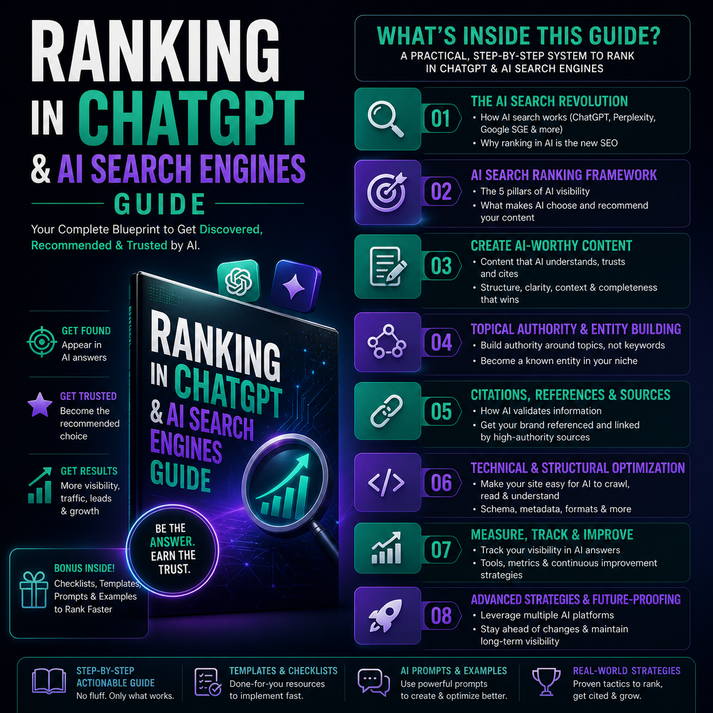
The complete RANKING IN CHATGPT & AI SEARCH ENGINES digital guide by Lywire goes far beyond basic SEO concepts.
Inside the full system, you’ll discover:
- Platform-specific AI ranking frameworks
- AI search optimization workflows
- Semantic SEO structures
- Topical authority systems
- AI visibility scaling strategies
- Content engineering methods for AI retrieval
- Advanced entity optimization tactics
- Future-proof AI content strategies
Ready to dominate the next generation of search?
Get the complete RANKING IN CHATGPT & AI SEARCH ENGINES Guide from Lywire
Conclusion
AI search is not a future trend anymore — it is already changing how users discover information online.
Platforms like ChatGPT, Perplexity, Bing Chat, and Google SGE are redefining visibility, authority, and organic discovery.
Businesses that adapt early will gain a massive competitive advantage in the coming years.
Build Your AI Search Advantage Today
Frequently Asked Questions
What is AI SEO?
AI SEO refers to optimizing content for AI-powered search systems like ChatGPT, Google SGE, Perplexity, and Bing Chat instead of only traditional search engines.
How is AI SEO different from traditional SEO?
Traditional SEO focuses on ranking webpages in SERPs, while AI SEO focuses on becoming a trusted source AI systems can retrieve, summarize, and recommend.
Can websites rank inside ChatGPT?
Yes. Websites with strong authority, semantic structure, and high-quality educational content are more likely to be referenced by AI systems.
Does schema markup help AI search optimization?
Yes. Schema markup improves content understanding, entity recognition, and contextual clarity for AI-powered search systems.
What type of content performs best in AI search?
Comprehensive educational content, structured guides, topical clusters, FAQs, and expert-driven resources tend to perform best.
Is AI SEO important for small businesses?
Absolutely. AI search creates opportunities for smaller niche websites to gain visibility through expertise and content quality rather than only domain size.