

Research & Topic Discovery in Content Ecosystem & Topical Authority
Why Most Content Strategies Fail Before They Even Begin
Most websites don’t fail because of poor writing. They fail because they publish disconnected content without a strategic ecosystem behind it.
In today’s search landscape, publishing random articles is no longer enough to rank consistently on Google. Search engines now reward websites that demonstrate deep topical relevance, semantic coverage, and structured authority within a niche.
That’s where Research & Topic Discovery in Content Ecosystem & Topical Authority becomes a game-changing advantage.
Instead of chasing isolated keywords, modern SEO focuses on building interconnected topic clusters, content hierarchies, and semantic relationships that help search engines understand your expertise.
Whether you're a digital creator, affiliate marketer, ecommerce brand, SaaS founder, blogger, or agency owner, mastering topical authority can dramatically improve rankings, organic traffic, and conversion rates.
The Real Problem With Traditional Keyword Research
Most marketers still rely on outdated SEO workflows:
- Targeting isolated keywords
- Publishing unrelated blog posts
- Ignoring semantic relationships
- Creating shallow content
- Competing directly on high-volume terms
The result?
Low rankings. Weak authority. Poor indexing. Minimal traffic growth.
Google’s algorithms increasingly evaluate content contextually. That means your website needs comprehensive topical depth—not just optimized pages.
Research and topic discovery now require strategic ecosystem thinking.
What Is a Content Ecosystem?
A content ecosystem is a structured network of interconnected content assets designed to establish topical authority around a specific niche or subject.
Instead of creating standalone articles, you build layers of content that support one another semantically.
Core Components of a Strong Content Ecosystem
- Pillar Content: Broad authority pages targeting major themes
- Cluster Content: Supporting articles covering subtopics
- Semantic Relevance: Related concepts and NLP-driven optimization
- Internal Linking: Strategic pathways connecting topical relevance
- Search Intent Matching: Content aligned with user journey stages
- Authority Signals: Expertise depth across the topic landscape
When executed properly, this structure helps search engines interpret your site as an authoritative resource rather than a collection of unrelated pages.
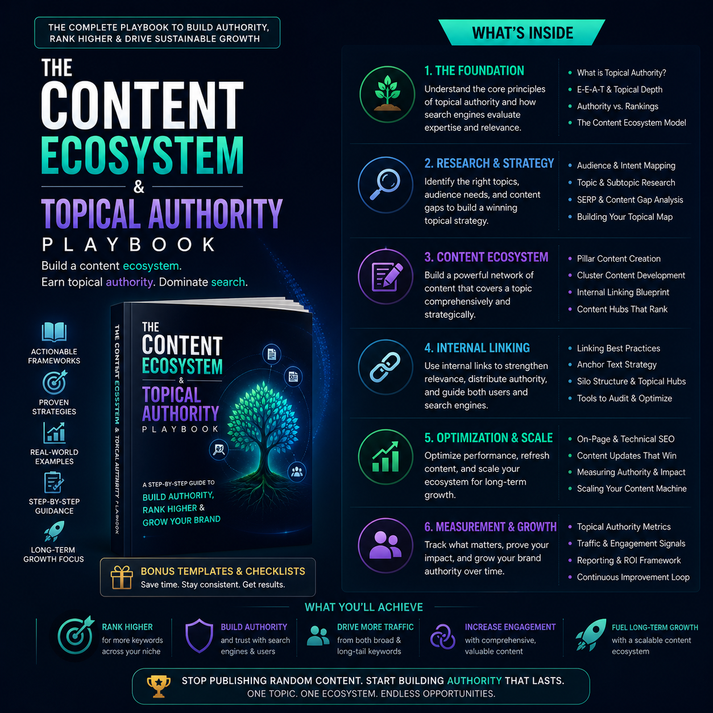
Want to master the complete system behind Research & Topic Discovery in Content Ecosystem & Topical Authority?
Access The Content Ecosystem & Topical Authority Playbook here.
How Elite SEO Teams Discover High-Authority Topics
Topic discovery isn’t about finding random keywords with search volume. It’s about identifying strategic opportunities within a niche ecosystem.
1. Start With Core Topical Buckets
Every authority website begins with primary thematic categories.
For example, a digital marketing brand may structure topics around:
- SEO
- Content Marketing
- Paid Ads
- Conversion Optimization
- Email Marketing
- Analytics
These become the foundation of the ecosystem.
2. Expand Through Semantic Research
Modern SEO requires semantic depth.
That means researching:
- Related search terms
- People Also Ask queries
- Entity relationships
- Long-tail intent variations
- Problem-aware searches
- Contextual subtopics
This creates broader topical coverage and improves ranking potential across multiple query variations.
3. Build Intent-Based Topic Clusters
Different users search with different intent stages:
- Informational
- Commercial
- Transactional
- Navigational
A high-performing content ecosystem addresses every stage strategically.
Benefits of Strong Topic Discovery & Topical Authority
- Higher Google rankings
- Faster indexing of new content
- Improved internal link equity
- Better organic traffic consistency
- Increased topical relevance
- Higher conversion potential
- Long-term SEO sustainability
- Reduced dependence on backlinks alone
This is why authoritative websites dominate entire niches while smaller sites struggle to rank individual pages.
Common Topical Authority Mistakes
Publishing Random Content
Without ecosystem structure, content lacks contextual reinforcement.
Ignoring Internal Linking
Internal links help distribute authority and reinforce semantic relationships.
Over-Focusing on Volume
Many low-volume keywords collectively outperform a few competitive terms.
Creating Thin Content
Surface-level articles rarely establish authority in competitive niches.
Actionable Implementation Tips
- Create a master topic map before publishing content
- Group keywords by intent and semantic relevance
- Build pillar pages around broad authority themes
- Use supporting clusters to expand topical depth
- Update old content regularly to maintain freshness
- Strengthen contextual internal linking
- Analyze competitors’ topic coverage gaps
What You’ll Learn Inside The Full Playbook
The complete The Content Ecosystem & Topical Authority Playbook goes far beyond basic SEO theory.
Inside, you’ll discover:
- Advanced topical authority frameworks
- Scalable topic discovery systems
- Content ecosystem mapping templates
- Semantic SEO implementation strategies
- Internal linking architecture methods
- AI-assisted content planning workflows
- Authority-building content structures
- Modern search intent optimization systems
Ready to build a scalable SEO ecosystem instead of publishing disconnected content?
Explore The Content Ecosystem & Topical Authority Playbook now.
Final Thoughts
Research & Topic Discovery in Content Ecosystem & Topical Authority is no longer optional for serious SEO growth.
The websites winning organic traffic today are those building interconnected, semantically rich ecosystems that demonstrate genuine expertise.
If you want sustainable rankings, stronger visibility, and long-term authority, you need a strategic framework—not random content publishing.
That’s exactly what Lywire’s premium playbook is designed to help you achieve.
Master the complete system behind scalable authority-driven SEO.
Get The Content Ecosystem & Topical Authority Playbook today.
Frequently Asked Questions
What is topical authority in SEO?
Topical authority refers to how comprehensively and consistently a website covers a specific subject area, helping search engines recognize expertise and relevance.
Why is topic discovery important for SEO?
Topic discovery helps uncover semantic relationships, user intent opportunities, and content gaps that improve search visibility and organic growth.
How do content clusters improve rankings?
Content clusters strengthen contextual relevance through interconnected pages, making it easier for search engines to understand your authority within a niche.
Can small websites build topical authority?
Yes. Even smaller websites can dominate niches by focusing on deep topical coverage, strategic content planning, and strong internal linking.
What’s the difference between keyword research and topic discovery?
Keyword research focuses on individual search terms, while topic discovery builds broader semantic ecosystems around user intent and subject relationships.
Who should use a topical authority framework?
Bloggers, ecommerce brands, SaaS companies, affiliate marketers, agencies, and creators can all benefit from structured content ecosystem strategies.