
Schema Markup in 2026: The Invisible Code That Makes AI Search Engines Love Your Content
Traditional SEO is evolving faster than most brands realize.
Search is no longer limited to blue links on Google. In 2026, users increasingly rely on AI-powered systems like ChatGPT, Gemini, Perplexity, and AI-enhanced search experiences to discover answers, products, and recommendations.
The websites winning visibility in this new landscape are not simply publishing more content. They are structuring information in ways AI systems can instantly understand.
That invisible advantage is called schema markup.
Schema markup acts like a translator between your content and AI search engines. It helps machines understand entities, relationships, expertise, product details, FAQs, authorship, and topical authority with remarkable precision.
If your business wants a serious edge in RANKING IN CHATGPT & AI SEARCH ENGINES, schema implementation is no longer optional. It is foundational.
Why AI Search Engines Depend on Structured Data
AI systems do not consume websites the same way humans do.
While readers interpret design, emotion, and storytelling naturally, AI models depend on structured signals to determine context and trustworthiness.
Schema markup provides those signals.
It tells search engines:
- What your content is about
- Who created it
- Which topics you specialize in
- Whether your information is trustworthy
- How your content connects to related entities
- What products, services, or frameworks you offer
In the age of AI search, context beats keywords.
This is why brands investing in semantic SEO and structured data are beginning to dominate visibility across AI-generated answers.
Want to master the complete system behind Schema Markup in 2026 and future-proof your AI visibility strategy?
Access the full RANKING IN CHATGPT & AI SEARCH ENGINES GUIDE from Lywire.
The Shift from SEO to AI Visibility Optimization
For years, SEO revolved around backlinks, keywords, and on-page optimization.
Those factors still matter. But AI search engines now evaluate websites through a broader lens that includes:
- Entity relationships
- Topical authority
- Semantic relevance
- Content clarity
- Knowledge graph compatibility
- Machine-readable structure
Schema markup sits at the center of this transformation.
Whether you run a blog, ecommerce store, SaaS platform, agency, or educational website, structured data improves how AI systems interpret your expertise.
Types of Schema Markup That Matter Most in 2026
1. Article Schema
Essential for blog content and educational resources. It helps AI search engines understand authorship, publication dates, expertise signals, and content topics.
2. FAQ Schema
FAQ schema improves answer extraction and increases your chances of appearing in AI-generated summaries and conversational search results.
3. Product Schema
Critical for ecommerce and digital product brands. Product schema communicates pricing, reviews, features, and product intent directly to search systems.
4. Organization Schema
This strengthens brand trust and entity recognition, helping AI models associate your website with expertise in specific categories.
5. How-To Schema
AI engines increasingly prioritize instructional content. Structured tutorials make your content easier for AI assistants to summarize and recommend.
Common Schema Mistakes Hurting Rankings
Many websites implement schema incorrectly or rely on outdated practices.
Here are the biggest mistakes limiting AI visibility:
- Using incomplete structured data
- Ignoring entity optimization
- Adding irrelevant schema types
- Failing to validate JSON-LD markup
- Using duplicate or conflicting schema
- Not aligning schema with content intent
AI search engines are becoming increasingly sophisticated. Poorly implemented schema can dilute trust instead of strengthening it.
The future belongs to websites that communicate clearly with both humans and machines.
Practical Ways to Improve AI Search Visibility Today
If you want stronger visibility across AI search platforms, start with these actions:
- Implement JSON-LD schema sitewide
- Build entity-focused content clusters
- Create highly structured educational content
- Optimize FAQs for conversational search
- Use semantic headings and internal linking
- Strengthen author and organization trust signals
The brands winning in AI search are not guessing anymore. They are building machine-readable ecosystems designed for modern search behavior.
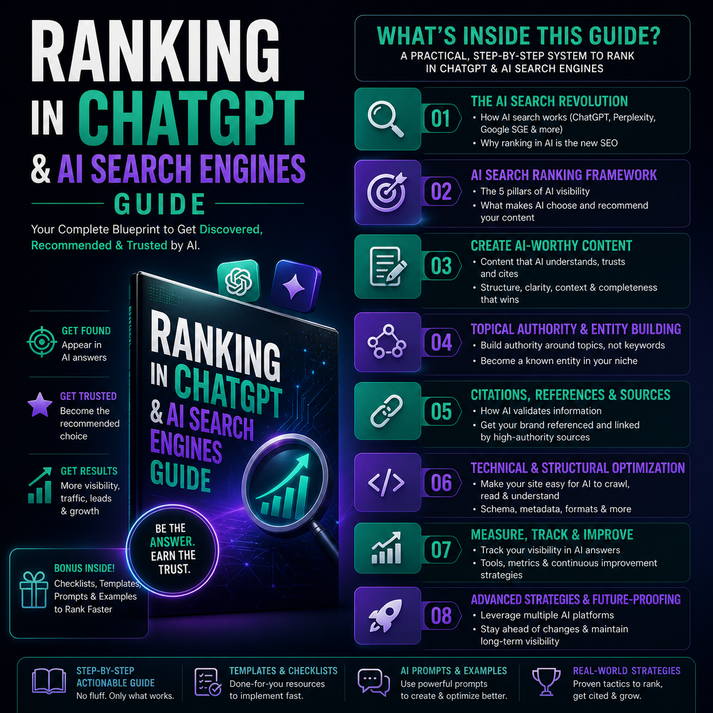
The complete AI search optimization framework is explained in detail inside Lywire’s premium guide.
Explore the full RANKING IN CHATGPT & AI SEARCH ENGINES GUIDE to learn advanced schema systems, semantic SEO strategies, AI visibility frameworks, and future-proof ranking techniques.
What You’ll Learn Inside the Full Product
- Advanced AI SEO frameworks for 2026
- How ChatGPT and AI engines discover websites
- Entity-based SEO systems
- Schema strategies for authority building
- Content structures optimized for AI extraction
- Topical authority scaling frameworks
- AI-friendly content architecture
- Practical implementation strategies for modern SEO
Conclusion
Schema markup is no longer just a technical SEO enhancement.
In 2026, it is the invisible infrastructure powering AI discoverability.
As search evolves toward conversational AI systems, websites that provide structured clarity will outperform those relying solely on traditional optimization methods.
The opportunity is massive for brands willing to adapt early.
Ready to build authority in the next generation of search?
Access the complete RANKING IN CHATGPT & AI SEARCH ENGINES GUIDE and learn the systems shaping the future of AI-driven visibility.
Frequently Asked Questions
What is schema markup in SEO?
Schema markup is structured data added to websites that helps search engines and AI systems better understand content, entities, products, and relationships.
Does schema markup help with ChatGPT rankings?
While ChatGPT does not rank websites traditionally, structured data improves machine readability and increases the likelihood of content being understood, referenced, and surfaced by AI systems.
Which schema types are most important in 2026?
Article schema, FAQ schema, organization schema, product schema, and how-to schema are among the most impactful for AI search visibility.
Can beginners implement schema markup?
Yes. Many modern CMS platforms support schema plugins and JSON-LD integration, making implementation accessible even for non-developers.
Is schema markup necessary for AI SEO?
Increasingly, yes. AI search engines depend heavily on structured information to interpret and trust web content accurately.
How does schema improve topical authority?
Schema helps search engines connect your content to entities and subject areas, strengthening semantic relevance and expertise signals.