
Why Traditional SEO Alone Is No Longer Enough
Search behavior is changing faster than most marketers realize.
Users no longer rely solely on blue links. They ask questions directly to AI search engines, voice assistants, featured snippets, and conversational platforms expecting immediate, precise answers.
This shift has created a new digital battlefield known as Answer Engine Optimization.
While many SEO professionals are still focused exclusively on rankings and keywords, modern brands are optimizing for AI-generated answers, semantic relevance, topical authority, and conversational search experiences.
The brands that adapt early will dominate visibility in the next era of search.
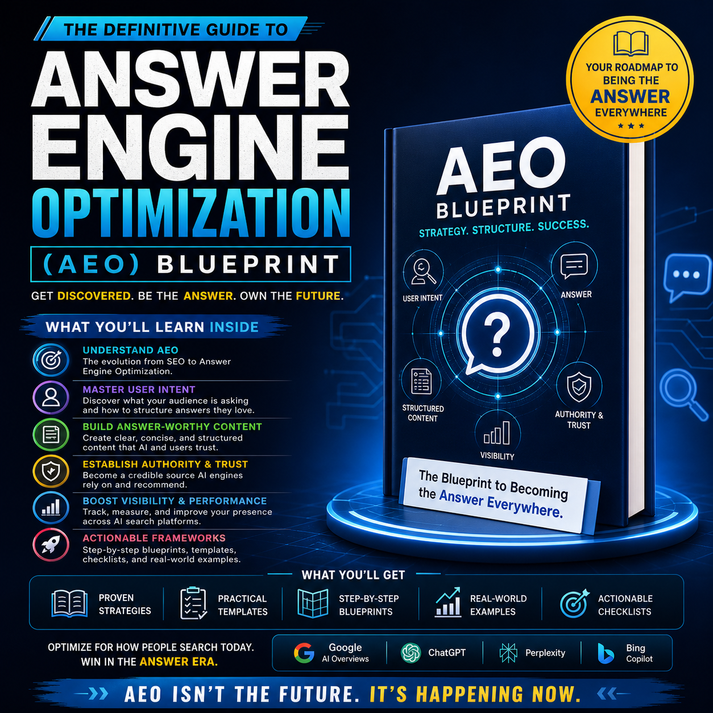
Want to master the complete system behind modern Answer Engine Optimization? Explore the full ANSWER ENGINE OPTIMIZATION (AEO) BLUEPRINT and learn how to future-proof your organic visibility.
The Real Problem Most SEOs Are Ignoring
Most SEO strategies were designed for traditional search engines.
But AI-powered search experiences prioritize something different:
- Direct answers
- Contextual relevance
- Semantic understanding
- Entity relationships
- User intent matching
- Trustworthiness signals
This means websites optimized only for keywords are increasingly losing visibility to content that better answers questions in a structured, machine-readable format.
That is exactly where Answer Engine Optimization becomes essential.
Pillar #1 — Semantic Search Optimization
Semantic SEO is the foundation of effective Answer Engine Optimization.
Instead of focusing purely on exact-match keywords, semantic optimization helps search engines understand the broader meaning and contextual relevance of your content.
What Semantic SEO Includes
- Topic clustering
- Entity optimization
- Natural language processing alignment
- Related subtopics and contextual keywords
- Intent-focused content architecture
Modern AI systems analyze relationships between concepts rather than isolated keywords.
If your content demonstrates deep topical expertise, your chances of appearing in AI-generated answers increase dramatically.
Pillar #2 — Conversational Query Optimization
Voice search and AI assistants changed how users interact with search engines.
Instead of typing:
“best running shoes”
Users now ask:
“What are the best running shoes for beginners with knee pain?”
This conversational shift requires content structured around natural language patterns.
High-Performing AEO Content Often Includes:
- Question-based headings
- Short direct answers
- Conversational phrasing
- FAQ structures
- Featured snippet formatting
- Clear semantic hierarchy
Websites that optimize for conversational intent become significantly more visible across AI-driven search interfaces.
Pillar #3 — Structured Data & Machine Readability
One of the most overlooked aspects of Answer Engine Optimization is structured data implementation.
AI systems rely heavily on machine-readable signals to understand page context, entities, products, FAQs, authorship, and relationships.
Important Structured Data Types for AEO
- FAQ Schema
- Article Schema
- Product Schema
- How-To Schema
- Organization Schema
- Breadcrumb Schema
Proper schema markup improves the probability of being selected for:
- Featured snippets
- AI answer boxes
- Voice assistant responses
- Rich search results
- Conversational search citations
Without structured data, even high-quality content may struggle to achieve maximum AI visibility.
The future of organic traffic belongs to brands that optimize for AI-powered discovery. Access the complete ANSWER ENGINE OPTIMIZATION (AEO) BLUEPRINT to implement advanced AEO systems step-by-step.
Pillar #4 — Topical Authority & Trust Signals
AI search systems prioritize trustworthy sources with demonstrated expertise.
Publishing isolated blog posts is no longer enough.
Modern Answer Engine Optimization requires building interconnected topical ecosystems that establish authority across an entire subject area.
Topical Authority Signals Include:
- Comprehensive content coverage
- Internal linking structures
- Expert-level educational content
- Consistent publishing cadence
- Entity associations
- Brand credibility signals
The more your website appears as a trusted source within a niche, the more likely AI systems are to reference and surface your content.
Common AEO Mistakes Businesses Keep Making
- Over-optimizing exact-match keywords
- Ignoring conversational search intent
- Publishing shallow content
- Missing schema markup opportunities
- Failing to build topical clusters
- Writing for algorithms instead of users
Answer Engine Optimization is not about gaming algorithms.
It is about becoming the most reliable and contextually relevant answer source available.
What You’ll Learn Inside the Full AEO Blueprint
- How AI search engines evaluate content
- Advanced semantic SEO frameworks
- Voice search optimization systems
- Featured snippet domination strategies
- Entity SEO implementation methods
- Topical authority scaling systems
- Prompt-driven search optimization
- Modern AI visibility frameworks
The complete framework was designed for creators, marketers, SEO professionals, agencies, affiliate marketers, ecommerce brands, and digital publishers who want long-term search visibility in the AI era.
The Future of Search Belongs to Answer Engines
Search is evolving from keyword retrieval to intelligent answer delivery.
Brands that understand this shift early will gain a major competitive advantage in visibility, authority, and organic traffic.
The four pillars covered above represent the foundational infrastructure behind successful modern Answer Engine Optimization strategies.
But implementing them effectively requires a deeper system.
Ready to build AI-proof organic visibility? Unlock the complete ANSWER ENGINE OPTIMIZATION (AEO) BLUEPRINT and discover the full framework behind next-generation search optimization.
Frequently Asked Questions About Answer Engine Optimization
What is Answer Engine Optimization?
Answer Engine Optimization (AEO) is the process of optimizing content to appear in AI-generated answers, featured snippets, voice search results, and conversational search platforms.
How is AEO different from traditional SEO?
Traditional SEO focuses heavily on rankings and keywords, while AEO prioritizes semantic relevance, direct answers, conversational search intent, and machine-readable content structures.
Why is Answer Engine Optimization important in 2026 and beyond?
As AI-powered search experiences grow, users increasingly receive answers directly from search engines without clicking traditional search results. AEO helps brands remain visible in this new search landscape.
Does schema markup help with AEO?
Yes. Structured data helps AI systems understand page context and improves eligibility for rich results, snippets, and AI-generated answer placements.
Can small websites compete using AEO strategies?
Absolutely. Websites that provide highly relevant, trustworthy, and well-structured answers can outperform larger competitors in specific topical areas.
What industries benefit most from Answer Engine Optimization?
Nearly every industry benefits from AEO, including ecommerce, SaaS, affiliate marketing, education, local businesses, agencies, and digital publishing brands.