
The Pinterest Algorithm in 2026 Finally Makes Sense — Here’s What It Rewards and What It Buries
Why Pinterest Traffic Looks Completely Different in 2026
For years, marketers treated Pinterest like a visual social media platform.
That assumption is exactly why most creators, bloggers, ecommerce brands, and affiliate marketers struggled to generate consistent PINTEREST TRAFFIC.
In 2026, the Pinterest algorithm has evolved into something far more sophisticated: a predictive discovery engine powered by search intent, behavioral relevance, topical authority, and session depth.
In simple terms, Pinterest now rewards creators who understand user intent — and quietly buries everyone else.
The good news? Once you understand the system, Pinterest becomes one of the most scalable organic traffic channels available today.
This guide breaks down exactly what Pinterest rewards in 2026, what kills visibility, and how smart creators are engineering massive traffic growth without relying on paid ads.
The Biggest Pinterest Myth That Still Destroys Reach
Most people still think Pinterest success comes from:
- Posting more pins daily
- Using random viral templates
- Repeating outdated hashtag tactics
- Joining endless group boards
- Chasing “fresh pin” loopholes
That strategy no longer works consistently.
Pinterest’s AI-driven recommendation system now evaluates content usefulness, topical consistency, engagement quality, click satisfaction, and niche authority at a much deeper level.
If your account lacks clear topical relevance, your impressions slowly disappear — even if your visuals look good.
This explains why many accounts suddenly lost traffic despite publishing more content than ever.
How the Pinterest Algorithm Works in 2026
The modern Pinterest algorithm prioritizes one thing above all:
User Satisfaction Signals
Pinterest tracks how users interact with your content after they discover it.
That includes:
- Outbound click behavior
- Save-to-impression ratio
- Long clicks and session duration
- Topic engagement depth
- Repeat interaction patterns
- Board relevance
- Keyword consistency
The platform now behaves more like Google Search combined with TikTok-style recommendation intelligence.
If users repeatedly engage with your content around a specific topic cluster, Pinterest increases distribution aggressively.
If users bounce quickly or ignore your pins, reach declines rapidly.
What Pinterest Rewards in 2026
1. Topical Authority
Pinterest wants creators to become trusted resources inside a niche.
Accounts covering too many unrelated topics struggle to rank consistently.
The winners focus deeply on:
- One audience
- One content ecosystem
- One search intent category
For example, a Pinterest account focused entirely on “small business marketing systems” will outperform a generic lifestyle account almost every time.
2. Search Intent Optimization
Keywords alone are not enough anymore.
Pinterest now maps:
- User intent
- Content relevance
- Visual context
- Click expectations
This means your title, pin design, description, landing page, and board placement must align perfectly.
3. Content Ecosystems
Single pins rarely dominate Pinterest anymore.
The algorithm rewards connected ecosystems of content.
That includes:
- Related boards
- Interconnected blog posts
- Keyword clusters
- Sequential pin topics
- Audience journey mapping
Creators building topical depth see dramatically better Pinterest traffic growth over time.
Want to Master the Complete Pinterest Traffic System?
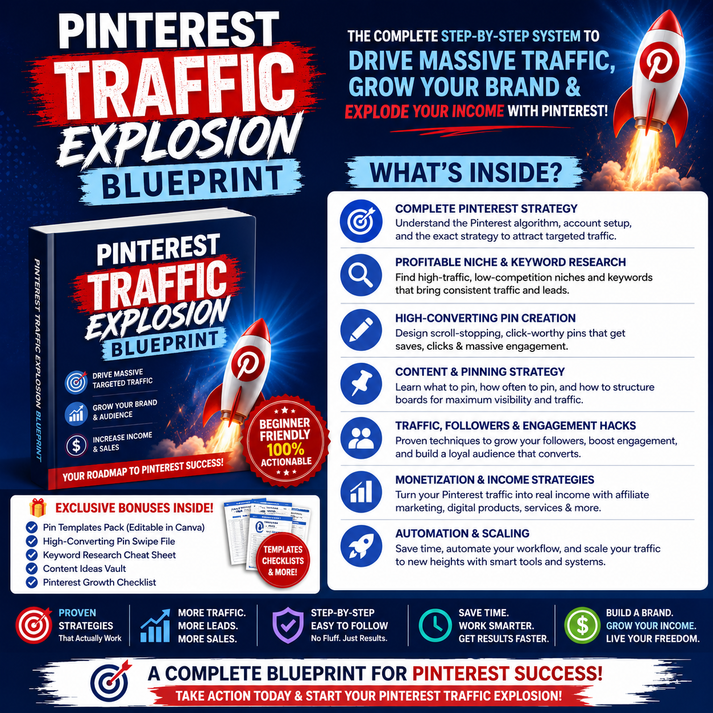
The full PINTEREST TRAFFIC EXPLOSION BLUEPRINT reveals the advanced ranking frameworks, content systems, traffic loops, keyword strategies, and scalable Pinterest growth methods modern creators are using right now.
What Pinterest Quietly Buries Now
Low-Quality AI Spam
Pinterest has become increasingly aggressive toward repetitive low-value content.
Mass-generated pins with weak engagement patterns lose visibility fast.
Misleading Clickbait
If users click and immediately return to Pinterest, the algorithm interprets it as dissatisfaction.
This negatively impacts future reach.
Inconsistent Niches
Random content categories confuse Pinterest’s recommendation engine.
Accounts without a clear topical identity struggle to build authority.
Over-Optimization
Keyword stuffing, repetitive titles, and unnatural descriptions now hurt performance more than they help.
Modern Pinterest SEO is about semantic relevance and audience alignment — not brute-force keyword repetition.
Practical Pinterest Traffic Strategies That Work in 2026
Create Topic Clusters
Instead of isolated content, build clusters around one central topic.
Example:
- Pinterest SEO
- Pinterest keyword research
- Pinterest affiliate marketing
- Pinterest design psychology
- Pinterest traffic funnels
Design for Curiosity, Not Just Aesthetics
The highest-performing pins create information gaps.
Users click when curiosity combines with clarity.
Optimize for Saves and Clicks Together
Many creators optimize only for outbound clicks.
But Pinterest also values saves because they signal long-term relevance.
The best-performing pins balance both behaviors naturally.
Build Long-Term Evergreen Assets
Unlike fast-moving social platforms, Pinterest rewards evergreen content longevity.
One optimized content ecosystem can drive traffic for years.
What You’ll Learn Inside the Full PINTEREST TRAFFIC EXPLOSION BLUEPRINT
- Advanced Pinterest SEO frameworks
- Traffic scaling systems for creators and brands
- Pinterest keyword domination strategies
- Content ecosystem architecture
- CTR optimization psychology
- High-converting Pinterest funnel structures
- Board authority frameworks
- Evergreen Pinterest traffic systems
- Pinterest affiliate marketing workflows
- Algorithm-proof growth strategies
The blueprint is designed for creators, bloggers, affiliate marketers, ecommerce brands, agencies, and digital entrepreneurs who want scalable organic visibility without relying entirely on ads.
Unlock the Full Pinterest Growth Framework
Stop guessing what works. Learn the complete Pinterest traffic system modern marketers are using to generate sustainable organic growth.
Final Thoughts
The Pinterest algorithm in 2026 is no longer mysterious.
It rewards relevance, topical authority, user satisfaction, and content ecosystems.
Creators who understand these signals are building massive organic traffic channels while competitors continue relying on outdated tactics.
Pinterest traffic today is less about hacks — and more about strategic authority building.
If you want to build sustainable visibility, long-term evergreen traffic, and scalable audience growth, understanding the system is no longer optional.
Explore the complete PINTEREST TRAFFIC EXPLOSION BLUEPRINT here and discover the advanced frameworks behind modern Pinterest growth.
Frequently Asked Questions
How does the Pinterest algorithm work in 2026?
The Pinterest algorithm now prioritizes topical authority, engagement quality, search intent alignment, and user satisfaction signals rather than simple posting frequency.
Is Pinterest still good for organic traffic?
Yes. Pinterest remains one of the strongest evergreen traffic platforms for bloggers, ecommerce brands, affiliate marketers, and content creators.
What type of content performs best on Pinterest now?
Educational, evergreen, search-optimized, visually clear, and curiosity-driven content performs best in the current Pinterest ecosystem.
How long does Pinterest traffic take to grow?
Pinterest growth is cumulative. Many creators begin seeing traction within weeks, but significant evergreen traffic often compounds over several months.
Does Pinterest punish AI-generated content?
Pinterest does not necessarily punish AI-assisted content, but low-quality repetitive spam content with poor engagement signals loses visibility quickly.
What is the best way to scale Pinterest traffic?
The most effective strategy combines topical authority, Pinterest SEO, content ecosystems, evergreen assets, and strong click-through optimization.