
The Role of AI Responsive Search Ads (RSAs) in Modern Google Ads Campaigns
Why AI in Google Ads Is Reshaping Digital Advertising
The era of manually testing dozens of ad variations is rapidly fading. Today, Google’s advertising ecosystem is powered by machine learning, predictive automation, and AI-driven optimization — and Responsive Search Ads (RSAs) are at the center of this transformation.
For marketers, ecommerce brands, agencies, and entrepreneurs, AI in Google Ads is no longer optional. It has become one of the most powerful competitive advantages for improving click-through rates, lowering acquisition costs, and scaling profitable campaigns faster than ever before.
Responsive Search Ads allow Google’s AI to dynamically mix and match headlines and descriptions to serve the most relevant ad combination for each user query. The result? Better personalization, stronger ad relevance, and significantly improved campaign performance.
Want to Master AI-Powered Google Ads?
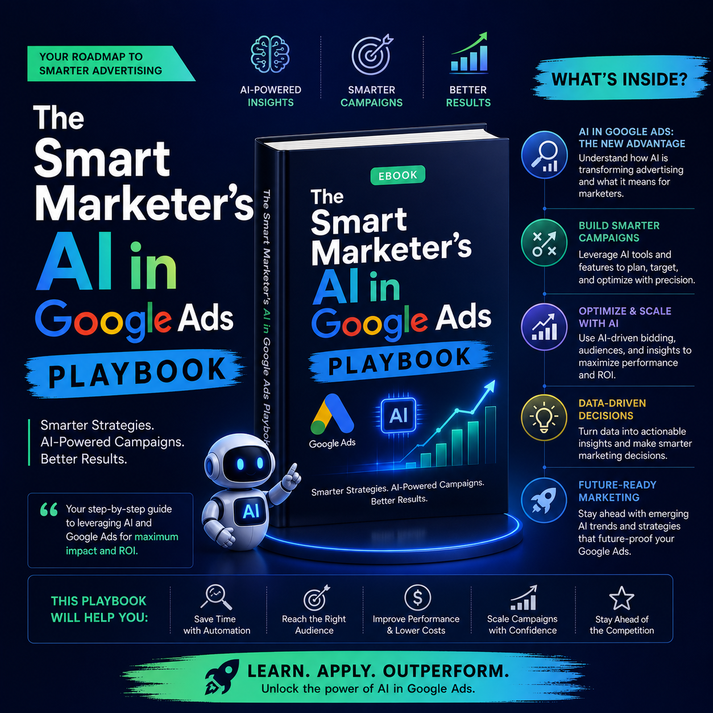
Discover the complete optimization system inside The Smart Marketer’s AI in Google Ads Playbook .
What Are Responsive Search Ads (RSAs)?
Responsive Search Ads are dynamic ad formats within Google Ads that use artificial intelligence to automatically test combinations of headlines and descriptions in real time.
Instead of creating one static ad, advertisers provide multiple assets:
- Up to 15 headlines
- Up to 4 descriptions
- Keyword-focused messaging
- Value propositions and CTAs
Google’s AI then analyzes user intent, device type, search behavior, historical engagement data, and contextual signals to assemble the most effective ad variation for each search query.
Responsive Search Ads use machine learning to automatically combine headlines and descriptions to deliver the highest-performing ad variation based on user intent and contextual signals.
Why AI in Google Ads Matters More Than Ever
Traditional PPC optimization relied heavily on manual testing and guesswork. AI changes this entirely.
Modern Google Ads AI systems process millions of data points instantly — something human marketers simply cannot replicate manually at scale.
Key Advantages of AI-Powered RSAs
- Real-Time Optimization: AI adapts ads instantly based on search behavior.
- Higher Relevance: Personalized messaging improves Quality Score and CTR.
- Automated Testing: Thousands of combinations can be tested automatically.
- Improved Conversion Rates: Better alignment between user intent and messaging.
- Scalability: Easier campaign management across multiple audiences and products.
For businesses competing in saturated industries, this level of automation can dramatically improve advertising efficiency and ROI.
Common Mistakes Marketers Make With Responsive Search Ads
Despite the power of AI in Google Ads, many advertisers still struggle to unlock the full potential of RSAs.
1. Writing Weak Headlines
AI can only optimize using the assets you provide. Poor headlines produce poor outcomes.
2. Repeating Similar Messaging
Many advertisers unknowingly submit repetitive variations instead of diverse emotional angles, benefits, and CTAs.
3. Ignoring Search Intent
AI performs best when ad copy aligns closely with buyer intent at different funnel stages.
4. Overusing Automation Without Strategy
AI is powerful, but strategy still matters. Smart marketers guide the algorithm with strong positioning, compelling offers, and conversion-focused messaging.
How Smart Marketers Use AI RSAs for Better Campaign Results
Elite advertisers treat AI as a strategic partner — not a replacement.
Here are practical ways high-performing marketers leverage Responsive Search Ads:
- Create emotional headline variations targeting different customer pain points
- Use keyword-rich headlines naturally for stronger relevance
- Combine urgency, authority, and curiosity in descriptions
- Continuously analyze asset performance reports
- Pair RSAs with Smart Bidding strategies
The best-performing campaigns blend human psychology with machine learning optimization.
Learn the Full AI Advertising Framework
Inside The Smart Marketer’s AI in Google Ads Playbook , you'll discover advanced RSA frameworks, AI optimization systems, bidding strategies, campaign scaling models, and modern PPC workflows used by high-level marketers.
What You’ll Learn Inside the Full Product
The complete playbook goes far beyond basic Google Ads tutorials. It provides a structured AI-powered advertising system designed for modern performance marketing.
- Advanced Responsive Search Ads optimization frameworks
- AI-driven campaign scaling systems
- Smart bidding implementation strategies
- Conversion-focused ad copywriting formulas
- Audience segmentation and intent targeting
- Performance Max and automation integration
- AI workflow systems for ecommerce and lead generation
Whether you're a freelancer, brand owner, media buyer, or agency marketer, understanding AI in Google Ads is becoming essential for long-term competitive growth.
The Future of Google Ads Is AI-Driven
Responsive Search Ads represent a major shift in how digital advertising works. Instead of relying solely on manual optimization, advertisers now have access to machine learning systems capable of improving campaign efficiency at scale.
However, the marketers who achieve the best results are not the ones blindly relying on automation. They are the ones who understand how to strategically guide AI with better copy, smarter targeting, stronger positioning, and data-driven frameworks.
As competition grows across every industry, mastering AI in Google Ads will increasingly separate average advertisers from elite performers.
Ready to Unlock Smarter Google Ads Performance?
Explore the complete system inside The Smart Marketer’s AI in Google Ads Playbook and start building AI-powered campaigns that scale profitably.
Frequently Asked Questions
What are Responsive Search Ads in Google Ads?
Responsive Search Ads are AI-powered ad formats that automatically test combinations of headlines and descriptions to deliver the most relevant ad variation for each search query.
How does AI improve Google Ads performance?
AI improves Google Ads by automating optimization, analyzing user behavior, improving targeting accuracy, increasing ad relevance, and enhancing conversion performance.
Are Responsive Search Ads better than Expanded Text Ads?
In most cases, yes. RSAs provide greater flexibility, automated testing, and improved personalization compared to traditional Expanded Text Ads.
Can beginners use AI in Google Ads effectively?
Yes. However, understanding ad copywriting, targeting, and campaign strategy is still essential for maximizing AI performance.
Do Responsive Search Ads increase conversions?
When properly optimized, RSAs often improve click-through rates, Quality Scores, and conversions due to better alignment with search intent.
What is the best way to optimize Responsive Search Ads?
Use diverse headlines, focus on search intent, test emotional angles, monitor asset performance, and combine RSAs with smart bidding strategies.