

Topic Clusters Are Back — Here's Why They're the Secret Weapon for AI Search Dominance
For years, marketers chased keywords. Then came backlinks. Then technical SEO. Then AI changed everything.
Today, search engines are no longer just indexing pages — they are understanding relationships between topics, entities, intent, and contextual depth.
That’s exactly why topic clusters are making a massive comeback.
But this time, they are not just helping websites rank on Google. They are becoming one of the most powerful frameworks for RANKING IN CHATGPT & AI SEARCH ENGINES.
AI-driven platforms like ChatGPT, Gemini, Perplexity, and Claude prioritize authoritative ecosystems of information rather than isolated articles. Brands that build semantic content networks are gaining disproportionate visibility in AI-generated answers.
And the brands still publishing disconnected blog posts? They are slowly disappearing from AI search relevance.
Why Traditional SEO Content Is Losing Visibility
Most websites still operate with an outdated publishing strategy:
- One keyword = one article
- Minimal internal linking
- No semantic relationships
- Surface-level information
- Random publishing schedules
This worked in older search systems because traditional algorithms focused heavily on keyword matching.
AI search engines work differently. They analyze:
- Topical authority
- Entity relationships
- Contextual relevance
- Knowledge depth
- Semantic content ecosystems
If your content lacks interconnected topical depth, AI systems struggle to trust your authority.
Brands winning AI search today are not publishing more content.
They are building smarter content ecosystems powered by topic clusters.
What Are Topic Clusters in AI SEO?
A topic cluster is a structured content framework where one primary pillar page connects to multiple related supporting articles.
Instead of creating isolated blog posts, you create an interconnected network around a central topic.
Example Structure
- Pillar Topic: AI Search Optimization
- Semantic SEO Strategies
- Entity-Based SEO
- Topical Authority Frameworks
- ChatGPT Ranking Signals
- Answer Engine Optimization
- Content Ecosystem Building
This structure helps AI systems understand:
- Your expertise
- Your niche relevance
- Your semantic authority
- Your contextual depth
In simple terms: Topic clusters help AI engines trust your content.
Why Topic Clusters Dominate AI Search Engines
1. They Build Topical Authority
AI search systems reward websites that comprehensively cover a subject. Topic clusters demonstrate expertise better than standalone articles ever could.
2. They Improve Semantic Relevance
Modern AI systems understand related concepts, synonyms, and contextual intent. Clusters naturally strengthen semantic signals across your site.
3. They Increase Internal Link Equity
Strategic internal linking distributes authority across related pages while improving crawlability and contextual understanding.
4. They Align With AI Retrieval Systems
Large language models retrieve information contextually. Well-structured topic clusters increase the likelihood of your content being referenced in AI-generated answers.
5. They Improve User Experience
Users stay longer when content naturally guides them deeper into related topics. This increases engagement signals and reinforces authority.
Want to Master the Complete AI Search Ranking System?
Discover advanced frameworks, semantic SEO systems, AI visibility strategies, and content ecosystem models inside the complete guide.
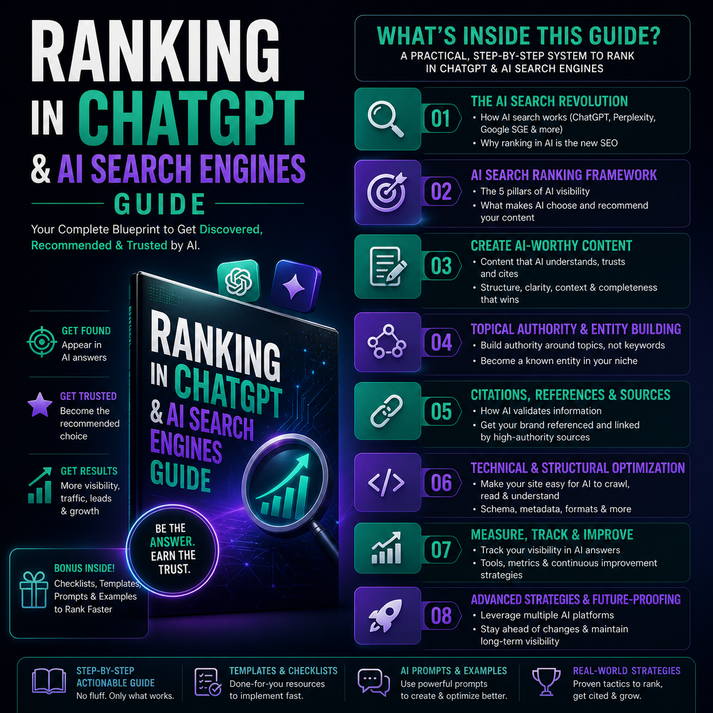
Access the Full RANKING IN CHATGPT & AI SEARCH ENGINES Guide
Common Topic Cluster Mistakes Most Brands Make
Publishing Thin Supporting Articles
AI systems value informational depth. Low-quality filler articles weaken overall authority.
Ignoring Entity Optimization
Topic clusters should reinforce entities, concepts, and semantic relationships — not just keywords.
Poor Internal Linking
Without strategic internal links, clusters lose contextual strength. Every article should support the pillar page naturally.
Creating Broad Unfocused Clusters
Topical authority grows faster when clusters are tightly focused around clear themes.
How to Build Topic Clusters for AI Search Dominance
Step 1: Choose a Pillar Topic
Select a high-value topic central to your niche.
Step 2: Map Semantic Subtopics
Use related search intent, AI query patterns, and entity relationships to identify supporting content.
Step 3: Create Deep Educational Content
Focus on solving problems comprehensively instead of chasing keyword density.
Step 4: Build Strategic Internal Linking
Connect every supporting article back to the pillar page and related supporting articles.
Step 5: Optimize for AI Retrieval
Use:
- Clear heading structures
- Semantic phrasing
- Entity-rich language
- Concise answer formatting
- Structured FAQs
What You’ll Learn Inside the Full Product
The complete RANKING IN CHATGPT & AI SEARCH ENGINES digital guide goes far beyond basic SEO tactics.
- AI search ranking frameworks
- Entity-based optimization systems
- Generative Engine Optimization (GEO)
- Topical authority blueprints
- Prompt-driven search visibility strategies
- AI content ecosystem building
- Semantic architecture frameworks
- Future-proof SEO systems for AI search
If you want long-term organic visibility in the AI era, understanding these systems early creates a massive competitive advantage.
The Future of SEO Belongs to Content Ecosystems
AI search is fundamentally changing how content gets discovered.
The websites dominating tomorrow’s search landscape are not relying on isolated blog posts. They are building interconnected ecosystems of expertise.
Topic clusters are no longer optional. They are becoming one of the strongest authority signals for AI-powered discovery systems.
Brands that understand this shift early will own disproportionate visibility across ChatGPT, Gemini, Perplexity, and next-generation AI search engines.
Ready to Build an AI Search Dominance Strategy?
Unlock the complete framework, advanced optimization systems, and future-proof SEO strategies inside the full guide.
Get the Complete RANKING IN CHATGPT & AI SEARCH ENGINES Guide Here
Frequently Asked Questions
What are topic clusters in SEO?
Topic clusters are interconnected groups of content built around a central pillar topic to improve semantic relevance and topical authority.
Why are topic clusters important for AI search engines?
AI search engines prioritize contextual understanding and topical depth. Topic clusters help AI systems recognize expertise and semantic relationships.
How do topic clusters improve ChatGPT visibility?
Structured topic ecosystems increase the likelihood of your content being referenced or retrieved in AI-generated responses.
Can small websites benefit from topic clusters?
Yes. Even smaller websites can establish authority faster by focusing on tightly related semantic content rather than publishing random articles.
What is the difference between traditional SEO and AI SEO?
Traditional SEO focuses heavily on keywords and rankings, while AI SEO prioritizes context, entities, semantic relationships, and informational depth.
How long does topical authority take to build?
Results vary by niche and competition, but consistently publishing high-quality interconnected content compounds authority over time.