

Tracking Your Topical Authority Growth: The SEO Framework Smart Brands Use to Dominate Search
Why Most Websites Fail to Build Real Topical Authority
Publishing more content doesn’t automatically make your website authoritative.
Many creators, marketers, bloggers, and digital brands push out dozens of articles every month but still struggle to rank consistently on Google. The reason is simple: they’re measuring the wrong things.
True Topical Authority is not just about content quantity. It’s about depth, semantic relevance, interconnected expertise, search intent coverage, and ecosystem expansion over time.
If you want sustainable organic growth, you need a system to track how your authority evolves across an entire topic — not just individual keywords.
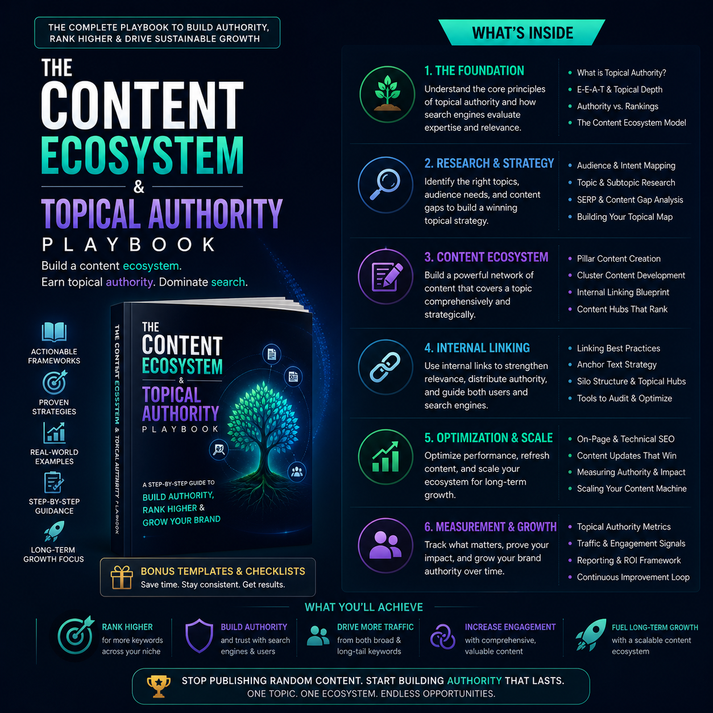
Want to master the complete system behind Tracking Your Topical Authority Growth? Access the full The Content Ecosystem & Topical Authority Playbook here.
What Is Topical Authority in Modern SEO?
Topical Authority refers to how comprehensively your website covers a subject compared to competitors.
Search engines increasingly reward websites that demonstrate expertise through:
- Semantic content coverage
- Interconnected topic clusters
- Entity relevance
- User intent satisfaction
- Consistent publishing depth
- Strong internal linking structures
Instead of ranking one isolated article, Google now evaluates how well your entire content ecosystem supports a topic.
This is why brands with smaller websites often outrank larger competitors — because their topical structures are tighter, clearer, and strategically connected.
How to Track Your Topical Authority Growth Properly
Tracking Topical Authority requires more than checking keyword rankings.
Elite SEO teams measure ecosystem-wide authority signals that indicate whether their content network is expanding strategically.
1. Measure Keyword Cluster Expansion
Instead of tracking isolated keywords, monitor topic clusters.
For example, if your niche is SEO, you should evaluate how many semantically related queries you rank for across:
- Semantic SEO
- Content clustering
- Entity optimization
- Search intent mapping
- Internal linking systems
As your topical authority grows, your website naturally begins ranking for long-tail variations you never directly targeted.
2. Analyze Internal Linking Depth
Internal links are one of the strongest indicators of topical relationships.
A weak internal structure creates isolated content silos that reduce contextual authority.
Strong topical ecosystems strategically connect:
- Pillar pages
- Supporting articles
- Entity-focused content
- Case studies
- Guides and frameworks
3. Monitor Search Visibility Across Topics
Organic traffic alone can be misleading.
Instead, track how many topics your domain becomes visible for over time. A growing topical footprint signals increasing authority.
The goal is not just ranking higher — it’s owning more semantic territory within your niche.
Common Mistakes That Kill Topical Authority Growth
Publishing Random Content
One of the biggest mistakes websites make is creating disconnected content without strategic relevance.
Google struggles to understand your expertise when your articles lack thematic consistency.
Ignoring Semantic Relationships
Modern SEO is entity-driven.
If your content doesn’t naturally cover related entities, subtopics, and contextual concepts, your authority ceiling remains limited.
Weak Content Depth
Thin articles no longer compete effectively in high-authority niches.
Comprehensive ecosystem content outperforms fragmented short-form publishing strategies.
Benefits of Tracking Your Topical Authority Growth
- Higher rankings across entire keyword groups
- Increased search engine trust
- Improved crawl and indexing performance
- Better long-tail keyword visibility
- More sustainable organic traffic growth
- Stronger brand positioning within your niche
- Greater resilience during algorithm updates
Brands that actively track and optimize topical authority create compounding SEO advantages that become difficult for competitors to replicate.
Actionable Ways to Improve Your Topical Authority
Create Topic Maps Before Publishing
Plan your ecosystem structure before writing content.
Map core topics, supporting subtopics, entities, and search intents systematically.
Build Pillar-to-Cluster Relationships
Every major topic should have:
- A comprehensive pillar page
- Supporting cluster articles
- Entity-driven supporting content
- Internal semantic links
Optimize Existing Content Regularly
Updating and expanding existing content often improves authority faster than constantly publishing new articles.
What You’ll Learn Inside the Full Playbook
The complete framework inside The Content Ecosystem & Topical Authority Playbook goes far beyond basic SEO advice.
Inside the full system, you’ll discover:
- Advanced topical mapping frameworks
- Semantic SEO implementation systems
- Entity-driven content architecture
- Content ecosystem scaling models
- Internal linking strategies for authority growth
- Modern search intent optimization frameworks
- AI-assisted topical expansion workflows
Ready to build a content ecosystem that compounds rankings, authority, and organic traffic? Explore the full The Content Ecosystem & Topical Authority Playbook now.
Final Thoughts
The future of SEO belongs to brands that think in ecosystems — not isolated articles.
Tracking your Topical Authority growth helps you understand whether your content strategy is actually building long-term search dominance.
Instead of chasing random keywords, focus on creating interconnected expertise, semantic relevance, and strategic topic depth.
That’s how modern authority is built.
Want the exact framework used to build scalable topical authority systems? Access The Content Ecosystem & Topical Authority Playbook and start building a search-driven content ecosystem today.
Frequently Asked Questions
How long does it take to build Topical Authority?
Building topical authority typically takes several months of consistent publishing, optimization, and semantic ecosystem development depending on competition and niche depth.
Can small websites build Topical Authority?
Yes. Smaller websites often outperform larger competitors when they focus on deep niche coverage and strategic topic clustering.
What is the difference between domain authority and topical authority?
Domain authority measures overall site strength, while topical authority measures expertise and depth within a specific subject area.
Does internal linking help Topical Authority?
Absolutely. Internal links help search engines understand semantic relationships between pages and strengthen contextual authority signals.
How do I know if my topical authority is improving?
Signs include increased keyword cluster visibility, broader organic rankings, better indexing, improved engagement, and higher search impressions across related topics.