

What Actually Is Topical Authority? The SEO Strategy Behind Sustainable Organic Growth
Search engines have evolved far beyond keyword matching. Today, Google wants to understand who truly owns a topic. And that’s exactly where Topical Authority becomes one of the most powerful SEO concepts in modern digital marketing.
If you’ve ever wondered why some websites dominate entire industries while others struggle to rank despite publishing endless content, the answer often comes down to one thing: their depth of topical relevance.
In this guide, you’ll learn what Topical Authority actually means, how it works, why it matters for SEO in 2026, and how brands are building content ecosystems that compound traffic over time.
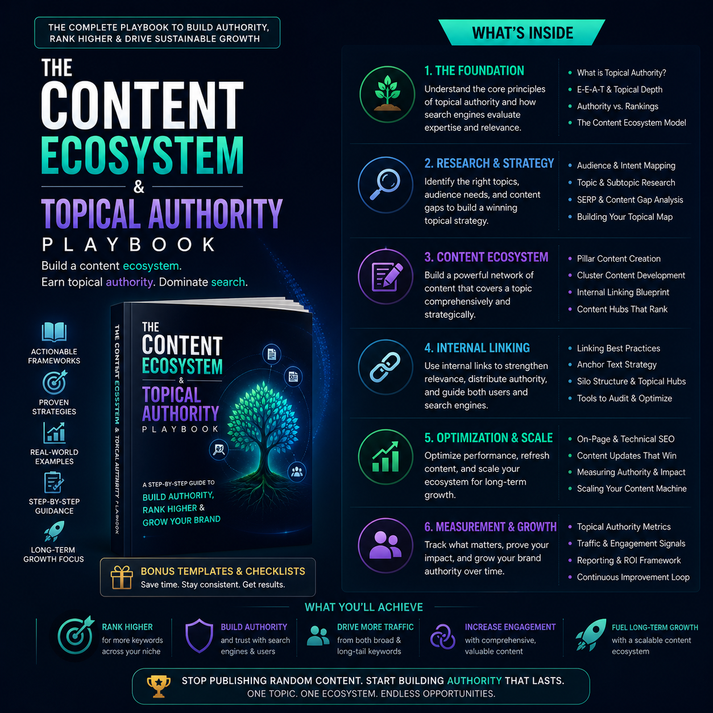
Want to master the complete system behind Topical Authority and modern SEO content ecosystems? Explore the full The Content Ecosystem & Topical Authority Playbook and learn the exact frameworks used to scale organic visibility strategically.
What Is Topical Authority?
Topical Authority is the level of trust and expertise search engines associate with your website around a specific subject area.
Instead of ranking a page purely based on isolated keywords, Google now evaluates:
- How comprehensively you cover a topic
- Whether your content answers related search intent
- How your pages connect semantically
- The depth and breadth of your content ecosystem
- User engagement and relevance signals
In simple terms: Topical Authority tells Google that your website is a reliable source on a subject.
Why Topical Authority Matters More Than Ever
Traditional SEO strategies focused heavily on individual keywords and backlinks. While those still matter, modern search algorithms prioritize contextual understanding.
Google’s AI systems now analyze:
- Entity relationships
- Semantic relevance
- Search intent clusters
- Content hierarchy
- User satisfaction metrics
This means publishing random blog posts without strategic topical structure no longer works effectively.
Modern SEO Reality
A website with 40 deeply connected, high-quality articles around a niche topic will often outperform a website with 400 scattered posts lacking topical cohesion.
How Topical Authority Actually Works
Think of Topical Authority like building a digital knowledge ecosystem.
Instead of creating standalone articles, you create:
- Pillar pages
- Topic clusters
- Supporting guides
- Semantic supporting content
- Internal linking structures
- Entity-rich educational resources
Each piece reinforces the others. Over time, search engines recognize your site as an authority within that subject area.
Example of a Topical Authority Structure
If your niche is SEO, your ecosystem may include:
- Technical SEO
- Semantic SEO
- On-page optimization
- Internal linking
- Content strategy
- Entity SEO
- Search intent mapping
- AI search optimization
Together, these interconnected topics create a strong topical footprint.
Most creators publish content randomly and wonder why rankings stagnate. The difference is having a structured ecosystem strategy. Learn how to architect one inside The Content Ecosystem & Topical Authority Playbook.
The Biggest Misconceptions About Topical Authority
1. Publishing More Content Automatically Creates Authority
Quantity alone does not create authority. Relevance, structure, semantic depth, and user satisfaction matter more.
2. Topical Authority Is Just Keyword Clustering
Keyword clustering is only one small component. True topical authority involves:
- Entity relationships
- Semantic coverage
- Search intent alignment
- Strategic internal linking
- Content hierarchy
3. Backlinks Are the Only Ranking Factor
Backlinks help, but Google increasingly rewards websites that demonstrate expertise through comprehensive topical ecosystems.
Benefits of Building Topical Authority
1. Higher Search Rankings
Search engines trust authoritative websites more, making it easier to rank both existing and future content.
2. Faster Indexing
Strong topical ecosystems help Google understand your site architecture quickly.
3. Increased Organic Traffic
Instead of relying on a few keywords, you capture traffic across hundreds of semantically related searches.
4. Better Conversion Potential
Users trust brands that demonstrate deep expertise. That trust increases engagement, leads, and sales.
5. Long-Term SEO Stability
Topical Authority creates resilient rankings that are less dependent on temporary algorithm fluctuations.
How to Start Building Topical Authority
Create a Topical Map
Identify your primary niche and break it into supporting subtopics.
Build Content Clusters
Create interconnected articles around each major subtopic.
Use Strategic Internal Linking
Help both users and search engines navigate your ecosystem naturally.
Focus on Search Intent
Every article should solve a specific user problem or answer a targeted query.
Prioritize Semantic SEO
Use related entities, concepts, and contextual relevance instead of repetitive keyword stuffing.
Key Insight
Topical Authority is not built through isolated blog posts. It’s built through systems, architecture, and strategic information depth.
What You’ll Learn Inside the Full Product
The complete The Content Ecosystem & Topical Authority Playbook goes far beyond basic SEO theory.
Inside, you’ll learn:
- How to build a scalable topical map
- Advanced semantic SEO frameworks
- Internal linking systems that boost rankings
- How to structure content clusters strategically
- Entity SEO implementation techniques
- Content ecosystem architecture for long-term growth
- AI search optimization strategies
- How modern search engines interpret expertise signals
If you want to build a website that compounds traffic instead of constantly chasing rankings, access the full The Content Ecosystem & Topical Authority Playbook today.
Conclusion
Topical Authority is no longer optional for serious SEO growth. It’s the foundation of modern search visibility.
The websites winning in organic search today are not simply publishing more content. They are building structured, semantically rich ecosystems that demonstrate expertise at scale.
If you want sustainable rankings, stronger trust signals, and long-term organic traffic growth, mastering Topical Authority should become a core part of your digital strategy.
Ready to build a high-performing content ecosystem that search engines trust? Get instant access to The Content Ecosystem & Topical Authority Playbook and start implementing proven frameworks today.
Frequently Asked Questions
What is Topical Authority in SEO?
Topical Authority refers to how strongly search engines associate your website with expertise and trust around a specific topic or niche.
How long does it take to build Topical Authority?
It depends on competition, content quality, and consistency. Most websites begin seeing strong authority signals after several months of strategic content publishing and internal linking.
Does Topical Authority help Google rankings?
Yes. Websites with strong topical relevance often rank higher because search engines trust their expertise and semantic coverage.
What is the difference between keyword SEO and Topical Authority?
Keyword SEO focuses on optimizing individual search terms, while Topical Authority focuses on comprehensive subject coverage and semantic relevance across an entire niche.
Can small websites build Topical Authority?
Absolutely. Smaller niche websites often build authority faster because they focus deeply on a specific topic instead of covering unrelated subjects.
Is internal linking important for Topical Authority?
Yes. Strategic internal linking helps search engines understand relationships between your pages and strengthens your content ecosystem structure.