
What Is AI in Google Ads? The Smart Marketer’s Guide to AI-Powered Advertising
AI in Google Ads Is Changing Digital Advertising Forever
Advertising has evolved dramatically over the last few years. Manual campaign management, endless bid adjustments, and guesswork-driven targeting are rapidly becoming outdated. Today, artificial intelligence is at the center of modern advertising performance — especially inside Google Ads.
If you’ve been hearing terms like Smart Bidding, Performance Max, automated targeting, or AI-generated ad assets, you’re already witnessing the rise of AI in Google Ads.
But what exactly does it mean?
More importantly, how can marketers, business owners, ecommerce brands, and advertisers actually use AI to generate better ROI instead of wasting budget on automation they don’t fully understand?
This guide breaks down everything you need to know about AI in Google Ads — from how it works to how smart marketers are using it to scale campaigns faster and more profitably.
Why Traditional Google Ads Management Is Becoming Inefficient
Managing Google Ads manually used to work well when campaigns were simpler and customer behavior was easier to predict.
Today, advertisers face:
- Massive competition across search and shopping ads
- Rising CPCs and customer acquisition costs
- Complex customer journeys across devices
- Constant algorithm updates
- Data overload and audience fragmentation
Human optimization alone can no longer process millions of signals in real time.
That’s where Google’s AI systems step in.
What Is AI in Google Ads?
AI in Google Ads refers to Google’s use of machine learning and automation to improve campaign performance, optimize bidding, predict user behavior, and deliver more relevant ads to the right people at the right time.
Instead of relying entirely on manual decisions, Google’s AI analyzes enormous amounts of real-time data signals including:
- User intent
- Search behavior
- Device usage
- Location data
- Audience patterns
- Historical conversion data
- Time of day
- Engagement signals
Using this data, AI continuously adjusts campaigns to maximize performance outcomes such as:
- Conversions
- Revenue
- ROAS (Return on Ad Spend)
- Lead generation
- Click-through rates
In simple terms: AI in Google Ads helps advertisers automate optimization while improving targeting precision and campaign efficiency.
How AI Is Used Inside Google Ads
1. Smart Bidding
Smart Bidding uses machine learning to automatically adjust bids based on conversion likelihood.
Popular strategies include:
- Target CPA
- Target ROAS
- Maximize Conversions
- Maximize Conversion Value
Instead of manually changing bids, AI predicts which clicks are more likely to convert and adjusts accordingly.
2. Performance Max Campaigns
Performance Max campaigns use AI to distribute ads across:
- YouTube
- Search
- Display
- Gmail
- Maps
- Shopping
Google’s AI determines where your ads should appear for the highest conversion potential.
3. Responsive Search Ads
AI dynamically mixes headlines and descriptions to identify the best-performing combinations.
This allows advertisers to test multiple creative variations automatically.
4. Audience Expansion & Predictive Targeting
Google AI can identify users similar to your existing converters and expand audience reach intelligently.
Want to Master AI-Driven Google Advertising?
The most successful marketers aren’t just using Google Ads — they’re leveraging AI strategically to outperform competitors and scale faster.
Access the complete Playbook here:
Benefits of Using AI in Google Ads
- Faster optimization: AI reacts in real time.
- Better targeting: Reach higher-intent users.
- Improved ROAS: Smarter budget allocation.
- Time efficiency: Reduce manual campaign management.
- Advanced personalization: Deliver relevant ad experiences.
- Scalable growth: Manage larger campaigns efficiently.
For ecommerce brands, SaaS companies, agencies, and online businesses, AI has become a competitive advantage rather than an optional feature.
Common Mistakes Marketers Make With AI in Google Ads
1. Blindly Trusting Automation
AI works best when guided properly. Poor conversion tracking or weak campaign structures can confuse the algorithm.
2. Ignoring Data Quality
AI is only as effective as the data it receives. Inaccurate tracking leads to poor optimization decisions.
3. Weak Creative Assets
Even advanced AI cannot fix weak copywriting or poor ad creatives.
4. Lack of Strategic Inputs
Many advertisers expect AI to “do everything.” Successful marketers still provide strategic direction, audience insights, and offer positioning.
How to Use AI in Google Ads More Effectively
- Implement accurate conversion tracking
- Feed AI enough campaign data before making changes
- Use strong audience signals
- Create multiple ad variations
- Combine automation with human strategy
- Monitor search terms and asset performance regularly
- Focus heavily on landing page optimization
The marketers seeing the biggest wins are those who combine AI automation with smart human decision-making.
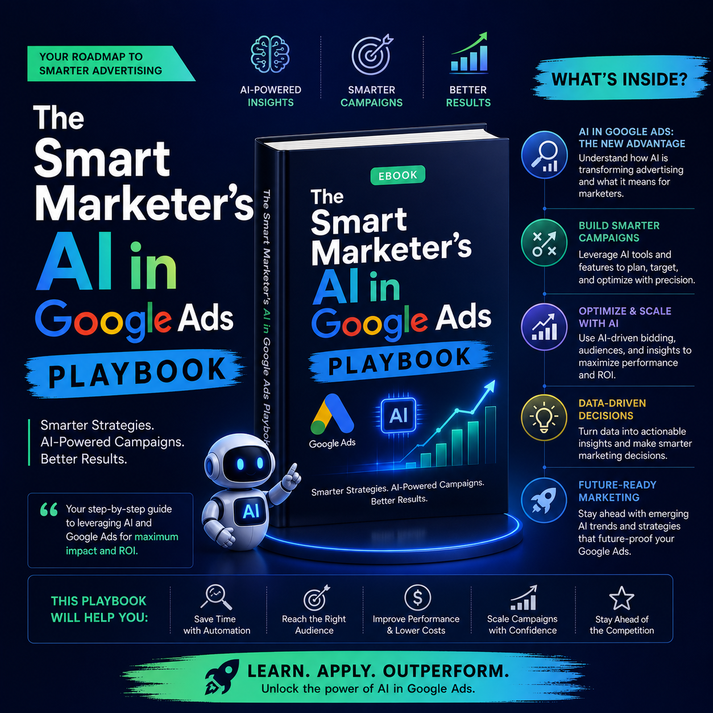
What You’ll Learn Inside The Smart Marketer’s AI in Google Ads Playbook
While understanding AI in Google Ads is important, mastering it requires a structured framework.
Inside the full playbook, you’ll discover:
- Advanced AI campaign structures
- Performance Max optimization systems
- AI-powered scaling strategies
- Conversion-focused audience frameworks
- Smart bidding optimization methods
- High-converting ad creative systems
- AI-driven ecommerce growth tactics
- Modern PPC workflows used by elite marketers
Unlock the Full AI Advertising Framework
If you want a complete system for using AI inside Google Ads profitably, explore the full guide today.
Final Thoughts
AI in Google Ads is not replacing marketers — it’s amplifying smart marketers.
Businesses that learn how to combine automation, data, creative strategy, and AI-driven optimization will dominate the next generation of digital advertising.
The future of Google Ads belongs to advertisers who understand how to work with AI instead of competing against it.
Whether you’re running ecommerce campaigns, lead generation funnels, or scaling a digital business, mastering AI-driven advertising can dramatically improve your results.
And if you want the exact frameworks, systems, and optimization strategies used by modern performance marketers, the full playbook is your next step.
Ready to Master AI in Google Ads?
Access the complete The Smart Marketer’s AI in Google Ads Playbook and learn the systems behind smarter targeting, better ROAS, and scalable campaign growth.
Frequently Asked Questions
Is AI in Google Ads good for beginners?
Yes. AI features like Smart Bidding and Responsive Search Ads can simplify campaign management for beginners while improving performance efficiency.
Does AI completely automate Google Ads?
No. AI automates optimization tasks, but marketers still need strategic oversight, audience understanding, creative direction, and conversion tracking.
What is the biggest advantage of AI in Google Ads?
The biggest advantage is real-time optimization using massive amounts of data that humans cannot process manually.
Can AI improve ROAS in Google Ads?
Yes. When implemented correctly, AI can improve targeting precision, bidding efficiency, and conversion performance, often leading to higher ROAS.
Are Performance Max campaigns powered by AI?
Yes. Performance Max campaigns heavily rely on machine learning and automation to optimize placements and conversions across Google’s network.
Should advanced marketers still manually optimize campaigns?
Absolutely. The best results typically come from combining AI automation with advanced human strategy and data-driven decision-making.