
Search behavior is changing faster than most businesses realize.
For years, traditional SEO focused almost entirely on one platform: Google Search. Brands optimized pages, chased backlinks, and competed for blue-link rankings. But today, users are increasingly getting direct answers instead of clicking websites.
Whether it’s ChatGPT, Google AI Overviews, Siri, Alexa, Gemini, Perplexity, or voice assistants, people now expect instant, summarized, conversational answers.
This shift has created a new digital battlefield known as Answer Engine Optimization.
And if your content is not optimized for answer engines, your visibility may slowly disappear — even if your traditional SEO rankings look fine.
Want to future-proof your traffic strategy before competitors catch up?
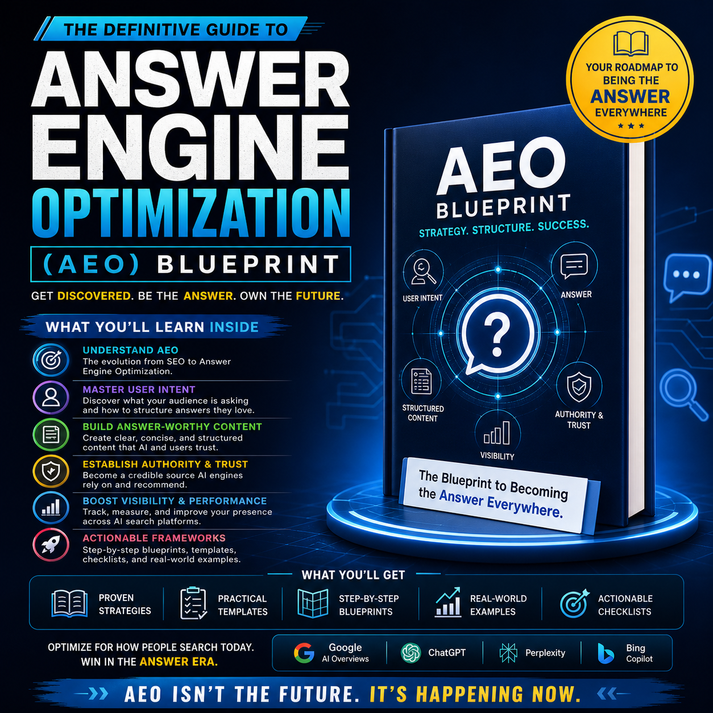
Access the complete ANSWER ENGINE OPTIMIZATION (AEO) BLUEPRINT by Lywire here.
What Is Answer Engine Optimization (AEO)?
Answer Engine Optimization (AEO) is the process of optimizing content so AI systems, search assistants, voice search tools, and generative engines can easily extract, understand, and present your information as direct answers.
Unlike traditional SEO — where users click through search results — AEO focuses on becoming the answer itself.
This includes optimization for:
- Google AI Overviews
- ChatGPT responses
- Voice search assistants
- Featured snippets
- AI search engines
- Smart devices
- Conversational search platforms
In simple terms:
Traditional SEO helps users find your website.
Answer Engine Optimization helps AI systems choose your content as the trusted answer.
Why Google Is No Longer Your Only Boss
Search is no longer limited to typing keywords into Google.
Today’s users ask conversational questions like:
- “What’s the best way to improve topical authority?”
- “How does AEO work?”
- “What’s the difference between SEO and Answer Engine Optimization?”
AI systems now aggregate answers from multiple sources and provide summarized responses instantly.
This changes the visibility model completely.
Here’s What’s Happening Right Now:
- Users are clicking fewer websites
- AI-generated answers are replacing search result exploration
- Voice search usage continues to rise
- Featured snippets dominate informational queries
- Brands without structured answer content are losing impressions
The companies adapting early to Answer Engine Optimization are positioning themselves for the next era of digital visibility.
How Answer Engine Optimization Works
AEO focuses heavily on content clarity, semantic structure, topical authority, and machine readability.
Modern AI systems prioritize content that:
- Directly answers questions
- Uses clear heading structures
- Demonstrates expertise
- Includes semantic relevance
- Provides concise, authoritative explanations
- Uses schema markup correctly
- Organizes information logically
This means brands must move beyond outdated keyword stuffing tactics and create content designed for understanding — not just indexing.
The Biggest Benefits of AEO
1. Increased Visibility Across AI Platforms
Optimized content can appear inside AI-generated answers, voice search results, and conversational search interfaces.
2. Higher Trust and Authority
When AI systems repeatedly cite your content as a trusted answer source, your perceived authority increases dramatically.
3. Future-Proof Organic Traffic
As AI-driven search grows, businesses prepared for AEO will maintain visibility while others lose exposure.
4. Better User Experience
Clear, answer-focused content improves readability and engagement for real users as well.
Most businesses are still optimizing only for old-school SEO.
The brands winning tomorrow are already building answer-engine-ready content ecosystems today.
Explore the full ANSWER ENGINE OPTIMIZATION (AEO) BLUEPRINT here.
Common AEO Mistakes Businesses Make
Ignoring Conversational Search Intent
AI systems prioritize natural language queries. Content that sounds robotic or overly optimized often performs poorly.
Creating Thin Content
Short, surface-level pages rarely become trusted answer sources.
Weak Structure and Formatting
Poor heading hierarchy makes it difficult for AI systems to interpret your content accurately.
Not Using Schema Markup
Structured data helps search engines understand context, FAQs, entities, and relationships within your content.
Actionable AEO Implementation Tips
- Create question-driven content sections
- Use concise answers under headings
- Build topical authority clusters
- Add FAQ schema markup
- Focus on semantic SEO relationships
- Optimize for voice-search phrasing
- Write naturally while maintaining expertise
- Use structured formatting for readability
The future of search belongs to brands that understand information architecture — not just keyword rankings.
What You’ll Learn Inside the Full ANSWER ENGINE OPTIMIZATION (AEO) BLUEPRINT
- How AI search engines choose sources
- Advanced Answer Engine Optimization frameworks
- Voice search optimization systems
- Semantic SEO strategies
- Featured snippet domination techniques
- AI visibility growth models
- Topical authority building systems
- AEO-focused content architecture
- Schema optimization methods
- Future-proof search visibility strategies
Want to master the complete system behind Answer Engine Optimization and stay visible in the AI-driven search era?
Access the full ANSWER ENGINE OPTIMIZATION (AEO) BLUEPRINT by Lywire here.
Conclusion
Search is evolving from “finding websites” to “finding answers.”
That shift changes everything.
Businesses that continue relying only on traditional SEO may slowly lose visibility as AI platforms become the primary gateway to information.
Answer Engine Optimization is not a trend — it’s the next layer of digital discoverability.
Brands that adapt early will dominate AI search visibility, build stronger authority, and capture attention across emerging platforms.
The question is no longer whether AEO matters.
The real question is whether your business will adapt before competitors do.
Ready to future-proof your traffic, authority, and visibility?
Get the complete ANSWER ENGINE OPTIMIZATION (AEO) BLUEPRINT from Lywire today.
Frequently Asked Questions
What is Answer Engine Optimization?
Answer Engine Optimization (AEO) is the process of optimizing content so AI systems, voice assistants, and search engines can directly use your content as answers to user questions.
How is AEO different from traditional SEO?
Traditional SEO focuses on ranking webpages in search results, while AEO focuses on helping AI systems extract and display your content as direct answers.
Why is Answer Engine Optimization important?
As AI-powered search and voice assistants grow, businesses need AEO to remain visible across modern search experiences beyond traditional Google rankings.
Does AEO replace SEO?
No. AEO complements SEO. The best modern strategies combine traditional SEO with answer-focused optimization techniques.
Can small businesses benefit from AEO?
Absolutely. Smaller brands can compete effectively by creating highly structured, authoritative, answer-focused content.
What platforms use Answer Engine Optimization principles?
Platforms like ChatGPT, Google AI Overviews, Siri, Alexa, Gemini, Perplexity, and voice assistants all rely on answer-focused information retrieval systems.