

What You Need to Know About Content Ecosystem & Topical Authority
Search engines have evolved far beyond simple keyword matching. Today, Google rewards websites that demonstrate deep expertise, semantic relevance, and comprehensive topical coverage. That’s exactly where Content Ecosystem & Topical Authority becomes a game-changing strategy.
Whether you're running a blog, digital product brand, ecommerce business, agency, or niche website, building topical authority is no longer optional if you want sustainable organic growth.
Brands dominating search results today are not winning because of a few isolated articles. They’re winning because they’ve built interconnected content ecosystems that signal expertise, trust, and relevance across entire subject areas.
Want to master the complete system behind Content Ecosystem & Topical Authority?
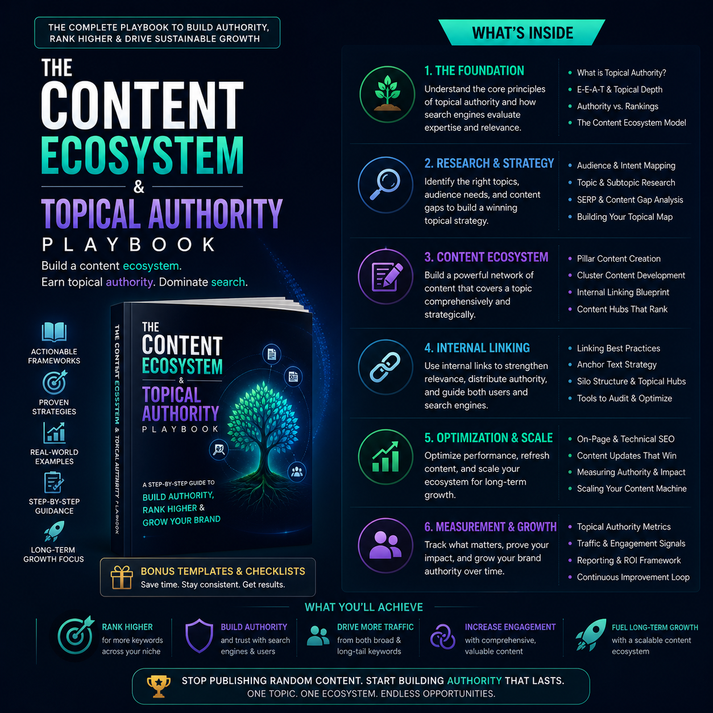
Access the full The Content Ecosystem & Topical Authority Playbook from Lywire here: Explore The Complete Playbook
Why Most Websites Struggle to Rank Consistently
Many websites publish random blog posts without a strategic structure. One week they write about SEO, the next week about social media, and then suddenly switch to AI tools or ecommerce trends.
The result? Weak topical signals, fragmented authority, and inconsistent rankings.
Google’s modern algorithms prioritize:
- Semantic relevance
- Entity relationships
- Topic depth
- User intent coverage
- Content clustering
- Internal linking architecture
- Expertise and authority signals
Without a connected ecosystem of content, even high-quality articles often fail to compete against authoritative sites that own entire topic clusters.
What Is a Content Ecosystem?
A content ecosystem is a strategically connected network of content assets designed to cover an entire subject comprehensively.
Instead of creating isolated articles, you build:
- Pillar pages
- Topic clusters
- Supporting guides
- Case studies
- Frameworks
- FAQs
- Resource hubs
- Internal linking pathways
Every piece supports the others, creating a strong semantic relationship that helps search engines understand your expertise.
Think of it this way: One article may rank temporarily. But a complete ecosystem builds long-term authority that compounds over time.
Understanding Topical Authority in Modern SEO
Topical authority refers to how strongly search engines perceive your website as an expert source on a specific subject.
The more comprehensively you cover related subtopics, user intents, and semantic variations, the stronger your authority becomes.
For example, a website focused on SEO shouldn’t only publish “SEO tips.” It should also cover:
- Technical SEO
- Semantic SEO
- Content strategy
- Internal linking
- Keyword clustering
- Entity optimization
- AI search optimization
- Topical maps
- Search intent frameworks
This layered approach sends strong authority signals to Google and improves visibility across hundreds of related queries.
Benefits of Building a Content Ecosystem
1. Higher Search Rankings
Comprehensive topical coverage improves semantic relevance, helping your content rank for broader keyword variations and long-tail queries.
2. Stronger Internal Linking Power
A well-structured ecosystem distributes authority efficiently across your website, helping important pages rank faster.
3. Better User Experience
Readers stay longer when they can seamlessly navigate related content. This improves engagement metrics and builds trust.
4. Increased Organic Traffic
Instead of relying on one or two keywords, topical ecosystems attract traffic from hundreds of related search intents.
5. Long-Term SEO Stability
Authority-driven websites are often more resilient during algorithm updates because they provide genuine topical depth.
If you want a proven framework for building scalable SEO authority, the Content Ecosystem & Topical Authority Playbook breaks down the exact systems, structures, and strategies used by modern authority websites.
Common Mistakes That Kill Topical Authority
Publishing Random Content
Random publishing creates weak contextual relationships between pages and confuses search engines about your expertise.
Ignoring Search Intent
Many creators optimize only for keywords while ignoring the actual user journey and intent behind searches.
Weak Internal Linking
Without strategic internal linking, your ecosystem becomes disconnected and loses authority flow.
Surface-Level Content
Thin content no longer works. Search engines reward comprehensive, expert-driven resources.
Chasing Trends Without Structure
Publishing trend-based content without aligning it to your core topical ecosystem weakens your long-term authority strategy.
How to Start Building Topical Authority
Create a Topical Map
Outline all primary categories, subtopics, and supporting content relevant to your niche.
Build Pillar Content
Create authoritative cornerstone pages that act as central hubs for major topics.
Use Strategic Internal Linking
Connect related pages naturally to strengthen contextual relationships.
Focus on Semantic SEO
Use related entities, NLP-friendly terms, and comprehensive coverage rather than repeating exact-match keywords.
Update and Expand Content Regularly
Authority compounds over time when content ecosystems continue evolving and deepening.
What You’ll Learn Inside The Full Product
The The Content Ecosystem & Topical Authority Playbook from Lywire goes far beyond basic SEO advice.
Inside, you’ll discover:
- Advanced topical mapping frameworks
- Semantic SEO systems
- Content cluster architecture
- Internal linking strategies
- Authority-building workflows
- Scalable content ecosystem models
- AI-assisted topical expansion methods
- Long-term organic traffic systems
It’s designed for creators, marketers, agencies, bloggers, ecommerce brands, and digital entrepreneurs who want sustainable SEO growth instead of temporary ranking spikes.
Ready to build a powerful authority-driven content strategy?
Access the full The Content Ecosystem & Topical Authority Playbook here and learn how to create scalable organic growth systems that compound over time.
Final Thoughts
SEO is shifting toward authority, expertise, and semantic depth. The websites that dominate tomorrow will not be the ones publishing the most content — they’ll be the ones building the smartest content ecosystems.
By understanding how Content Ecosystem & Topical Authority works, you position your brand for stronger rankings, higher visibility, and sustainable long-term traffic growth.
If you want a complete roadmap instead of fragmented tactics, Lywire’s premium framework gives you the exact systems needed to build modern SEO authority from the ground up.
Frequently Asked Questions
What is topical authority in SEO?
Topical authority is the level of expertise and relevance search engines associate with your website based on comprehensive coverage of a subject area.
Why is a content ecosystem important?
A content ecosystem helps search engines understand relationships between topics, improving rankings, semantic relevance, and user engagement.
How long does it take to build topical authority?
Building topical authority is a long-term process that typically takes several months of consistent publishing, optimization, and strategic internal linking.
Do internal links affect topical authority?
Yes. Internal linking strengthens contextual relationships between pages and helps distribute authority throughout your content ecosystem.
Can small websites build topical authority?
Absolutely. Small niche websites often outperform larger sites by focusing deeply on a specific topic cluster and serving search intent effectively.
What makes Lywire’s playbook different?
The playbook provides structured frameworks, actionable systems, and modern semantic SEO strategies designed specifically for scalable authority building.