
Why AI in Google Ads Matters Now More Than Ever
The Future of Advertising Has Already Arrived
Digital advertising is evolving faster than most businesses can keep up with. Traditional campaign management strategies that once delivered predictable results are becoming outdated in an ecosystem powered by machine learning, automation, and predictive data modeling.
Today, AI in Google Ads is no longer a futuristic concept reserved for enterprise brands. It has become a critical competitive advantage for businesses, agencies, ecommerce stores, and marketers looking to scale efficiently while lowering wasted ad spend.
The marketers winning in 2026 are not manually adjusting every keyword bid or endlessly testing creatives one at a time. They are leveraging AI-powered systems that analyze behavior, optimize targeting, predict conversions, and automate performance improvements at scale.
If you are still relying solely on manual optimization, you are already competing at a disadvantage.
Why Traditional Google Ads Strategies Are Failing
The digital advertising landscape has become significantly more complex over the last few years.
Consumer behavior changes rapidly. Search intent evolves constantly. Competition increases daily. Meanwhile, privacy updates and cookie limitations make audience targeting harder than ever.
Manual campaign management simply cannot process the massive amount of real-time data Google Ads now handles every second.
Modern Google Ads campaigns now rely heavily on:
- Machine learning algorithms
- Predictive conversion modeling
- Automated bidding strategies
- AI-generated audience signals
- Dynamic creative optimization
- Behavior-based targeting
Businesses that ignore these changes risk higher acquisition costs, weaker campaign performance, and declining profitability.
What AI in Google Ads Actually Does
At its core, AI in Google Ads helps advertisers make smarter decisions using real-time data analysis and automation.
Instead of relying purely on human guesswork, AI systems evaluate millions of signals instantly, including:
- User behavior
- Search intent
- Device usage
- Time of day
- Location data
- Conversion probability
- Historical performance patterns
This allows Google’s AI to automatically optimize campaigns for better results.
Key Areas Where AI Is Transforming Google Ads
1. Smart Bidding
AI automatically adjusts bids based on conversion likelihood, helping advertisers maximize ROI without manually tweaking campaigns all day.
2. Performance Max Campaigns
AI distributes ads across Search, YouTube, Gmail, Display, Maps, and Discover using predictive performance modeling.
3. Audience Expansion
Machine learning identifies hidden customer segments that marketers may never discover manually.
4. Creative Optimization
AI tests headlines, descriptions, and creatives dynamically to determine what combinations perform best.
5. Predictive Analytics
AI forecasts user behavior patterns and conversion probabilities before they happen.
The Biggest Benefits of AI in Google Ads
Businesses adopting AI-driven advertising strategies are seeing major improvements in campaign efficiency and scalability.
Key Benefits Include:
- Lower cost per acquisition (CPA)
- Higher conversion rates
- Faster campaign optimization
- Reduced manual workload
- Improved audience targeting
- Better budget allocation
- Smarter scaling opportunities
Most importantly, AI allows marketers to focus more on strategy and less on repetitive operational tasks.
Want to Master AI-Powered Google Ads?
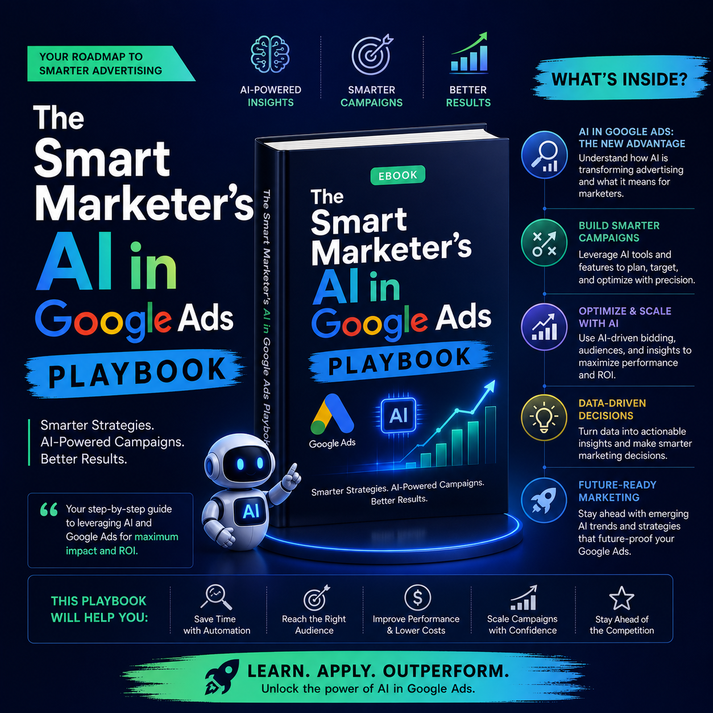
The complete framework behind advanced AI advertising systems is covered inside The Smart Marketer’s AI in Google Ads Playbook.
Discover how smart marketers are using AI-driven optimization, automation systems, audience intelligence, and scalable campaign frameworks to outperform competitors.
Common Mistakes Marketers Make With AI in Google Ads
Despite its power, AI is not a “set it and forget it” solution.
Many advertisers misuse automation and end up blaming AI when the real issue is poor strategy or weak campaign structure.
Common AI Advertising Mistakes
- Launching campaigns without conversion tracking
- Using low-quality creative assets
- Providing insufficient campaign data
- Ignoring audience signals
- Over-automating without strategic oversight
- Expecting instant optimization results
AI performs best when paired with strong strategic foundations, high-quality inputs, and clear performance goals.
How Smart Marketers Are Using AI to Scale Faster
Elite marketers are combining AI automation with strategic human decision-making.
Instead of fighting automation, they are learning how to guide it properly.
Successful AI-driven advertisers typically:
- Build structured campaign architectures
- Feed AI high-quality conversion data
- Create stronger audience segmentation
- Develop scalable creative systems
- Use AI insights to refine broader marketing strategy
This hybrid approach creates a powerful advantage that is increasingly difficult for competitors to replicate.
What You’ll Learn Inside The Full Product
The Smart Marketer’s AI in Google Ads Playbook goes far beyond basic automation tutorials.
Inside the guide, readers learn:
- Advanced AI bidding frameworks
- Performance Max optimization systems
- AI audience targeting strategies
- Conversion-focused campaign structures
- Creative testing frameworks
- AI scaling techniques for ecommerce and lead generation
- Campaign optimization workflows used by high-level marketers
The goal is not just to understand AI in Google Ads — but to use it strategically for long-term growth and profitability.
Stay Ahead Before Your Competition Does
AI-powered advertising is becoming the new standard in digital marketing.
Businesses that adapt early will gain a massive advantage in efficiency, targeting precision, and campaign scalability.
Final Thoughts
The rise of AI in Google Ads is not a temporary trend. It represents a fundamental shift in how digital advertising works.
As automation, machine learning, and predictive optimization continue evolving, marketers who understand these systems will dominate the next generation of online advertising.
The opportunity is enormous for businesses willing to adapt early and build AI-first advertising strategies.
If you want a deeper understanding of the systems, frameworks, and optimization methods modern advertisers are using right now, the complete roadmap is available inside the full guide.
Get Instant Access to The Smart Marketer’s AI in Google Ads Playbook
Frequently Asked Questions
What is AI in Google Ads?
AI in Google Ads refers to machine learning systems that automate bidding, targeting, optimization, audience analysis, and campaign performance improvements using real-time data.
Can beginners use AI in Google Ads effectively?
Yes. Google Ads automation tools are increasingly beginner-friendly, but understanding strategic campaign setup remains essential for strong results.
Does AI replace human marketers in PPC advertising?
No. AI enhances campaign efficiency, but strategic thinking, creative direction, and business positioning still require human expertise.
What are the biggest benefits of AI-driven Google Ads campaigns?
The biggest advantages include improved targeting, lower acquisition costs, smarter bidding, faster optimization, and better scalability.
Are Performance Max campaigns powered by AI?
Yes. Performance Max campaigns heavily rely on AI and machine learning to optimize placements, targeting, bidding, and creative delivery across Google’s ecosystem.
How can businesses learn advanced AI advertising strategies?
Businesses can accelerate results by studying structured frameworks, advanced optimization systems, and proven AI-driven advertising methods from expert-led resources and playbooks.