
Why Your Content Strategy Is Failing Answer Engines — And How to Fix It Today
Search behavior has fundamentally changed.
People are no longer just typing keywords into traditional search engines. They're asking conversational questions inside AI-driven answer engines like ChatGPT, Google’s AI Overviews, Perplexity, Gemini, and voice assistants.
And here’s the uncomfortable truth:
Most content strategies were never designed for this new ecosystem.
Brands that once dominated traditional SEO are suddenly losing visibility because their content cannot be interpreted, summarized, or cited effectively by modern AI systems.
If your traffic is stagnating, your rankings are unstable, or your content is getting ignored by AI-generated answers, your strategy likely needs a complete Answer Engine Optimization overhaul.
Want to future-proof your organic visibility?
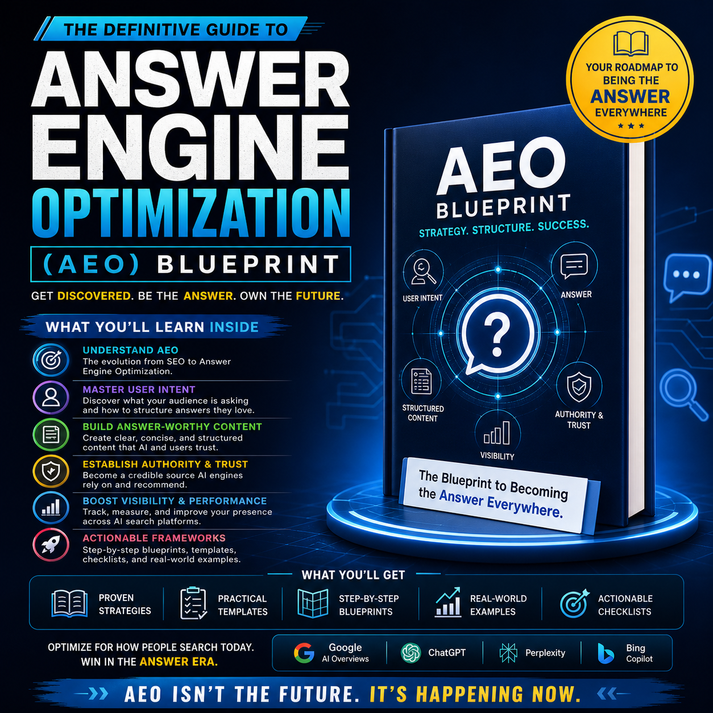
Learn the complete Answer Engine Optimization framework inside the ANSWER ENGINE OPTIMIZATION (AEO) BLUEPRINT.
What Is Answer Engine Optimization (AEO)?
Answer Engine Optimization (AEO) is the process of structuring and optimizing content so AI systems can easily understand, extract, summarize, and recommend your information in generated answers.
Traditional SEO focused heavily on rankings and clicks.
AEO focuses on visibility inside AI-generated responses.
In simple terms:
- SEO helps pages rank.
- AEO helps content become the answer.
This shift is massive because answer engines prioritize:
- Topical authority
- Clear semantic structure
- Question-based formatting
- Entity relationships
- Contextual relevance
- Trustworthiness and expertise
Why Traditional Content Strategies Are Failing
1. Content Is Written for Algorithms — Not Answers
Many brands still create content around outdated SEO tactics like keyword density, shallow blog posts, and repetitive optimization.
AI systems don't reward fluff.
They reward clarity, relevance, and usefulness.
If your article takes 800 words to answer a simple question, answer engines may skip it entirely.
2. Weak Topical Authority
Modern AI search systems analyze topic depth, semantic relationships, and expertise signals.
Publishing isolated articles without building a connected content ecosystem weakens your authority.
That’s why topical mapping has become essential in modern Answer Engine Optimization strategies.
3. Poor Content Structure
Huge paragraphs, vague headings, and unclear formatting make it difficult for answer engines to interpret your content.
Well-structured content dramatically increases extractability and citation potential.
4. Lack of Conversational Optimization
Users now search using natural language queries:
- “How does AEO work?”
- “Why isn’t my content appearing in AI search?”
- “How do I optimize for ChatGPT?”
If your content isn't built around conversational intent, you're invisible in the new search landscape.
How to Fix Your Content Strategy for Answer Engines
Focus on Search Intent First
Instead of chasing isolated keywords, focus on what users actually want to know.
Modern Answer Engine Optimization prioritizes:
- Problem-solving content
- Question-based formatting
- Contextual explanations
- Actionable insights
- Clear information hierarchy
Build Topical Authority Clusters
AI systems trust brands that deeply cover an entire topic.
Instead of creating random articles, build interconnected content clusters around:
- AEO
- AI search optimization
- Entity SEO
- Semantic search
- Conversational content strategies
- AI-driven content architecture
This creates stronger authority signals across your domain.
Want the exact framework used to build AI-search-friendly authority systems?
Access the full ANSWER ENGINE OPTIMIZATION (AEO) BLUEPRINT and learn the complete methodology behind scalable answer engine visibility.
Use Structured, Extractable Formatting
Answer engines prefer content they can easily parse.
That means using:
- Clear H2 and H3 headings
- Short paragraphs
- Bullet points
- Definitions
- Step-by-step formatting
- FAQ sections
- Schema markup
Formatting is no longer just about readability.
It directly impacts AI visibility.
Create Entity-Rich Content
Search engines and AI systems understand entities better than keywords alone.
Your content should naturally connect concepts, tools, brands, and industry terminology in meaningful ways.
This strengthens contextual relevance and improves semantic understanding.
Common AEO Mistakes Brands Make
- Publishing generic AI-written articles with no expertise
- Ignoring conversational queries
- Creating thin content with weak topical depth
- Over-optimizing for keywords instead of intent
- Failing to structure content properly
- Neglecting schema and semantic markup
- Not adapting to AI search behavior changes
What You’ll Learn Inside the Full Product
The ANSWER ENGINE OPTIMIZATION (AEO) BLUEPRINT by Lywire goes far beyond basic SEO tactics.
Inside the framework, you’ll discover:
- How answer engines actually process content
- Advanced AEO content architecture
- AI-search visibility frameworks
- Topical authority systems
- Conversational query optimization
- Semantic SEO implementation
- Content extraction optimization
- AI citation strategies
- Schema and entity optimization techniques
- Future-proof AI search ranking systems
This isn’t just another SEO ebook.
It’s a strategic blueprint for dominating the next generation of search visibility.
Ready to optimize your content for the future of search?
Explore the full ANSWER ENGINE OPTIMIZATION (AEO) BLUEPRINT and start building content that answer engines actually trust and recommend.
Conclusion
The era of traditional SEO-only strategies is fading.
Answer engines are reshaping how users discover information, how AI systems rank authority, and how brands earn visibility online.
Businesses that adapt early will dominate the next generation of organic traffic.
Those that don’t may slowly disappear from AI-driven search experiences altogether.
Answer Engine Optimization is no longer optional.
It’s the future of discoverability.
Master the complete Answer Engine Optimization framework today with the ANSWER ENGINE OPTIMIZATION (AEO) BLUEPRINT.
Frequently Asked Questions
What is Answer Engine Optimization?
Answer Engine Optimization (AEO) is the practice of optimizing content so AI systems and answer engines can easily understand, summarize, and recommend it in generated responses.
How is AEO different from traditional SEO?
Traditional SEO focuses on rankings and clicks, while AEO focuses on becoming the direct answer within AI-generated search experiences and conversational interfaces.
Why are answer engines important for content marketing?
Answer engines are changing how users discover information online. Brands optimized for AI search gain higher visibility, stronger authority, and increased organic reach.
Can small websites benefit from Answer Engine Optimization?
Yes. Smaller brands with highly structured, authoritative, and intent-driven content can compete effectively in answer engine ecosystems.
Does schema markup help with AEO?
Absolutely. Schema markup improves machine readability, helping AI systems better interpret and categorize your content.
How do I start optimizing for AI search engines?
Start by focusing on topical authority, semantic structure, conversational content, and extractable formatting. Comprehensive frameworks like the AEO Blueprint can accelerate the process significantly.