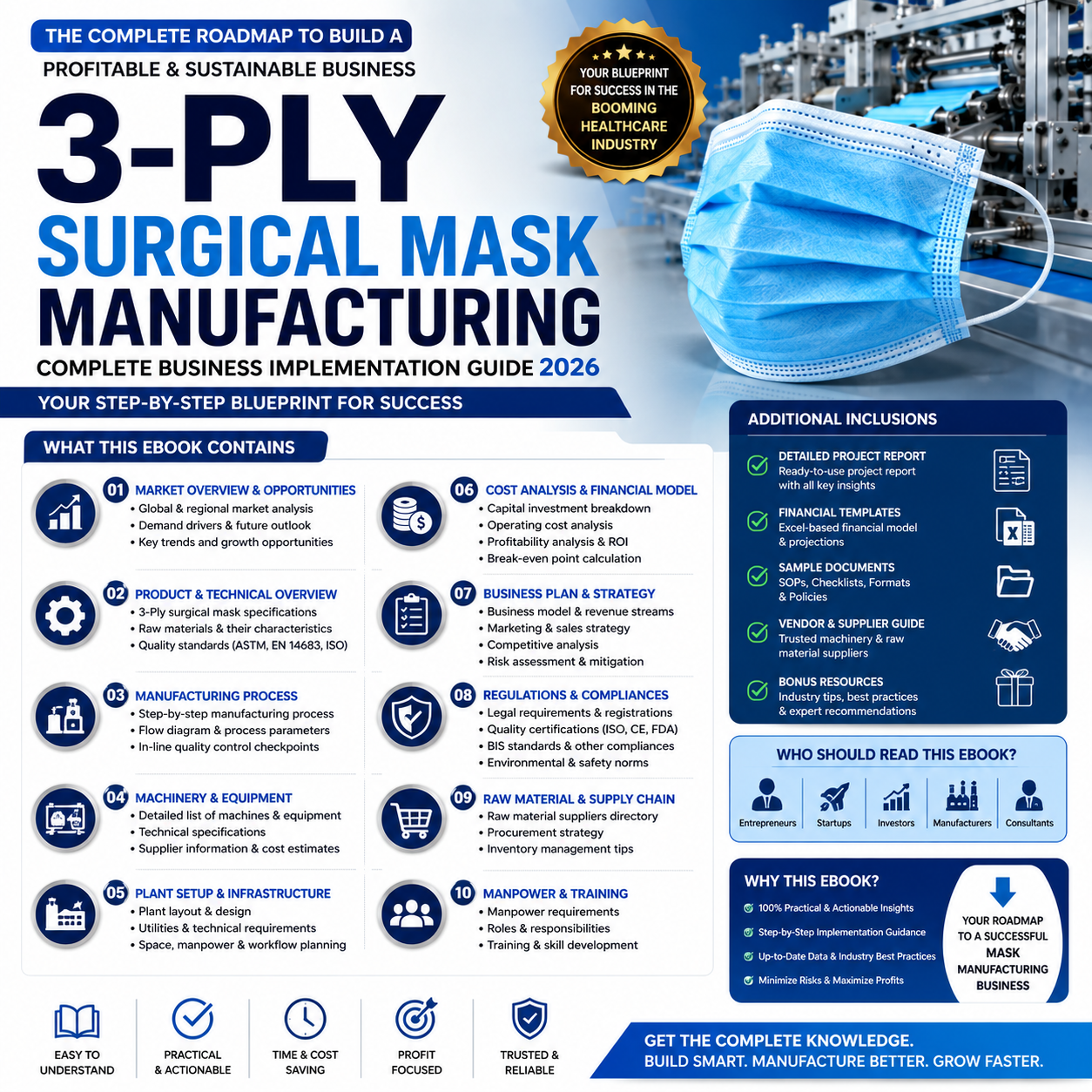


3-PLY Surgical Mask Manufacturing Complete Business Implementation Guide 2026
3-PLY Surgical Mask Manufacturing Complete Business Implementation Guide 2026
Couldn't load pickup availability
A Practical Business Planning and Implementation Guide for Setting Up a 3-Ply Surgical Mask Manufacturing Unit in India
Plan Your 3-Ply Surgical Mask Manufacturing Business
Enter the medical textiles and personal protective equipment (PPE) manufacturing sector with a structured understanding of the machinery, materials, infrastructure, quality requirements and business considerations involved in producing three-layer surgical face masks.
The 3-Ply Surgical Mask Manufacturing – Complete Business Implementation Guide 2026 is a digital business resource for entrepreneurs, manufacturers, investors and businesses evaluating the establishment or expansion of a surgical mask production facility.
From understanding the three-layer mask construction and sourcing non-woven materials to selecting production machinery, planning factory infrastructure, evaluating project costs and understanding applicable product standards, this guide brings essential business and technical considerations together.
What Can You Explore Through This Guide?
- Understand the three-layer surgical mask manufacturing process.
- Evaluate automatic and semi-automatic manufacturing machinery.
- Identify essential raw materials and sourcing considerations.
- Understand factory layout, infrastructure and utility requirements.
- Explore machinery investment, working capital and production costing.
- Understand quality testing and relevant Indian product standards.
- Evaluate regulatory, documentation and labelling considerations.
- Explore institutional sales, distribution and market-entry strategies.
Understanding the 3-Ply Surgical Mask Manufacturing Business
A typical three-layer surgical mask is manufactured using suitable non-woven materials arranged to perform different functions. The production process involves feeding and layering materials, folding, forming, nose-wire insertion, ultrasonic welding, ear-loop attachment, cutting, inspection and packaging.
Manufacturing quality depends on appropriate material selection, machine settings, production consistency and verification against the performance requirements applicable to the intended product.

What Is Covered in This Business Implementation Guide?
Technical Specifications and Product Standards
Understand the construction of a typical three-layer surgical mask, including the outer spunbond layer, middle melt-blown filtration layer and inner comfort layer. Explore bacterial filtration efficiency (BFE), particulate filtration efficiency (PFE), differential pressure, breathability and fluid resistance.
Factory Setup and Infrastructure
Explore production-area planning, factory layout, machinery positioning, utilities, material movement, workflow arrangements and infrastructure considerations for different manufacturing scales.
Machinery and Equipment Procurement
Understand fully automatic and semi-automatic mask manufacturing machines, nose-wire insertion systems, ultrasonic welding equipment, ear-loop attachment systems, counting arrangements and packaging machinery. Learn what to evaluate when comparing machinery suppliers.
Raw Material Sourcing and Supply Chain
Explore spunbond non-woven polypropylene, melt-blown filtration fabric, nose wires, elastic ear loops and packaging materials. Understand procurement planning, supplier evaluation, material specifications and inventory management.
Investment and Project Cost Evaluation
Study capital expenditure (CAPEX), operating expenditure (OPEX), machinery costs, working capital requirements, production costing, operating expenses, break-even analysis and financial planning considerations.
Regulatory Compliance and Quality Testing
Explore relevant Indian and international standards, product testing, laboratory requirements, quality-control procedures, documentation, labelling and certification considerations for the intended market.
Market Research and Sales Strategy
Understand potential B2B sales channels, including hospitals, clinics, pharmacies, medical distributors, institutional buyers and corporate procurement. Explore tender participation, export-market research and direct-to-consumer branding.
Packaging, Labelling and Branding
Explore retail packaging, product information, batch identification, labelling considerations and brand positioning across different market segments and customer categories.
Machinery Required for 3-Ply Surgical Mask Manufacturing
Machinery selection is an important part of planning a surgical mask manufacturing unit. The production configuration depends on the required output, automation level, factory infrastructure, labour arrangements and product specifications.
Typical Production Equipment
- Automatic or semi-automatic mask-making machine: For feeding, folding, forming and assembling the mask body.
- Ultrasonic welding equipment: For joining non-woven fabric layers and attaching components.
- Nose-wire insertion system: For inserting and positioning the nose strip.
- Ear-loop welding equipment: For attaching elastic ear loops to the mask body.
- Cutting and counting arrangements: For product finishing and quantity control.
- Packaging machinery: For preparing masks for storage, distribution and sale.
Before purchasing machinery, entrepreneurs should compare production capacity, compatibility with the selected raw materials, automation features, power requirements, installation arrangements, after-sales support and availability of replacement parts.
Raw Materials Required for Surgical Mask Production
Raw material quality has a direct bearing on production consistency and finished-product performance. Typical materials used in a three-layer surgical mask include:
Outer Spunbond Fabric
The external non-woven polypropylene layer, selected according to the intended product design and performance requirements.
Middle Melt-Blown Fabric
The filtration layer that plays an important role in the mask's bacterial and particulate filtration performance.
Inner Spunbond Fabric
The layer positioned towards the wearer's face, selected with consideration for comfort and product construction.
Nose Wires and Ear Loops
Components used for nose fitting and securing the mask around the ears.
Packaging Materials
Suitable packaging inputs for product protection, identification, labelling and distribution.
Procurement and Inventory
Supplier assessment, incoming material inspection, procurement schedules and stock management considerations.
Investment Planning and Financial Evaluation
The financial feasibility of a surgical mask manufacturing project depends on production capacity, machinery selection, factory location, raw material consumption, operating arrangements and the market segment being targeted.
This guide explores important financial planning areas to consider before committing capital to the proposed manufacturing facility.
1. Capital Expenditure (CAPEX)
Evaluate machinery procurement, installation, factory infrastructure, electrical arrangements and other initial setup requirements.
2. Operating Expenditure (OPEX)
Consider recurring expenses such as raw materials, employee costs, electricity, maintenance, packaging, transportation and administrative overheads.
3. Working Capital
Assess the funds required for inventory, operational expenses, receivables and day-to-day business requirements.
4. Production Costing
Understand the factors influencing per-unit manufacturing costs, material consumption, production efficiency and capacity utilisation.
5. Break-Even and Financial Analysis
Explore break-even considerations, operating assumptions and financial evaluation methods for assessing the proposed business.
Why Financial Planning Matters
A manufacturing business should be evaluated on more than the purchase price of its machinery. Factory expenses, working capital, material wastage, testing requirements, production efficiency and the ability to secure repeat orders all influence its commercial feasibility.
The guide provides a structured starting point for examining these considerations before finalising a project investment.
Regulatory Compliance and Surgical Mask Quality Standards
Manufacturing medical-use surgical masks requires careful consideration of product specifications, testing, documentation and the regulatory framework applicable to the intended product and market.
Indian Standard: IS 16289:2014
IS 16289:2014 is the Indian Standard titled Medical Textiles – Surgical Face Masks – Specification, published by the Bureau of Indian Standards (BIS).
It provides a relevant technical reference for evaluating surgical face mask construction and performance requirements. The BIS standards portal currently lists certification against this standard as voluntary. Manufacturers must separately verify all applicable regulatory and product-certification obligations.
Important Product Performance Parameters
- Bacterial Filtration Efficiency (BFE): Evaluates the bacterial filtration performance of the mask.
- Particulate Filtration Efficiency (PFE): Relates to filtration of specified particulate matter under the applicable test method.
- Differential Pressure: Evaluates airflow resistance associated with breathability.
- Splash Resistance: Evaluates resistance to penetration by specified liquid exposure.
- Materials and Construction: Covers the material composition and construction characteristics of the product.
- Quality Documentation: Includes relevant testing records, batch traceability and product specifications.
International Standards and Market Requirements
Entrepreneurs considering international markets should also understand the applicable destination-country requirements.
- ASTM F2100: A US standard addressing performance requirements for medical face mask materials.
- European Union: Applicable medical-device legislation, conformity assessment and CE marking obligations must be evaluated for the intended product.
- WHO technical references: Can provide additional technical context for medical mask specifications and procurement requirements.
- Indian regulatory framework: The Medical Devices Rules, 2017 and relevant notifications should be reviewed for the product's classification and manufacturing obligations.
Factory Setup and Manufacturing Infrastructure
A well-planned manufacturing facility helps organise production activities, material movement, machinery operations, quality inspection and finished-product handling.
Important planning considerations include:
- Production area and machinery installation requirements.
- Raw material storage and inventory arrangements.
- Electrical connections and utility requirements.
- Material movement and production workflow.
- Quality inspection and testing arrangements.
- Finished goods storage and packaging areas.
- Worker safety, hygiene and applicable facility requirements.
Market Entry and Sales Opportunities
A surgical mask manufacturing business must evaluate its target customers, competitive positioning, product quality and ability to meet procurement specifications.
Hospitals and Healthcare Institutions
Potential institutional customers requiring suitable medical consumables, subject to their procurement and product specifications.
Medical Distributors
Wholesale and distribution networks serving hospitals, clinics, pharmacies and other healthcare establishments.
Pharmacies and Retailers
Retail distribution opportunities through pharmacies, medical stores and relevant product channels.
Institutional Procurement
Research tender opportunities and institutional procurement requirements, including applicable quality and documentation conditions.
Corporate Buyers
Evaluate potential supply arrangements with organisations requiring suitable protective and medical consumables.
Export Markets
Research destination-country standards, conformity requirements, documentation, labelling and potential distribution partners.
Who Should Purchase This Guide?

- Aspiring Entrepreneurs: Individuals researching the feasibility of establishing a surgical mask manufacturing unit.
- Existing Manufacturers: Textile, non-woven fabric and related manufacturing businesses considering product diversification.
- MSME Business Owners: Entrepreneurs evaluating opportunities in medical textiles and PPE manufacturing.
- Investors: Individuals examining machinery requirements, investment considerations and commercial feasibility.
- Import and Export Businesses: Businesses researching medical consumables and international supply chains.
- Business Consultants: Professionals seeking a structured reference for understanding surgical mask manufacturing operations.
Why Choose This Business Implementation Guide?
Business-Oriented Coverage
Brings manufacturing, financial planning, sourcing, compliance and market considerations into one structured resource.
Technical and Commercial Understanding
Covers both production-related considerations and the business factors involved in evaluating a manufacturing unit.
Implementation-Focused Approach
Helps entrepreneurs organise their research before selecting machinery, committing investment or establishing a facility.
Convenient Digital Access
Receive the guide in PDF format and refer to its contents digitally during business research and planning.
Product Information and Digital Deliverables
Frequently Asked Questions
1. What is a 3-ply surgical mask manufacturing business?
It is a manufacturing activity involving the production of disposable three-layer surgical face masks using suitable non-woven materials, filtration media, nose wires and elastic ear loops. The process typically includes material feeding, forming, ultrasonic welding, component attachment, cutting, inspection and packaging.
2. What raw materials are required to manufacture 3-ply surgical masks?
Typical materials include outer and inner spunbond non-woven polypropylene fabric, middle melt-blown filtration material, nose wires, elastic ear loops and suitable packaging materials. Specifications should be selected according to the intended product and applicable performance requirements.
3. What machinery is required for surgical mask manufacturing?
A typical production setup may include an automatic or semi-automatic mask-making machine, ultrasonic welding equipment, a nose-wire insertion system, ear-loop welding equipment, cutting and counting arrangements and packaging machinery. The exact configuration depends on the production capacity and automation level.
4. What investment is required to start a surgical mask manufacturing unit?
Investment depends on machinery configuration, production capacity, factory location, infrastructure, working capital, raw material requirements and compliance arrangements. This guide covers CAPEX, OPEX, machinery costs, working capital and financial evaluation considerations. Obtain current machinery quotations and location-specific cost estimates before finalising a project budget.
5. Which Indian standard is relevant to 3-ply surgical face masks?
IS 16289:2014 is the Indian Standard titled Medical Textiles – Surgical Face Masks – Specification. It provides a relevant technical reference for surgical mask performance and construction. Manufacturers should consult the current BIS standard and verify all applicable regulatory and certification requirements.
6. Is BIS certification compulsory for every surgical mask manufacturer in India?
BIS currently lists certification against IS 16289:2014 as voluntary on its standards portal. However, other applicable medical-device regulatory requirements, product classification, buyer specifications and government procurement conditions must be assessed independently. Manufacturers should confirm the applicable requirements before commercial production.
7. What quality tests are relevant to surgical mask manufacturing?
Depending on the applicable product standard and intended claims, relevant performance assessments may include bacterial filtration efficiency, particulate filtration efficiency, differential pressure, splash resistance and material and construction checks. Testing should follow the applicable standard and recognised test methods.
8. Does the guide cover licences, registrations and regulatory requirements?
The guide covers relevant regulatory frameworks, product standards, testing, documentation, quality-control and certification considerations. The precise licences and registrations required depend on the product classification, manufacturing setup, location and applicable regulations. Verify current requirements with the relevant authorities before starting operations.
9. Can surgical masks manufactured in India be exported?
Export opportunities depend on destination-country regulations, product performance, conformity assessment, labelling, documentation, customs requirements and buyer specifications. Manufacturers should research the regulatory requirements of each target market before entering export contracts.
10. Does this guide provide a guaranteed bank loan or government subsidy?
No. Purchasing a business guide does not guarantee a bank loan, subsidy, grant or government approval. Financing decisions are subject to lender assessment, project viability, applicant eligibility and the applicable scheme guidelines. Any government support must be independently verified.
11. Is this a physical book or a digital PDF eBook?
This is a digital eBook supplied in PDF format. No printed book or physical product will be shipped.
12. How will I receive the guide after purchasing?
The digital download link will be shared after the purchase has been completed. You can access the PDF digitally using a compatible device.
This guide is an educational and business-planning reference. It should not be treated as a guarantee of business success, profitability, loan approval, subsidy eligibility, regulatory approval or product certification.
Actual machinery prices, raw material costs, project investment, production expenses and operating results vary according to location, supplier quotations, production scale, market conditions and operating assumptions. Financial estimates should be independently evaluated before investment.
Regulations, standards and certification requirements may change. Verify current requirements with BIS, CDSCO, relevant state authorities and other applicable organisations before commencing manufacturing or selling medical-use products.
Digital Product Notice: This is an eBook that will be provided digitally. The download link will be shared after the purchase is completed. No physical book or printed document will be provided.
Ready to Explore Surgical Mask Manufacturing?
Understand the production process, machinery requirements, raw material sourcing, factory planning, financial considerations and regulatory framework involved in establishing a 3-ply surgical mask manufacturing unit.
Get the 3-Ply Surgical Mask Manufacturing Business Implementation Guide and organise your business research with a structured approach.
Digital eBook | PDF Format | Business and Technical Reference
What's included in the box
What's included in the box