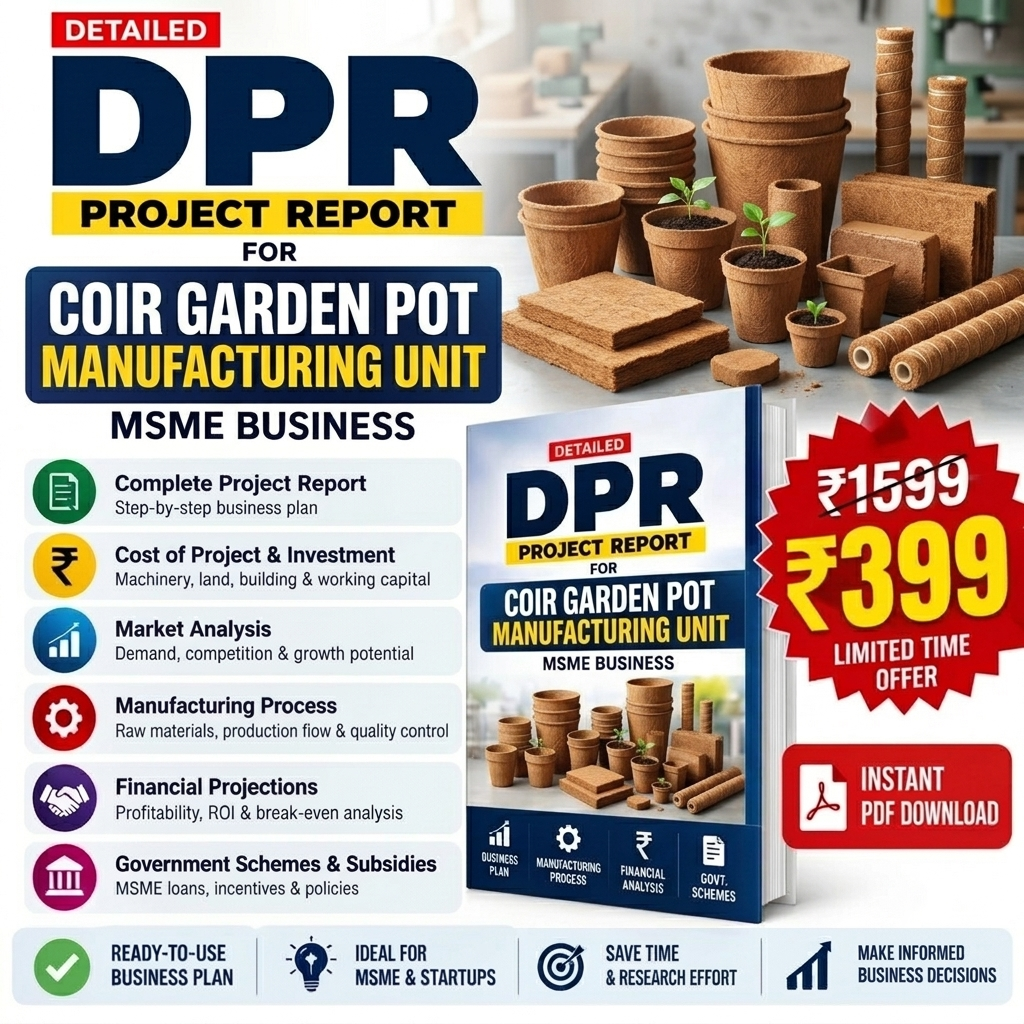

COIR GARDEN POT MANUFACTURING UNIT DETAILED PROJECT REPORT(DPR)
COIR GARDEN POT MANUFACTURING UNIT DETAILED PROJECT REPORT(DPR)
⭐️⭐️⭐️⭐️⭐️ 4.9/5 1445 Reviews
People's Choice
500+ bought in past month
Couldn't load pickup availability
COIR GARDEN POT MANUFACTURING UNIT - DETAILED PROJECT REPORT (DPR)
A practical project-report blueprint for setting up a coir garden pot manufacturing unit using coconut coir fibre and natural rubber latex, covering the project concept, manufacturing process, machinery, financial structure, operations, marketing and funding considerations.
Turn Nature Into a Thriving Business
Coir garden pots are plant containers made from coconut coir fibre and binding material, designed for nursery, horticulture and gardening applications. Government project material for coir garden pots describes a manufacturing process involving fibre procurement, moisture removal, latex mixing, pressing, trimming and packaging.
This Detailed Project Report is designed to help an entrepreneur understand the proposed unit before making investment, financing, machinery or operational decisions.
Why Coir Garden Pots?
Coconut coir fibre is obtained from coconut husk and is used in a wide range of horticultural applications. Coir pots are valued for their porous fibre structure, plantability and biodegradable characteristics, making them an alternative to conventional nursery containers in suitable applications.
Natural Fibre Base
Uses coconut coir fibre as the principal raw material for forming the pot.
Plant-Friendly Design
The porous structure can support air and water movement around developing roots.
Direct Transplanting
Coir pots can be planted with seedlings into soil, reducing the need to remove the container during transplantation.
Biodegradable Material
Coir-based pots are designed as biodegradable alternatives to conventional plastic nursery containers.
Horticultural Applications
Suitable applications include seed starting, nursery plants, gardening and transplanting.
Value-Added Coir Product
The project converts processed coconut fibre into a higher-value horticultural product.
What's Inside This Detailed Project Report?
- Project Concept & Business Model
- Product Description & Raw Material Details
- Market Analysis & Marketing Strategy
- Manufacturing Process & Plant Layout
- Plant & Machinery Requirements
- Financial Projections & Profitability Analysis
- Loan & Funding Guidance
- Management & Operational Framework
Project Financials at a Glance
| Parameter | Project Figure |
|---|---|
| Total Project Cost | ₹19.34 Lakhs |
| Plant & Machinery | ₹14.04 Lakhs |
| Land & Building | Owned / Leased |
| Other Miscellaneous Assets | ₹1.50 Lakhs |
| Working Capital Requirement | ₹3.80 Lakhs |
| Own Contribution | ₹1.93 Lakhs |
| Term Loan | ₹13.99 Lakhs |
| Working Capital Loan | ₹3.42 Lakhs |
| Break-Even Point | 39% |
| Power Requirement | 20 KW |
| Employment Generated | 10 Persons |
| DSCR | 2.76 |
The financial figures above represent the project assumptions contained in this DPR and should be reviewed against current machinery quotations, raw-material prices, labour costs, financing terms, location-specific expenses and applicable taxes before investment or loan submission.
About the Product
Coir garden pots are formed from coconut coir fibre and a binding material such as natural rubber latex. Government project documentation for coir garden pots identifies coconut fibre and latex as key materials and describes pressing the fibre mixture into the required pot shape.
Natural & Biodegradable
Coir-based containers are designed to provide a biodegradable alternative for suitable nursery and gardening applications.
Water & Air Movement
The fibre structure provides permeability that can support root-zone aeration and moisture management.
Root-Friendly
The porous nature of coir pots can support root development and reduce disturbance during transplantation.
Directly Plantable
Depending on the product specification and application, the pot can be transplanted together with the plant.
Horticultural Use
Potential applications include seedlings, nurseries, flowers, vegetables, indoor gardening and outdoor gardening.
Raw Materials
Primary materials: Coir Fibre + Natural Rubber Latex.
Manufacturing Process
The manufacturing process covered in the project profile follows a straightforward sequence from fibre preparation to finished-pot packaging.
Plant & Machinery Overview
Machinery requirements depend on the selected capacity, product dimensions, process configuration and level of automation. The project structure includes equipment for fibre drying, mixing, pressing and finishing.
| Equipment | Indicative Project Requirement |
|---|---|
| Coconut Fibre Dryer Machine | 1 Unit |
| Mixing Chamber | 1 Unit |
| Press Machine | 1 Unit |
| Surface Finishing / Trimming Equipment | As required |
Actual machinery specifications, capacity and quotations should be confirmed from suppliers before finalising the investment or bank-finance proposal.
Who Is This DPR For?
Customisation Available
Need a different capacity or investment structure? The project can be customised according to your required production capacity, project cost and business requirements.
A project report can also be prepared for other manufacturing, processing, trading or service-sector subjects as per the required project specifications.
Why Use a Structured DPR?
Project Clarity
Understand the proposed business model, production process, resources and operating structure in one document.
Financial Planning
Review project cost, means of finance, working capital and financial assumptions before committing capital.
Loan Documentation
Use the structured project information as a starting point when preparing financing documentation.
Operational Planning
Map machinery, raw materials, manpower, production and packaging requirements.
Market Preparation
Plan customer segments, distribution channels and positioning for coir-based horticultural products.
Decision Support
Evaluate the project assumptions and identify the information that should be validated before investment.
Start Your Green Manufacturing Journey
A coir garden pot unit combines coconut-fibre processing with horticultural product manufacturing. This DPR brings the major project components together so that entrepreneurs can study the opportunity, understand the operating requirements and work towards a customised business plan.
Get the Detailed Project Report and take the next step towards evaluating your coir garden pot manufacturing project.
Frequently Asked Questions
What is a coir garden pot?
A coir garden pot is a plant container made primarily from coconut coir fibre and a binding material such as natural rubber latex. It is used for nursery, gardening and horticultural applications.
What raw materials are used to manufacture coir garden pots?
The project uses coconut coir fibre as the principal raw material along with natural rubber latex as the binding material.
What is the manufacturing process for coir garden pots?
The process generally includes coir fibre procurement, moisture removal or drying, mixing with latex, pressing into the required mould, trimming unwanted fibres and packaging the finished pots.
What machinery is required for a coir garden pot manufacturing unit?
The project structure includes equipment such as a coconut fibre dryer, mixing chamber, press machine and finishing or trimming equipment. Exact specifications depend on production capacity and product design.
Are coir garden pots biodegradable?
Coir-based pots are designed as biodegradable planting containers. The rate and conditions of decomposition can vary according to fibre composition, binder, pot construction and soil environment.
Can coir garden pots be planted directly into the soil?
Yes. Coir pots are commonly designed for direct transplantation, allowing the plant and pot to be placed together into soil. Suitability depends on the specific pot construction and crop application.
What is the project cost mentioned in this DPR?
The project financial structure presented in this DPR indicates a total project cost of ₹19.34 lakhs, including ₹14.04 lakhs for plant and machinery and ₹3.80 lakhs for working capital requirements.
Can the project cost and capacity be customised?
Yes. The project can be customised according to the required production capacity, machinery configuration, location, project cost and other business requirements.
Is this DPR suitable for a bank loan application?
The DPR is structured to support project planning and financing documentation. However, final bank acceptance depends on the lender, applicant profile, location, current quotations, financial assumptions and the bank's documentation requirements.
What's included in the box
What's included in the box
📘 Ebook & Printed Book Information
Ebook: Available for instant download after purchase.
Printed Copy: Add a printed copy of the book for just ₹2,999 extra.
If you do not receive your ebook after completing your purchase, please email us at hello@lywire.com with the following details:
- Order Number
- Email Address
- WhatsApp Phone Number
Our team will verify your order and send the ebook to you as soon as possible.