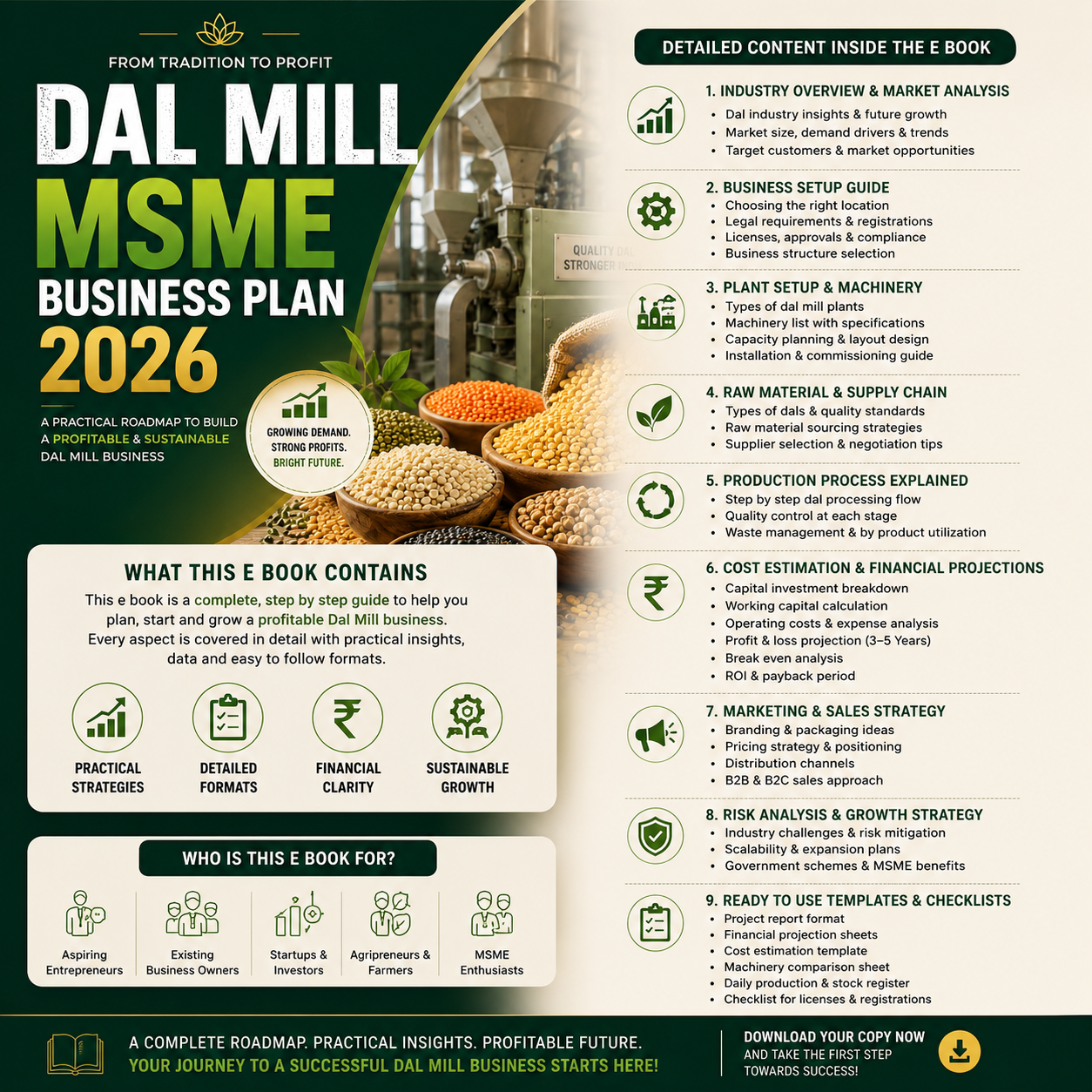


DAL MILL MSME BUSINESS PLAN 2026
DAL MILL MSME BUSINESS PLAN 2026
⭐️⭐️⭐️⭐️⭐️ 4.9/5 1445 Reviews
500+ bought in past month
Couldn't load pickup availability
Planning to start a Dal Mill business in India?
The Dal Mill Business Plan 2026 by LyWire is a digital business planning resource for entrepreneurs, investors and MSME aspirants exploring opportunities in pulse processing and dal manufacturing.
It brings together important business planning areas, including market analysis, plant and machinery, project costs, financial projections, raw material sourcing, manpower, sales strategy and regulatory requirements.
Whether you are evaluating a new dal processing unit, planning an expansion or preparing a business proposal, this resource provides a structured starting point for understanding the business.
What makes this business plan useful?
- Understand the commercial and operational aspects of a Dal Mill business.
- Explore plant and machinery requirements for small and medium-scale operations.
- Understand project investment, operating expenses and financial planning.
- Study raw material sourcing and pulse processing operations.
- Explore sales, distribution and packaged dal marketing strategies.
- Identify important registrations and compliance requirements.
- Use a structured business planning resource before committing capital.
Understanding the Dal Mill Business Opportunity in India
A Dal Mill is a food-processing unit that converts whole pulses into cleaned, processed and market-ready dal. Common raw materials include pigeon pea (toor), chickpeas (chana), green gram (moong), black gram (urad) and lentils (masoor), depending on the machinery configuration and business model.
Processed pulses are consumed across Indian households, retail markets, wholesale distribution networks, institutional buyers and food-service businesses.
Entrepreneurs entering this sector need to consider more than machinery installation. Raw material quality, processing recovery, production efficiency, working capital, packaging and distribution all influence the commercial performance of a dal mill.
A properly structured business plan helps bring these considerations together before making major investment decisions.
What Is Covered in the Dal Mill Business Plan?

The resource covers the principal areas involved in evaluating and planning a Dal Mill MSME project.
01. Market Analysis
Understand the Indian pulse-processing industry, market demand, business opportunities and growth considerations relevant to a dal milling venture.
02. Plant & Machinery
Explore machinery requirements, equipment selection, plant layout considerations and procurement planning for a dal processing unit.
03. Financial Planning
Review project cost considerations, revenue assumptions, break-even analysis and projected profit and loss planning for MSME operations.
04. Bank Loan & Funding
Understand the role of project documentation in financing discussions and the relevance of schemes such as PMEGP and MUDRA, subject to eligibility.
05. Raw Material & Supply Chain
Understand sourcing considerations for chana, masoor, moong, toor and urad pulses and the importance of reliable procurement.
06. Manpower & Operations
Review staffing requirements, operational responsibilities, workforce planning and the activities involved in managing a processing unit.
07. Sales & Marketing
Explore retail, wholesale, B2B distribution, product branding, packaging and e-commerce opportunities.
08. Legal & Compliance
Identify important business registration and regulatory considerations, including FSSAI, Udyam, pollution-related approvals and trade licensing.
Dal Mill Manufacturing Process: Key Operational Stages
Understanding the production workflow is important when evaluating a pulse-processing business. The machinery configuration and exact processing sequence can vary according to the pulse variety, product quality requirements and plant capacity.
A typical dal processing operation may involve the following stages:
- Raw material procurement: Sourcing suitable whole pulses from agricultural markets, traders or other suppliers.
- Cleaning and destoning: Removing dust, stones and unwanted foreign material.
- Grading: Separating raw pulses according to size and quality.
- Conditioning: Applying suitable conditioning methods according to the pulse and processing requirements.
- Dehusking and splitting: Separating the outer husk and splitting the pulse into dal.
- Polishing: Carrying out polishing where required by the product specification.
- Final grading: Separating finished dal and handling broken material.
- Weighing and packaging: Preparing finished products for storage and distribution.
Plant, Machinery & Infrastructure Requirements
Machinery selection is one of the most important decisions when establishing a dal mill. The equipment required depends on the production capacity, varieties of pulses processed, automation level and desired finished-product quality.
A typical dal processing line may require the following categories of equipment:
- Pulse cleaning and grading machines.
- Destoning and separation equipment.
- Dehusking and splitting machinery.
- Dal polishing equipment, where applicable.
- Sieving and grading systems.
- Material handling and conveying arrangements.
- Weighing and packaging machinery.
Infrastructure considerations
Before establishing the unit, entrepreneurs should evaluate:
- Suitable industrial premises and factory space.
- Raw material receiving and storage areas.
- Machinery installation and production layout.
- Electrical load and power requirements.
- Finished product storage and packaging arrangements.
- Material movement and internal logistics.
- Safety, sanitation and maintenance requirements.
Machinery quotations and infrastructure estimates should be obtained from relevant suppliers and service providers before finalising the project investment.
Dal Mill Project Cost & Financial Planning
The investment required for a Dal Mill manufacturing unit depends on production capacity, machinery selection, premises, infrastructure, automation, raw material inventory and working capital requirements.
Rather than relying on a single generic investment figure, entrepreneurs should prepare a project-specific cost assessment.
Major project cost components
- Land and building: Premises, factory space, storage and related infrastructure.
- Plant and machinery: Processing equipment, installation and associated systems.
- Electrical infrastructure: Power connections, electrical installation and related requirements.
- Pre-operative expenses: Applicable setup, professional and establishment costs.
- Raw material inventory: Initial pulse procurement and stock requirements.
- Working capital: Wages, electricity, packaging, logistics and operating expenses.
- Marketing and distribution: Branding, packaging, sales development and distribution arrangements.
Financial planning and profitability considerations
Financial evaluation should consider:
- Production capacity and capacity utilisation.
- Raw pulse purchase prices.
- Processing recovery and wastage.
- Finished dal selling prices.
- Electricity and manpower expenses.
- Packaging, transportation and distribution costs.
- Working capital cycle and operating margins.
- Break-even requirements and projected cash flows.
The business plan includes financial projections, cost estimates, revenue forecasts, break-even analysis and projected profit and loss planning as described in the existing product specification.
Bank Loan, DPR & Government Scheme Considerations
Entrepreneurs establishing a Dal Mill may explore suitable MSME financing options depending on the project structure, investment requirement and eligibility.
A structured business plan or Detailed Project Report (DPR) can help organise important project information for discussions with banks and financial institutions.
Funding and scheme areas to understand
- PMEGP: Prime Minister's Employment Generation Programme, subject to current scheme guidelines and eligibility.
- MUDRA: Financing options under the Pradhan Mantri MUDRA Yojana, subject to lender assessment.
- State MSME schemes: Potential state-level incentives and assistance, depending on the location and applicable policies.
- Bank financing: Term loans and working capital facilities, subject to the financial institution's requirements.
Licences, Registrations & Regulatory Requirements
A food-processing business must evaluate the applicable business registrations, food safety requirements, factory-related obligations and local regulatory permissions before commencing operations.
Important areas to investigate include:
- Udyam Registration: MSME registration, where applicable.
- FSSAI Registration or Licence: Applicable food business registration or licensing requirements.
- Pollution-related permissions: Applicable State Pollution Control Board requirements and consents.
- Trade Licence: Local municipal or other applicable business permissions.
- Factory-related compliance: Applicable factory registration, safety and labour requirements.
- GST: Registration and tax compliance, where applicable.
- Other permissions: Additional local and industry-specific requirements depending on the project.
The exact approvals depend on the state, location, installed capacity, business structure and prevailing regulations. Verify the requirements with the relevant authorities before commencing operations.
Sales, Marketing & Distribution Strategy
Manufacturing quality alone does not guarantee commercial success. A Dal Mill business also requires a practical strategy for selling processed dal and developing reliable distribution channels.
Potential business channels include:
- Wholesale pulse and grain markets.
- Retail grocery stores and supermarkets.
- Distributors and regional dealers.
- Hotels, restaurants and institutional buyers.
- Branded packaged dal products.
- Online and e-commerce distribution channels.
Product quality, packaging, pricing, customer relationships and consistent supply are important considerations when developing a sustainable sales model.
Who Should Buy This Dal Mill Business Plan?

First-time Entrepreneurs
Individuals evaluating a new food-processing or dal manufacturing venture.
Existing MSME Owners
Business owners exploring expansion or diversification into pulse processing.
Investors
Individuals assessing the commercial and operational aspects of a Dal Mill project.
Consultants & Professionals
Consultants, CA professionals and business advisers working on project planning and documentation.
Agriculture Graduates & Students
Individuals studying food processing, agri-business and manufacturing opportunities.
Existing Food Businesses
Food-processing operators exploring additional pulse processing activities.
Why Choose the LyWire Dal Mill Business Plan?
- Structured business planning: Important business establishment and operational topics organised in one resource.
- Industry-specific information: Focused on Dal Mill and pulse-processing operations.
- Financial planning support: Includes project cost considerations and financial projections.
- Machinery guidance: Covers equipment requirements and plant setup considerations.
- Compliance awareness: Identifies important registrations and regulatory areas.
- Digital convenience: Access the purchased resource digitally without waiting for physical shipment.
What Will You Receive After Purchasing?
Dal Mill MSME Business Plan 2026
You will receive the digital business plan described on this product page.
- Digital Dal Mill business planning document.
- Market analysis and industry information.
- Plant and machinery setup guidance.
- Financial projections and project cost planning.
- Raw material and supply chain information.
- Manpower and operational planning.
- Sales and marketing strategy.
- Legal and compliance checklist.
Document format: The existing product specification describes an editable Word/PDF resource. Please check the actual delivered files for the available formats.
Digital Delivery & Download Information
This is a digital product. No physical book, printed report or machinery will be shipped to your address.
- Select the product and complete your purchase through the LyWire website.
- After successful order completion, the digital download link is shared through the stated delivery process.
- Check your registered email inbox for the delivery message.
- Download the supplied files and review the business plan.
If you experience any difficulty receiving or accessing your purchased resource, contact LyWire customer support at hello@lywire.com.
Frequently Asked Questions
1. What is included in the Dal Mill Business Plan 2026?
The resource covers market analysis, plant and machinery requirements, financial projections, project cost considerations, raw material sourcing, manpower, operations, sales and marketing, and important legal and compliance requirements.
2. Is this Dal Mill business plan suitable for beginners?
Yes. It is intended for first-time entrepreneurs as well as existing business owners evaluating a Dal Mill project. Beginners should also consult relevant machinery suppliers, professionals and authorities before making investment decisions.
3. Does the business plan cover Dal Mill machinery and plant setup?
Yes. The existing product specification covers plant and machinery requirements, equipment selection, layout planning and procurement considerations for small to medium-scale dal milling operations.
4. Does it include Dal Mill project cost and financial projections?
Yes. The product description includes cost estimates, revenue forecasts, break-even analysis and projected profit and loss planning. Actual project investment and profitability will depend on machinery, capacity, location, raw material prices and operating conditions.
5. Does this resource explain how to start a Dal Mill business in India?
It provides a structured business planning framework covering important areas such as machinery, infrastructure, raw material sourcing, manpower, operations, financial planning, marketing and compliance. Actual implementation requires project-specific decisions and verification.
6. Does the Dal Mill plan help with bank loans and government schemes?
The product covers bank loan and subsidy-related planning, including references to PMEGP, MUDRA and state MSME schemes. It can help organise project information, but it does not guarantee loan approval, subsidy eligibility or government assistance.
7. Does it cover licences and registrations for a Dal Mill?
Yes. The existing product specification identifies FSSAI, Udyam registration, pollution-related permissions, trade licensing and other relevant compliance areas. The exact requirements must be checked with the appropriate authorities for your location and project.
8. Will I receive a physical book or printed project report?
No. This is an electronic product. The digital resource is delivered online after successful purchase. No physical book or printed report is shipped.
9. How will I receive my Dal Mill Business Plan after payment?
The download link is shared digitally after the order is completed, through the stated delivery process and registered email address. If you cannot locate your download, contact LyWire support at hello@lywire.com.
10. Does purchasing this business plan guarantee business profitability or loan approval?
No. A business plan is a planning resource, not a guarantee of business success, profits, loan approval or subsidy. Actual outcomes depend on investment decisions, operational efficiency, market conditions, financial management and applicable eligibility requirements.
Important Disclaimer
Business planning: This digital business plan is intended for informational and planning purposes. It does not replace independent professional, financial, technical or legal advice.
Financial projections: Financial estimates, revenue forecasts, profitability calculations and break-even projections depend on assumptions. Actual results may differ due to changes in machinery costs, raw material prices, production capacity, labour, electricity, demand and operating conditions.
Project investment: Actual project costs vary by location, machinery configuration, infrastructure, capacity and working capital requirements. Obtain updated quotations before investment.
Loans and subsidies: Loan approvals are entirely subject to the assessment and discretion of financial institutions. Government schemes, grants and subsidies have independent eligibility conditions and are not guaranteed.
Regulatory compliance: Laws, registrations, licensing requirements and government scheme guidelines may change. Verify current requirements with the relevant government departments and qualified professionals.
Digital product: This is an electronically delivered resource. No physical book, printed report or machinery is included in the purchase.
Start Planning Your Dal Mill Business with Greater Clarity
Setting up a Dal Mill requires thoughtful planning across machinery, raw materials, infrastructure, financial requirements, operations and marketing.
The LyWire Dal Mill Business Plan 2026 brings these important planning areas together in one digital resource to help you evaluate the opportunity and prepare for your next steps.
Explore the business plan and take a more structured approach to planning your Dal Mill venture.
What's included in the box
What's included in the box