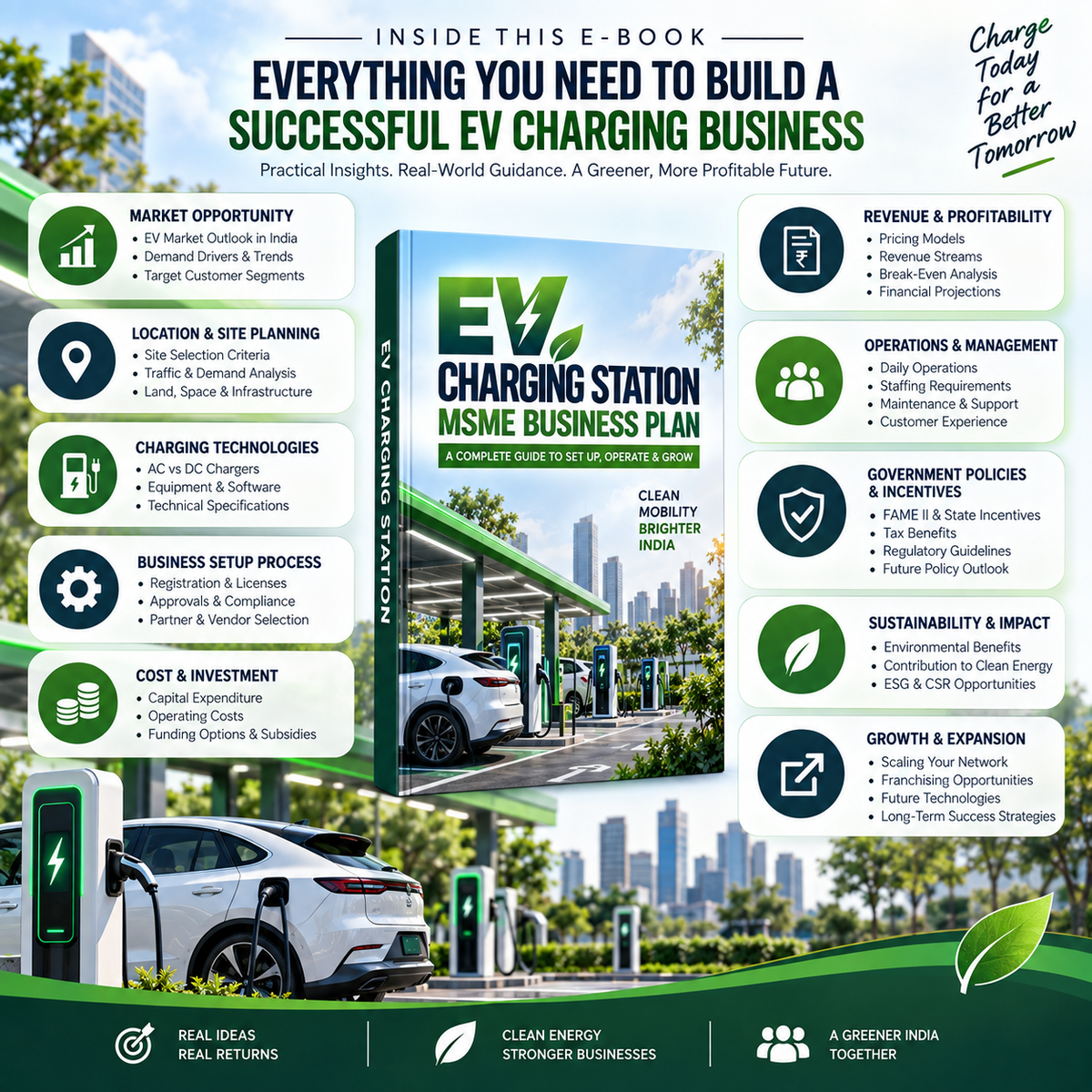


EV Charging Station MSME Business Plan
EV Charging Station MSME Business Plan
Absolute Data Backed Clarity for EV Charging Business
Save months of reseach with this one ebook
⭐️⭐️⭐️⭐️⭐️ 4.9/5 1445 Reviews
Couldn't load pickup availability
EV Charging Station MSME Business Plan
The EV revolution is transforming India's mobility landscape, creating new opportunities in charging infrastructure. This comprehensive business guide is designed to help first-time entrepreneurs understand, plan, launch, operate, market, finance, and scale an EV charging station business in India.
What Is This?
The EV Charging Station MSME Business Plan is a complete, step-by-step operating manual created for Indian first-time founders who want to explore and build an EV charging station business as a registered MSME.
Whether you own land or plan to rent it, whether you are working with a smaller starting budget or a larger investment capacity, and whether you operate in a metropolitan city or a Tier 3 town, the guide provides practical frameworks for planning your business around your specific situation.
From market research and registrations to operations, customer acquisition, financial planning, risk management, and scaling, the guide brings the major business decisions together in one structured resource.
Built for Execution
The focus is on practical implementation rather than abstract business theory.
- Step-by-step planning frameworks
- Business setup guidance
- Compliance and registration checklists
- Operational SOP concepts
- Marketing and customer acquisition strategies
- Financial planning frameworks
- Risk and contingency planning
Who Is This For?

The guide is structured for different types of entrepreneurs and property owners considering entry into the EV charging infrastructure sector.
For individuals entering the EV sector and looking for a structured business roadmap.
For property owners exploring ways to utilise suitable idle or underused property.
For professionals evaluating a side business or a potential transition into entrepreneurship.
For established entrepreneurs exploring diversification into EV and clean-energy infrastructure.
For investors researching the commercial potential, financial requirements, and operating structure of EV charging businesses.
For entrepreneurs evaluating owned-property and rental-property charging station models.
What's Inside — 22 Chapters Across 9 Power-Packed Parts

The guide takes you from opportunity assessment and business setup through launch, operations, marketing, financial management, risk planning, and long-term growth.
Understand the market, business models, economics, and broader EV charging landscape before committing your capital.
Explore registrations, licences, government schemes, state EV policies, financing options, and key compliance considerations.
Follow a structured Day 0–30 launch framework covering the major activities from initial setup through the first charging session.
Build practical SOPs around daily station operations, hardware maintenance, procurement, inventory, and supply-chain management.
Develop EV-specific marketing and sales systems covering local visibility, Google Maps, fleet partnerships, customer relationships, and app integrations.
Understand staffing, team structures, financial planning, ROI modelling, and the differences between rental and owned-property scenarios.
Study competitive positioning, branding, technology-stack considerations, and market intelligence to support informed strategic decisions.
Explore scaling frameworks, exit strategies, sustainability approaches, and a structured risk register with contingency planning.
Access practical templates, compliance checklists, planning resources, and reference material designed to reduce repetitive groundwork.
Two Business Models. One Guide.
The business plan covers both owned-property and rental-property approaches, allowing founders to compare the implications of each model before deciding which structure fits their circumstances.
Owned Property Model
Rental Property Model
Government Schemes & Support Areas Covered
The guide discusses important government and institutional support areas that entrepreneurs may need to investigate while planning an EV charging station business. Eligibility, availability, and applicable conditions should always be verified with the relevant authority before making financial decisions.
Why This Plan Stands Apart
Built around Indian business conditions, regulations, financing institutions, and EV market considerations.
Frameworks are designed to help evaluate opportunities in Tier 1, Tier 2, and Tier 3 locations.
Includes planning considerations for different capital ranges, including approximately ₹4 lakh to ₹40 lakh+ scenarios.
Includes applications, agreements, checklists, operating frameworks, and other practical planning resources.
Includes a structured 20-point Risk Register with contingency-planning considerations for major business threats.
Covers financial projections, breakeven analysis, operating assumptions, and exit valuation considerations.
The Promise
“Read it once. Follow the checklists. Launch. Scale. Exit when you are ready.”
This is more than a conventional business plan document. It is designed as a practical reference file that brings together business research, setup planning, compliance considerations, competition analysis, financial frameworks, marketing systems, operating procedures, and growth strategies.
Instead of starting from a blank page, founders can use the guide as a structured roadmap for evaluating the opportunity and organising the steps required to build their EV charging business.
The EV Opportunity Is Moving Fast
India's transition toward electric mobility is creating an expanding need for charging infrastructure. Location selection, customer demand, utilisation, electricity costs, competition, equipment choices, regulatory requirements, financing, and operating discipline can all influence the performance of an EV charging station.
This guide helps you approach those decisions with a structured business framework before committing your capital.
Your station. Your revenue model. Your long-term business opportunity.
Frequently Asked Questions
Common questions about the EV Charging Station MSME Business Plan.
Who should buy this EV charging station business plan?
It is designed primarily for first-time entrepreneurs, landowners, working professionals, existing MSME owners, and investors researching the EV charging station business in India.
Can I use this guide if I do not own land?
Yes. The guide covers both owned-property and rental-property business models, including the different financial and operational considerations associated with each approach.
Does the guide cover government schemes and financing?
Yes. It covers government-support areas, MSME registration considerations, institutional financing options, state EV policy incentives, subsidy and interest-support concepts, and other financing routes. Actual eligibility, availability, and current scheme terms should be verified with the relevant authority or financial institution.
Does it include financial planning?
Yes. The guide includes financial planning frameworks, investment considerations, breakeven analysis, ROI projections, and separate considerations for owned and rented property models.
Is this suitable for Tier 2 and Tier 3 cities?
Yes. The guide is designed for entrepreneurs evaluating EV charging opportunities across Tier 1, Tier 2, and Tier 3 locations, with emphasis on adapting the business model to local demand and operating conditions.
Does the eBook include operational guidance?
Yes. The operations section covers daily station management, hardware maintenance, procurement, supply-chain considerations, and SOP-oriented operational planning.
Is prior business experience required?
No prior business experience is required to use the guide. It is specifically structured as a first-time founder's reference. However, entrepreneurs should independently verify applicable regulations, costs, technical requirements, and professional advice before implementation.
How will I receive the product?
This is a digital eBook. The download link will be shared after the purchase is completed. No physical book will be provided.
What's included in the box
What's included in the box