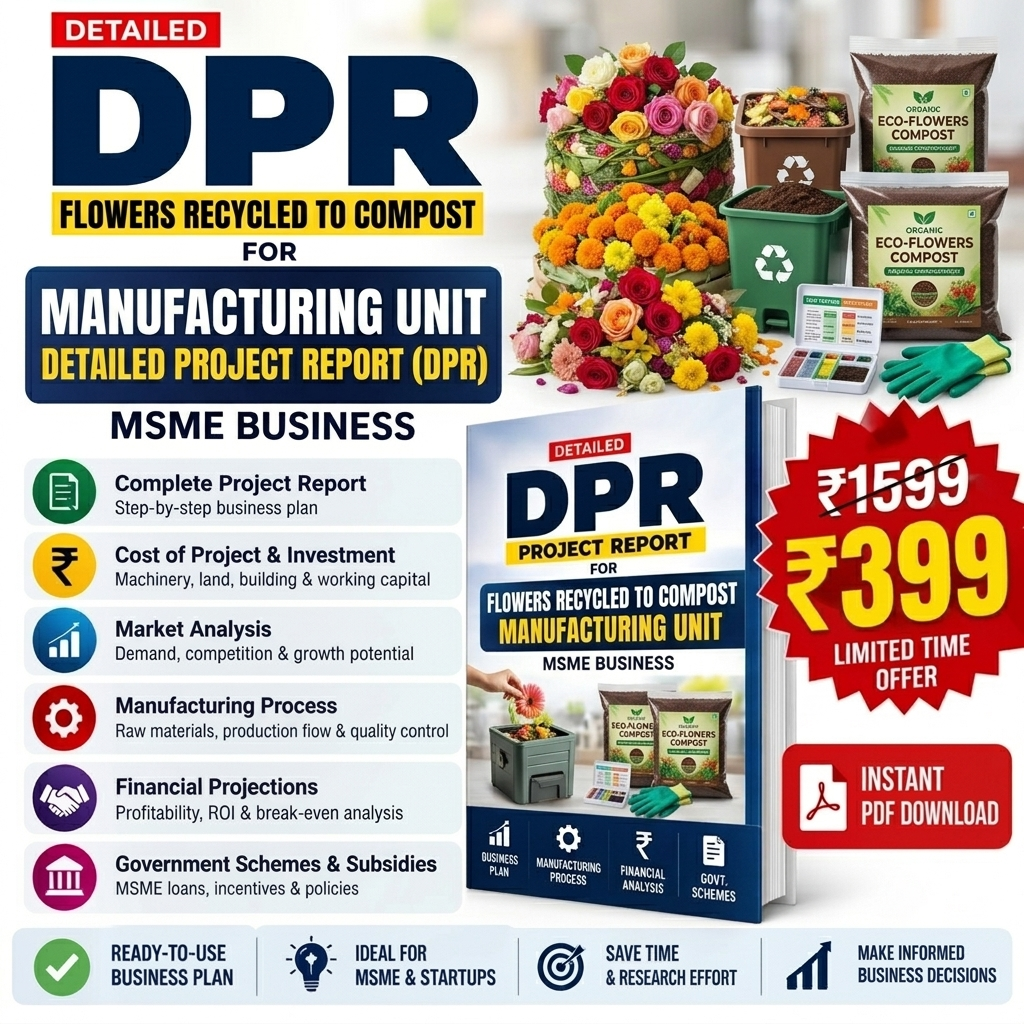

FLOWERS RECYCLED TO COMPOST MANUFACTURING UNIT DETAILED PROJECT REPORT(DPR)
FLOWERS RECYCLED TO COMPOST MANUFACTURING UNIT DETAILED PROJECT REPORT(DPR)
⭐️⭐️⭐️⭐️⭐️ 4.9/5 1445 Reviews
People's Choice
500+ bought in past month
Couldn't load pickup availability
FLOWERS RECYCLED TO COMPOST MANUFACTURING UNIT - DETAILED PROJECT REPORT (DPR)
Transform Sacred Blooms Into Earth's Gold - A Complete Business Blueprint
Are you exploring an environmentally responsible business based on the collection, processing and composting of floral waste? This Flowers Recycled to Compost Manufacturing Unit — Detailed Project Report (DPR) provides a structured foundation for understanding the proposed project, its operating requirements, machinery, financial structure and business considerations.
The project focuses on converting segregated floral waste — including flowers such as roses, marigolds, jasmine and hibiscus — into organic compost through a controlled processing and composting model.
Research has examined temple floral waste as a feedstock for composting and vermicomposting, demonstrating its potential for resource recovery when collected, segregated and processed scientifically. Government initiatives have also highlighted composting pits and participation by temple trusts and self-help groups as approaches to improve floral-waste management.
What Is This Report?
This is a comprehensive pre-feasibility and detailed project report created for entrepreneurs, investors, agri-business professionals, green-business founders and organizations evaluating a flowers-to-compost manufacturing unit.
The report examines how floral waste generated at temples, religious institutions, flower markets, events and other collection points can become an organized raw material stream for compost production.
Instead of treating used flowers only as discarded organic matter, the project considers a circular-economy model in which biodegradable floral material is collected, processed and converted into a useful soil-enrichment product.
Why This Business Opportunity?
Floral Waste as a Resource
Floral waste is biodegradable organic material and can be separately collected from temples, flower markets and other suitable sources before entering mixed waste streams.
Waste-to-Value Model
The business model converts a waste-management challenge into a potential resource-recovery activity by producing compost from segregated organic material.
Growing Sustainability Focus
Circular economy, organic waste management, resource recovery and environmentally responsible production are increasingly important considerations for businesses and local waste-management initiatives.
Multiple Customer Segments
Depending on product quality, packaging and market positioning, compost may be supplied to agriculture, horticulture, nurseries, landscaping businesses, gardens and other appropriate users.
Project at a Glance
| Project Parameter | Details |
|---|---|
| Total Project Cost | ₹17.55 Lakhs |
| Term Loan | ₹11.67 Lakhs |
| Own Contribution | ₹1.75 Lakhs |
| Working Capital | ₹4.12 Lakhs |
| Power Requirement | 15 KW |
| Employment Generated | 16 Persons |
| Break-Even Point | 40% |
| Plant & Machinery | ₹12.47 Lakhs |
The above project figures are the figures presented in this DPR and should be evaluated against the applicant's location, capacity, quotations, operating assumptions and financing requirements before implementation.
Raw Materials Used
Floral Waste
Segregated flowers and other suitable biodegradable floral material collected from identified sources.
Sawdust
A potential bulking material used in composting systems to assist structure, aeration and moisture management.
Composting Culture
Appropriate microbial inputs may be incorporated depending on the selected composting process and operating methodology.
Packaging Material
Materials required for packing, labeling, handling and distribution of the finished compost product.
What's Inside This DPR?
- Project Concept & Introduction — Understand the business concept, waste-management problem and resource-recovery opportunity.
- Market Analysis — Explore demand drivers, target customers, applications and competitive considerations.
- Technical Details — Review the proposed manufacturing process, machinery, plant requirements, power requirements and operating considerations.
- Financial Projections — Examine project cost, means of finance, profitability analysis, cash flow and balance-sheet considerations.
- Break-Even & DSCR Analysis — Understand the financial indicators used for evaluating project viability and debt-servicing capacity.
- Management & Staffing Plan — Review workforce requirements, responsibilities and organizational considerations for the proposed project.
- Environmental & Social Impact — Understand the waste-reduction, resource-recovery and employment dimensions of the project.
Understanding the Manufacturing Concept
A flowers-to-compost unit generally begins with the organized collection of suitable floral waste. The incoming material needs to be inspected and segregated so that non-biodegradable contaminants such as plastic, thread, packaging and other unwanted materials are removed.
Depending on the selected technology, the floral material may then be size-reduced and combined with appropriate bulking or organic materials before controlled composting. Moisture, aeration, temperature and decomposition conditions are important operating considerations.
Scientific studies have investigated both microbial composting and vermicomposting of temple floral waste. Research has also examined mechanical processing and compost maturity parameters for floral-waste systems.
Who Should Buy This Report?
Aspiring Entrepreneurs
Suitable for individuals evaluating a structured waste-to-value or green-business opportunity.
Farmers & Agri-Entrepreneurs
Useful for those exploring organic-input production alongside agriculture or horticulture activities.
NGOs & CSR Initiatives
Relevant to organizations evaluating organized floral-waste collection, recycling and community-based resource recovery.
Bank & MSME Loan Applicants
Helpful as a structured project-planning document when preparing project information for discussions with lenders or financial institutions.
Eco-Startups
Useful for sustainability-focused founders evaluating a floral-waste recycling and compost manufacturing concept.
Green Business Investors
Provides a structured starting point for reviewing the operational and financial dimensions of the proposed unit.
Fully Customisable Report
We can modify the project capacity and project cost as per your requirement. We can also prepare a project report on any subject as per your requirement.
This DPR can serve as a structured foundation for project planning. Project capacity, location, machinery configuration, investment level, financing structure and operating assumptions can vary from one proposed unit to another.
Key Highlights at a Glance
- Waste-to-Value Model — Converts suitable floral waste into a useful organic product.
- Circular Economy Approach — Supports resource recovery and organic-waste utilization.
- Multiple Raw-Material Sources — Potential collection points include temples, flower markets and other suitable generators.
- Compost Market Applications — Potential users include agriculture, horticulture, nurseries, landscaping and gardening segments.
- Structured Financial Information — Includes project cost, financing and financial-analysis components.
- Employment Potential — The proposed project profile includes an employment estimate of 16 persons.
- Environmental Dimension — Supports organized management of biodegradable floral waste instead of uncontrolled disposal.
- India-Focused Project Format — Designed around an Indian MSME/project-planning context.
Government information published by the Ministry of Housing & Urban Affairs has highlighted temple composting, participation by temple trusts and self-help groups, and floral-waste recycling as part of broader circular-economy and waste-management efforts.
From Sacred Flowers to Sustainable Futures
Don't just see discarded flowers — understand the resource-recovery opportunity behind them.
A properly planned flowers-to-compost project brings together raw-material collection, segregation, processing, composting, quality management, packaging, marketing and financial planning. This DPR brings these project dimensions together in a structured format so that entrepreneurs can evaluate the opportunity with greater clarity.
Research literature has documented the conversion of temple floral waste into compost and vermicompost, while Indian government initiatives have also recognized floral-waste composting as a practical component of waste-to-wealth and circular-economy efforts.
Frequently Asked Questions
What is a Flowers Recycled to Compost Manufacturing Unit?
It is a waste-to-value business model in which suitable segregated floral waste is collected and processed through a controlled composting system to produce organic compost.
What type of flower waste can be used?
Suitable biodegradable floral material may include flowers such as marigold, rose, jasmine and hibiscus, subject to proper segregation and suitability for the selected composting process.
Where can floral waste be collected from?
Potential sources include temples, religious institutions, flower markets, ceremonial venues and other generators where floral waste can be separately collected.
Can temple flower waste be converted into compost?
Yes. Scientific studies have specifically investigated microbial composting and vermicomposting of temple floral waste, including floral material collected from temples in India.
Does the DPR include financial information?
Yes. The project profile includes project cost, term loan, own contribution, working capital, plant and machinery, break-even information and other financial analysis components.
Is this report useful for MSME or bank project planning?
The report is structured as a project-planning document and can be used as a reference while preparing information for MSME, financing or business-evaluation discussions. Final requirements of a lender or government authority may vary.
Can the project capacity or cost be customised?
Yes. The report can be customised according to the required project capacity, investment scale and other project-specific requirements.
Is this a physical book?
No. This is a digital eBook/DPR. After the purchase is completed, the download link will be shared digitally.
Build the Project With a Clearer Starting Point
From floral-waste collection and composting concepts to machinery, project cost, financial analysis and operational planning, this DPR provides a structured reference for evaluating a Flowers Recycled to Compost Manufacturing Unit.
Get the report and take the next step toward evaluating your own floral-waste recycling and compost manufacturing project.
What's included in the box
What's included in the box
📘 Ebook & Printed Book Information
Ebook: Available for instant download after purchase.
Printed Copy: Add a printed copy of the book for just ₹2,999 extra.
If you do not receive your ebook after completing your purchase, please email us at hello@lywire.com with the following details:
- Order Number
- Email Address
- WhatsApp Phone Number
Our team will verify your order and send the ebook to you as soon as possible.