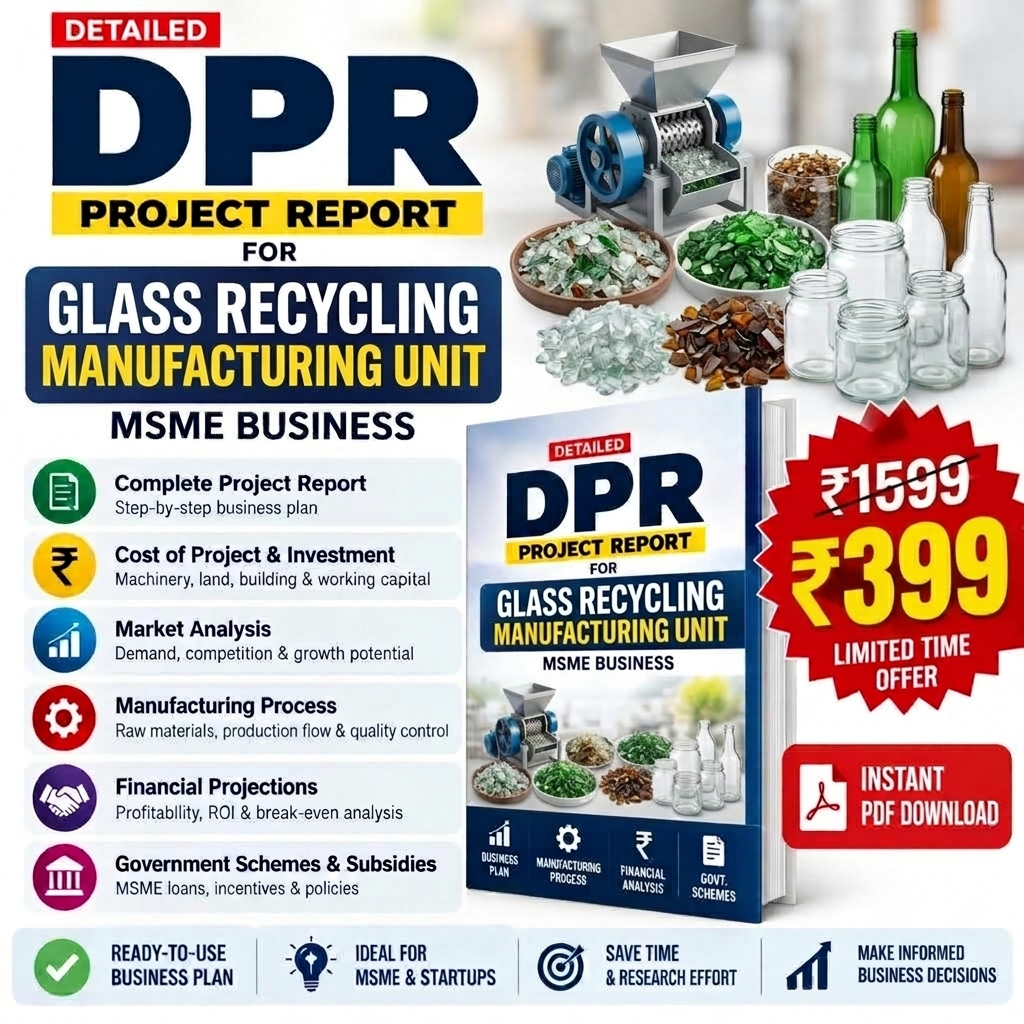

GLASS RECYCLING MANUFACTURING UNIT DETAILED PROJECT REPORT(DPR)
GLASS RECYCLING MANUFACTURING UNIT DETAILED PROJECT REPORT(DPR)
⭐️⭐️⭐️⭐️⭐️ 4.9/5 1445 Reviews
People's Choice
500+ bought in past month
Couldn't load pickup availability
GLASS RECYCLING MANUFACTURING UNIT -DETAILED PROJECT REPORT (DPR)
Transform waste into a structured business opportunity with a detailed, India-focused project report covering project setup, investment structure, machinery, working capital, operations, market applications, financing, and financial projections for a glass recycling manufacturing unit.
Are you exploring a glass recycling, waste-to-resource, or circular-economy manufacturing venture? This Detailed Project Report (DPR) provides a structured framework for entrepreneurs, investors, SME owners, consultants, and loan applicants who need a practical starting point for evaluating and planning a glass recycling unit.
The report brings together the major commercial, operational, technical, financial, and management considerations involved in establishing a glass recycling manufacturing unit.
What's Inside This Glass Recycling DPR?
- Project concept and business development framework
- Start-up planning and operational setup
- Market analysis and marketing strategy
- Project cost and financial projections
- Funding structure and financing requirements
- Management and organisational framework
- Raw material and working capital considerations
- Product applications and potential market segments
Project Snapshot at a Glance
| Parameter | Project Details |
|---|---|
| Total Project Cost | ₹13.88 Lakhs |
| Term Loan | ₹8.10 Lakhs |
| Own Contribution | ₹1.39 Lakhs |
| Working Capital Loan | ₹4.39 Lakhs |
| Break-Even Point | 37% |
| Power Requirement | 25 KW |
| Employment Generation | 10 Persons |
The above figures represent the project assumptions and financial structure presented in this DPR. Actual project costs, financing terms, operating expenses, and returns may vary according to location, capacity, supplier quotations, lender requirements, market conditions, and the final project configuration.
Smart Investment & Structured Financing
Cost of Project Breakdown
| Project Component | Indicative Amount |
|---|---|
| Land & Building | Owned / Leased |
| Plant & Machinery | ₹7.50 Lakhs |
| Other Miscellaneous Assets | ₹1.50 Lakhs |
| Working Capital Requirement | ₹4.88 Lakhs |
| Total Investment | ₹13.88 Lakhs |
Means of Finance
| Source | Amount |
|---|---|
| Own Contribution | ₹1.39 Lakhs |
| Term Loan | ₹8.10 Lakhs |
| Working Capital Loan | ₹4.39 Lakhs |
Key Raw Materials Required
The availability, quality, segregation, transportation, and purchase cost of waste glass are important factors when evaluating the feasibility of a recycling unit. The DPR helps organise these considerations into a project-planning framework.
Why Glass Recycling?
Glass recycling fits within the broader circular-economy approach because recovered glass can be processed into reusable material streams rather than being treated solely as waste. Government environmental frameworks in India have also increasingly addressed circular economy, recycling, resource conservation and waste-management systems. :contentReference[oaicite:0]{index=0}
- Glass can be recycled repeatedly without the same type of material degradation associated with many other materials.
- Recycled glass can serve as a secondary raw material for suitable glass-manufacturing applications.
- Using cullet can reduce dependence on virgin raw materials in appropriate manufacturing processes.
- Recovered glass can be processed into different particle sizes and forms for different commercial applications.
- Recycling supports resource conservation and the wider circular-economy ecosystem.
Actual environmental and energy benefits depend on the feedstock, processing technology, product specification, transportation distance, furnace/process conditions, and end use.
What Does This Glass Recycling Unit Produce?
1. Cullet — Crushed & Ready-to-Remelt Glass
Processed glass cullet can be supplied as a secondary raw material to suitable glass manufacturers for applications such as the production of glass containers and other glass products, subject to quality and specification requirements.
2. Crushed Glass / Glass Sand
Processed crushed glass can be evaluated for applications in construction-related materials, pavements, decorative uses, and other suitable end uses depending on particle size, composition, cleanliness, and technical specifications.
3. Glass Powder
Finely processed glass powder may have applications including surface treatment, selected industrial filler applications, synthetic resin systems, road-marking formulations, and other specialised uses where the material meets required specifications.
End-Use Applications & Potential Revenue Streams
| Industry / Segment | Potential Application |
|---|---|
| Construction | Concrete-related applications, pavements and selected road-building materials |
| Glass Manufacturing | Cullet as a secondary raw material |
| Paint & Plastics | Selected filler and material applications |
| Agriculture / Horticulture | Selected growing and rooting-media applications |
| Industrial Applications | Selected adsorbent and material-processing applications |
| Filtration | Suitable filtration-media applications |
| Interiors | Tiles, decorative surfaces and related applications |
Financial Highlights
The financial section is designed to help the reader understand project investment, financing requirements, operating assumptions, repayment considerations, and the financial structure used for project evaluation.
Financial indicators should be independently reviewed against current quotations, lending terms, production capacity, local operating costs, selling prices, taxation, and actual business assumptions before investment or loan submission.
Need a Different Project Size or Industry?
The project report can be adapted to different project capacities, investment levels, locations, operating assumptions, and business requirements.
We can also prepare a Detailed Project Report on any subject or industry as per your specific requirement.
- Different project capacity
- Different investment size
- Location-specific project assumptions
- Customised machinery and cost structure
- Custom financial projections
- Industry-specific project planning
Who Should Buy This DPR?
For individuals evaluating a structured entry into glass recycling and waste-to-resource manufacturing.
For applicants who need a structured project document to support discussions with lenders, subject to lender-specific requirements.
For entrepreneurs exploring recycling and circular-economy business models.
For businesses evaluating diversification into recycling and recovered-material processing.
For consultants and advisors working with MSME clients on project planning and documentation.
For individuals who need a structured starting framework for assessing a proposed glass recycling unit.
Why Use This Glass Recycling Project Report?
- Professionally structured project documentation
- Organised project cost and financing framework
- Coverage of raw materials, machinery and operations
- Market and end-use application overview
- Financial assumptions and project evaluation framework
- Adaptable to different project scales and requirements
- Useful as a starting document for project planning and lender discussions
- Saves substantial time in organising a project proposal from scratch
Your Green Business Journey Starts With the Right Plan
A well-structured project report can help convert a business idea into a clearer project framework. Use this Glass Recycling Manufacturing Unit DPR to understand the project structure, organise investment requirements, evaluate operational considerations, and prepare for the next stage of your business planning.
Need a customised DPR? Project reports can also be prepared for other industries and business concepts according to your specific requirements.
Frequently Asked Questions
The report covers project planning, project cost, means of finance, machinery, raw materials, working capital, operational considerations, product applications, market considerations, financial projections and other key elements required for evaluating a glass recycling unit.
The project snapshot in this DPR presents a total project cost of ₹13.88 Lakhs. Actual project cost should be recalculated based on location, capacity, machinery quotations, land or building arrangements, working capital and other current project requirements.
Yes. The project can be modified according to your required capacity, location, investment level, machinery configuration and other project-specific assumptions.
Yes. Detailed Project Reports can be prepared for other subjects and industries according to your specific requirements.
The report is structured as a project-planning and financial-documentation resource that can support lender discussions. Final bankability, documentation requirements, appraisal and loan approval are determined by the concerned financial institution and depend on the applicant, project, location, collateral, financials and lender policies.
No. Project figures and financial projections are planning assumptions and should be independently validated. Business performance and financing decisions depend on actual market conditions, operating performance, project execution and lender requirements.
No. This product is a digital eBook/project report. The download link will be shared after the purchase is completed.
What's included in the box
What's included in the box
📘 Ebook & Printed Book Information
Ebook: Available for instant download after purchase.
Printed Copy: Add a printed copy of the book for just ₹2,999 extra.
If you do not receive your ebook after completing your purchase, please email us at hello@lywire.com with the following details:
- Order Number
- Email Address
- WhatsApp Phone Number
Our team will verify your order and send the ebook to you as soon as possible.