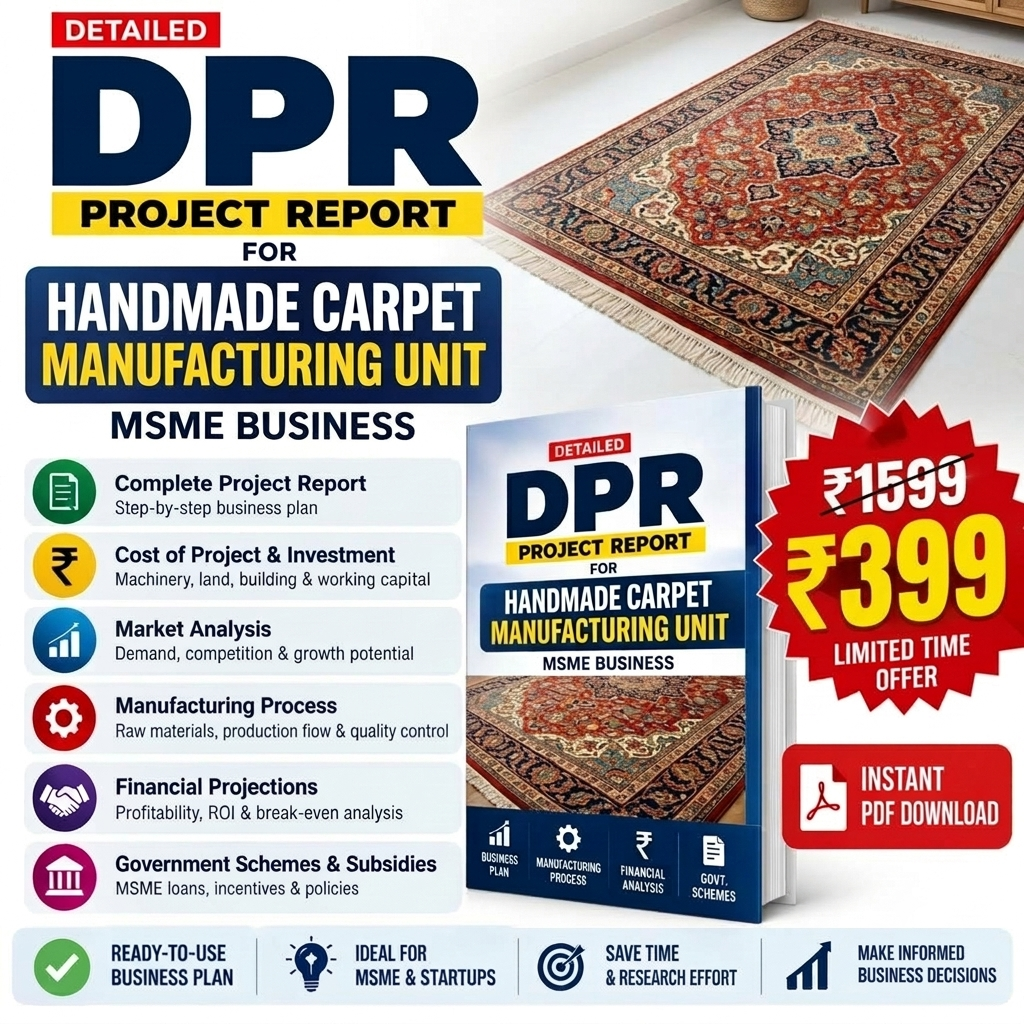

HANDMADE CARPET MANUFACTURING UNIT DETAILED PROJECT REPORT(DPR)
HANDMADE CARPET MANUFACTURING UNIT DETAILED PROJECT REPORT(DPR)
⭐️⭐️⭐️⭐️⭐️ 4.9/5 1445 Reviews
People's Choice
500+ bought in past month
Couldn't load pickup availability
HANDMADE CARPET MANUFACTURING UNIT — DETAILED PROJECT REPORT (DPR)
Transform Threads Into Timeless Art — And Turn Art Into a Thriving Business!
Are you an aspiring entrepreneur looking to invest in a time-tested, export-oriented, and culturally rich industry? This comprehensive Detailed Project Report (DPR) for a Handmade Carpet Manufacturing Unit provides a structured roadmap covering project concept, setup, finance, raw materials, marketing, operations, employment and implementation planning.
What's Inside This DPR?
This ready-to-use project report is structured for entrepreneurs, consultants, financial planning, and business documentation. It brings the major elements of a handmade carpet manufacturing project together in one professional format.
Project Financials at a Glance
| Parameter | Details |
|---|---|
| Total Project Cost | ₹7.28 Lakhs |
| Term Loan | ₹4.05 Lakhs |
| Own Capital | ₹0.73 Lakhs |
| Working Capital | ₹2.50 Lakhs |
| Annual Sales Turnover | ₹49.57 Lakhs at Maximum Capacity |
| Break-Even Point | 41% |
| Payback Period | 5 Years |
| DSCR | 3.52 |
| Employment Generated | 8 Persons |
| Power Requirement | 3.00 HP |
| Implementation Period | 5–6 Months |
About the Industry — A Legacy Woven in Gold
Handmade carpet weaving is a long-established Indian craft and an important part of the country's handicraft and textile ecosystem. Carpet-producing clusters such as Bhadohi and Mirzapur in Uttar Pradesh have been supported through government cluster-development initiatives, including SFURTI projects for hand-knotted carpet clusters.
India's handmade carpet ecosystem also has an established export-support structure. The Carpet Export Promotion Council (CEPC), established under the Ministry of Textiles, works to promote exports of carpets, handmade knotted carpets, rugs, floor coverings and allied products.
Industry context: Ministry of Textiles material identifies CEPC as the export-promotion body for Indian carpets and records established carpet clusters and export activity.
The Craft — Where Skill Meets Soul
Handmade carpets are distinguished by their labour-intensive production process, design detail and use of natural or synthetic textile materials depending on the product specification.
- Woven or knotted using specially designed looms and traditional techniques.
- Produced using materials such as wool, cotton, silk, jute and other fibres.
- Finished using suitable dyes, chemicals and treatment processes according to product requirements.
- Dependent on skilled labour, craftsmanship, quality inspection and finishing.
- Suitable for domestic décor, premium retail, institutional buyers and export markets.
Cost of Project — Detailed Breakdown
| Particulars | Amount (₹ in Lakhs) |
|---|---|
| Land | — (Own/Rented) |
| Building/Shed (1,200 Sq. Ft.) | 4.00 |
| Furniture & Fixtures | 0.50 |
| Working Capital | 2.78 |
| Total | 7.28 |
Means of Finance
| Particulars | Amount (₹ in Lakhs) |
|---|---|
| Own Contribution | 0.73 |
| Working Capital (Finance) | 2.50 |
| Term Loan | 4.05 |
| Total | 7.28 |
Financing shown here represents the structure contained in this project report. Actual lending, margin, interest rate, collateral/security requirements and working capital limits are subject to the financing institution's appraisal and applicable rules.
Key Raw Materials Required
The project requires textile and process materials selected according to the carpet design, construction method, quality level and intended market.
Additional consumables and finishing materials may be required depending on the selected product range, production technique and quality specifications.
Why This DPR Is Useful
A structured starting point for understanding the setup and economics of a carpet unit.
Useful for evaluating capacity expansion, production planning and financial requirements.
Can serve as supporting project documentation subject to lender-specific requirements.
Useful for preparing project information for applicable MSME and financing processes.
Helps organize project economics, operating assumptions and market considerations.
Provides a structured base that can be adapted to client-specific project requirements.
100% Customisable — Made for Your Requirement
Project reports often need to reflect the entrepreneur's actual location, capacity, investment structure and business model. This DPR can be adapted to suit specific project requirements.
- Project capacity — small, medium or large scale
- Project cost according to budget and location
- Unit address and entrepreneur details
- Legal structure and business profile
- Financial assumptions and project-specific requirements
- Other manufacturing, service or business subjects as required
A Detailed Project Report can also be prepared on a different business subject according to your specific requirement.
What You Get With This Report
Project Implementation Roadmap
| Stage | Key Activity |
|---|---|
| 1. Project Planning | Finalize business model, product range, capacity and investment structure. |
| 2. Location & Infrastructure | Identify the premises and prepare the required production and working areas. |
| 3. Finance & Registrations | Arrange applicable registrations, financing documentation and project approvals. |
| 4. Equipment & Materials | Arrange looms, furniture, fixtures, raw materials and other production requirements. |
| 5. Workforce | Recruit or organize skilled artisans and supporting personnel. |
| 6. Production Setup | Establish workflow, quality checks, finishing and inventory processes. |
| 7. Marketing & Sales | Develop buyer channels covering local, institutional, online and export opportunities. |
| 8. Commercial Operations | Begin production, sales tracking, financial monitoring and capacity utilization. |
The project report uses an indicative implementation period of approximately 5–6 months. Actual timelines depend on premises, finance, procurement, registrations, workforce availability and project scale.
MSME & Financing Context
Handmade carpet manufacturing may fall within the broader micro-enterprise and traditional-artisan ecosystem. Government programmes such as PMEGP are designed to support eligible new micro-enterprises, with implementation involving KVIC, KVIBs, District Industries Centres and banks.
Eligibility, project-cost limits, own contribution, subsidy structure and other conditions depend on the applicable PMEGP guidelines and the applicant/project circumstances. The report should therefore be customized and checked against the latest applicable scheme requirements before submission.
Frequently Asked Questions
What is included in the Handmade Carpet Manufacturing DPR?
The report covers the project concept, business overview, entrepreneur profile, project cost, means of finance, raw materials, employment, power requirement, marketing, financial projections, break-even analysis, DSCR and implementation planning.
What is the project cost shown in this DPR?
The project structure provided in this DPR shows a total project cost of ₹7.28 lakhs, comprising building/shed, furniture and fixtures and working-capital requirements. Actual costs can vary by location, capacity and specifications.
Can this DPR be used for a bank loan application?
It is structured as project documentation that can support a financing discussion. However, each bank or financial institution may have its own appraisal process and document requirements, so the DPR should be customized before submission.
Can the project report be customized?
Yes. Project capacity, cost, location, entrepreneur details, legal structure, financial assumptions and other business-specific information can be modified according to the intended project.
Can a DPR be prepared for another business subject?
Yes. A Detailed Project Report can be prepared for another manufacturing, service or business subject according to the required project scope and information.
What financial indicators are included?
The supplied project structure includes break-even analysis, DSCR, payback period and financial projections. Depending on the customized DPR, additional indicators such as IRR, NPV, profit and loss, cash flow and balance sheet projections may also be included.
What raw materials are required for handmade carpet manufacturing?
The project identifies wool, yarn, dyes and chemicals as key raw-material categories. The exact materials depend on carpet construction, design, quality, finishing process and product positioning.
How long does the project implementation take?
The supplied DPR uses an indicative implementation period of 5–6 months. Actual implementation time depends on infrastructure, financing, procurement, registrations, workforce and project scale.
Invest in a Craft That the World Loves
Handmade carpets combine craftsmanship, design, skilled employment and commercial opportunity. Build your project around a structured plan covering investment, operations, finance, marketing and implementation.
Get the Handmade Carpet Manufacturing Unit Detailed Project Report and use it as a practical foundation for planning and developing your proposed unit.
What's included in the box
What's included in the box
📘 Ebook & Printed Book Information
Ebook: Available for instant download after purchase.
Printed Copy: Add a printed copy of the book for just ₹2,999 extra.
If you do not receive your ebook after completing your purchase, please email us at hello@lywire.com with the following details:
- Order Number
- Email Address
- WhatsApp Phone Number
Our team will verify your order and send the ebook to you as soon as possible.