

How To Win An Argument Tomaque Explainer
How To Win An Argument Tomaque Explainer
⭐️⭐️⭐️⭐️⭐️ 4.9/5 1445 Reviews
People's Choice
500+ bought in past month
Couldn't load pickup availability
How To Win An Argument - Tomaque Explainer
Turn Arguments Into Structured, Clear & Persuasive Conversations
Tired of walking away from debates, meetings, negotiations, or difficult conversations wishing you had made your point more clearly? This practical explainer distils classical rhetorical ideas associated with Marcus Tullius Cicero into an accessible modern framework for understanding arguments, persuasion, structure, and delivery.
What Is This?
How To Win An Argument - Tomaque Explainer is a concise, practical summary of classical rhetorical thinking, adapted for modern communication.
Drawing inspiration from Cicero's influential work on rhetoric and oratory, this eBook focuses on the practical mechanics behind constructing an argument, organising ideas, presenting evidence, understanding an audience, responding to opposing points, and communicating with greater clarity and confidence.
Instead of approaching rhetoric as a purely historical or academic subject, the Tomaque Explainer turns major concepts into practical ideas that can be understood and applied in everyday communication.
What's Inside?
This is a Power Summary of classical rhetoric — rebuilt into a straightforward format for readers who want the ideas without getting buried in technical terminology.
Clear & Practical
Complex rhetorical concepts are presented in accessible language designed for modern readers.
Argument-Focused
Learn how claims, evidence, structure, counterarguments, and presentation work together to create a stronger case.
Modern Applications
Connect classical rhetoric with meetings, negotiations, presentations, debates, sales conversations, and online discussions.
Zero Unnecessary Complexity
No requirement to study Latin or work through lengthy academic explanations before understanding the core concepts.
Why Cicero? Why Now?
Marcus Tullius Cicero (106–43 BCE) was a prominent Roman statesman, orator, and writer whose works on rhetoric and oratory became highly influential in the Western rhetorical tradition. His writings include De Oratore (On the Orator) and De Inventione (On Invention). :contentReference[oaicite:1]{index=1}
Cicero's approach connected rhetorical skill with broader knowledge, reasoning, communication, and civic life. His rhetorical tradition continues to be studied as part of the history of argumentation and public speaking. :contentReference[oaicite:2]{index=2}
The goal of this Tomaque Explainer is not to reproduce ancient texts. It is to make the underlying ideas easier to understand and connect them with situations modern readers encounter every day.
The Classical Five-Part Rhetorical Framework
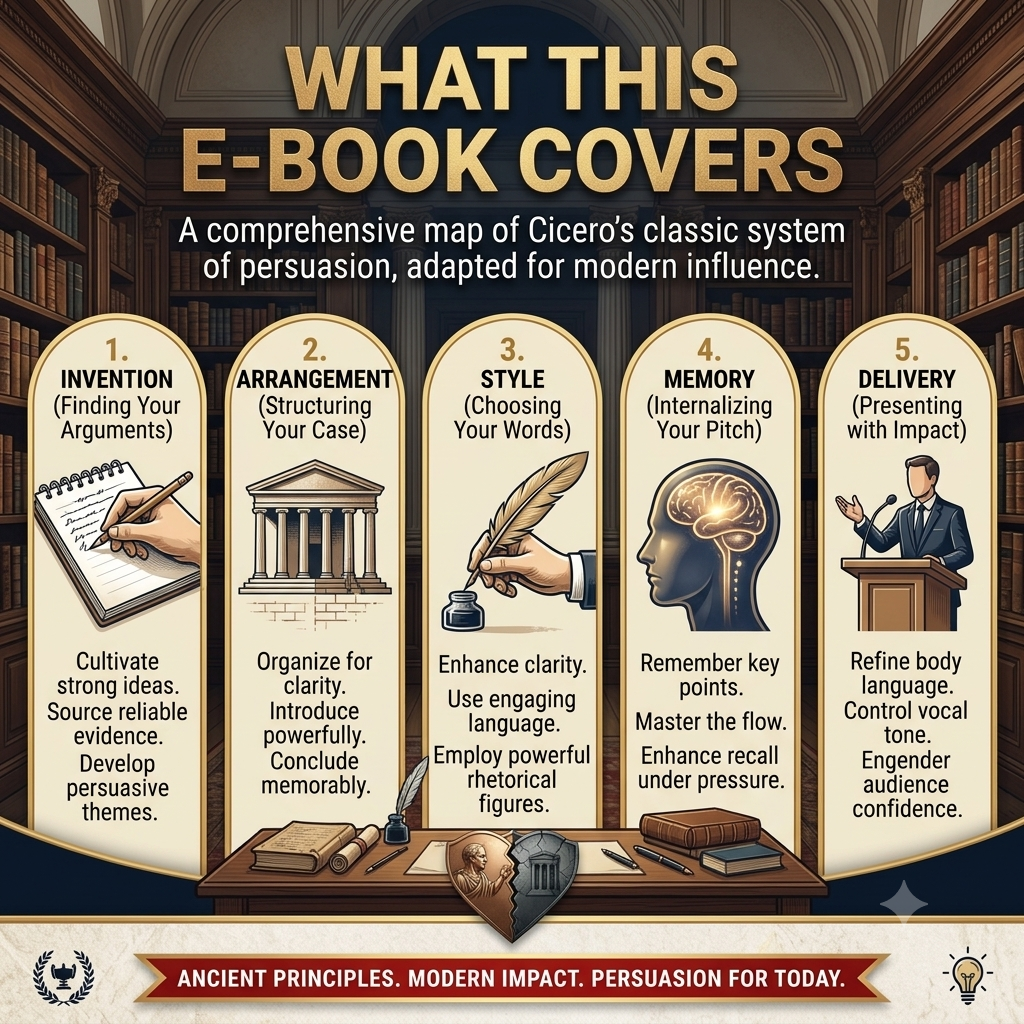
Classical rhetorical instruction is commonly described through five major canons: invention, arrangement, style, memory, and delivery. These provide a useful framework for thinking about how an argument is developed and communicated. :contentReference[oaicite:3]{index=3}
What You'll Walk Away With
- How to structure an argument so your central point is easier to understand and defend.
- How to identify the difference between a strong argument and a weak argument.
- How to remain composed and communicate clearly when a discussion becomes challenging.
- How the classical five-part rhetorical framework can help you prepare and present an argument.
- How to identify weaknesses, assumptions, gaps, and unsupported claims in an opposing argument.
- How to make important points more clear, memorable, relevant, and audience-focused.
- How rhetorical principles can be adapted to modern conversations rather than remaining purely historical concepts.
Where Can You Apply These Ideas?
Boardroom Meetings
Organise your reasoning, communicate recommendations, and respond to objections with greater structure.
Arguments & Debates
Break down claims, examine supporting reasons, and develop clearer responses instead of reacting impulsively.
Negotiations
Think carefully about audience, framing, evidence, objectives, and the way your position is communicated.
Online Discussions
Apply structured reasoning when responding to disagreement, criticism, and competing viewpoints.
Who Is This For?
Argument vs. Persuasion: Understand the Difference
Strong communication is not simply about speaking more forcefully. Classical rhetorical traditions distinguish between the structure of an argument and the broader mechanisms through which an audience may be persuaded.
The broader rhetorical tradition also examines elements such as credibility, emotional response, and reasoning. Aristotle's account, which strongly influenced later rhetorical traditions including Roman rhetoric, famously distinguishes ethos, pathos, and logos as three means of persuasion. :contentReference[oaicite:4]{index=4}
The aim is not simply to speak more. It is to understand how an idea is built, organised, communicated, questioned, and defended. — The practical principle behind the Tomaque Explainer
The Bottom Line
This isn't a traditional academic textbook and it isn't a full-length rhetoric course. It is a focused digital explainer designed to make classical ideas about argumentation and persuasion easier to understand and apply.
Whether you're preparing for a meeting, a debate, a negotiation, a presentation, or simply want to communicate your position more effectively, this guide gives you a practical framework for thinking about arguments before, during, and after the conversation.
Get Your Copy Today
Explore the principles of classical rhetoric and discover how structured reasoning, audience awareness, argument design, and effective delivery can transform the way you approach difficult conversations.
Learn Today!Tomaque Explainer - Smart Summaries. Real Strategy. Zero Fluff.
Frequently Asked Questions
What is How To Win An Argument — Tomaque Explainer?
It is a concise digital explainer that introduces practical ideas from classical rhetoric, particularly traditions associated with Cicero, and connects them with modern arguments, discussions, negotiations, meetings, and presentations.
Is this the original work of Cicero?
No. This is a modern Tomaque Explainer and summary-style educational product. It is designed to simplify and contextualise ideas associated with classical rhetorical works rather than present itself as an original Cicero text.
Do I need to know Latin to understand it?
No. The explainer is designed for modern readers and focuses on accessible explanations rather than requiring knowledge of Latin.
Can I use these concepts in everyday conversations?
Yes. The concepts are presented with modern applications in areas such as workplace communication, debates, negotiations, presentations, and online discussions.
What are the five classical rhetorical canons?
They are commonly described as invention, arrangement, style, memory, and delivery. Together they provide a framework for developing, organising, remembering, and presenting an argument or speech.
Who should read this eBook?
It can be useful for professionals, students, entrepreneurs, sales professionals, people involved in leadership or negotiation, and anyone interested in argumentation, rhetoric, persuasion, and effective communication.
What's included in the box
What's included in the box
📘 Ebook & Printed Book Information
Ebook: Available for instant download after purchase.
Printed Copy: Add a printed copy of the book for just ₹2,999 extra.
If you do not receive your ebook after completing your purchase, please email us at hello@lywire.com with the following details:
- Order Number
- Email Address
- WhatsApp Phone Number
Our team will verify your order and send the ebook to you as soon as possible.