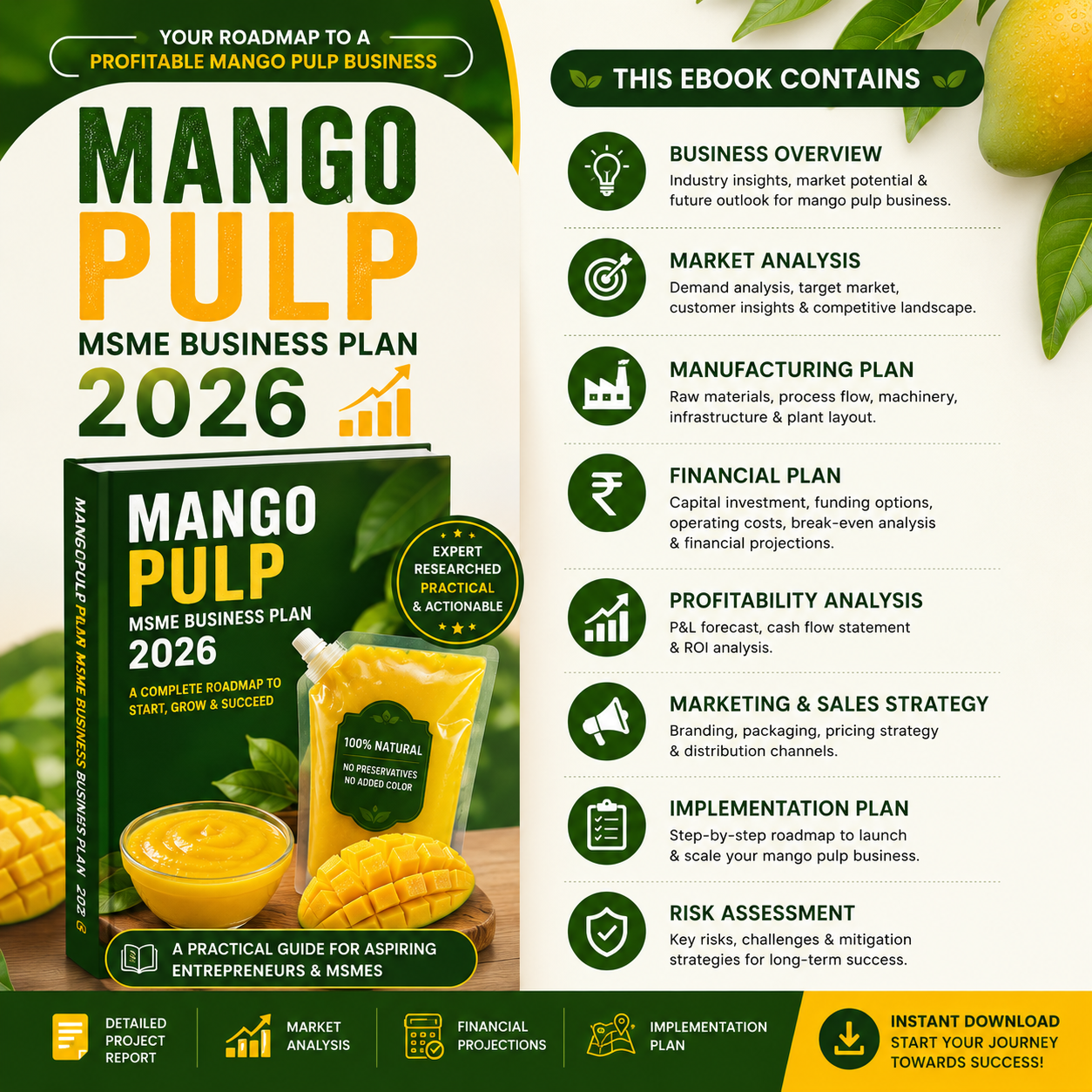


Mango Pulp MSME Business Plan 2026
Mango Pulp MSME Business Plan 2026
⭐️⭐️⭐️⭐️⭐️ 4.9/5 1445 Reviews
500+ bought in past month
Couldn't load pickup availability
Mango Processing | Food Manufacturing | MSME Business Planning
Mango Pulp MSME Business Plan 2026
Planning to establish or expand a mango pulp processing business in India? This digital business plan is designed to help entrepreneurs understand the business opportunity, production process, machinery requirements, infrastructure planning, financial projections and important operational considerations involved in setting up a mango pulp manufacturing unit.
Whether you are exploring your first food processing venture, planning an MSME manufacturing unit or evaluating opportunities in mango pulp processing for domestic and export markets, this resource provides a structured starting point for business planning.
Format: Professional, print-ready PDF | Delivery: Digital download after purchase
What makes this business plan useful?
- Understand the mango pulp processing business and its market opportunities.
- Explore the manufacturing workflow from raw mango procurement to packaged pulp.
- Understand machinery and infrastructure requirements for a processing unit.
- Review financial projections, profit and loss statements, cash flow and break-even analysis.
- Understand raw material sourcing and seasonal procurement considerations.
- Identify relevant business registrations, food safety compliance and export documentation considerations.
- Explore marketing, B2B sales and funding-readiness considerations.
Understanding the Mango Pulp Processing Business
Mango pulp manufacturing is a food processing activity that involves converting fresh mangoes into processed pulp for use in beverages, juices, dairy products, desserts, confectionery and other food applications.
The business involves multiple interconnected activities, including raw mango procurement, sorting, washing, pulping, processing, quality considerations, packaging, storage and distribution.
Entrepreneurs entering this industry need to evaluate factors such as mango availability, processing capacity, machinery selection, seasonal production planning, infrastructure requirements and potential buyers before establishing a manufacturing facility.
This business plan introduces these important areas to support a more informed approach to mango processing business development.
What Is Covered in the Mango Pulp Business Plan?

01. Market Analysis
Explore the Indian mango pulp industry, market opportunities, demand considerations and potential domestic and export markets.
02. Financial Projections
Understand projected profit and loss statements, cash flow forecasts and break-even analysis for business planning.
03. Production Process
Understand the processing workflow involved in converting raw mangoes into packaged mango pulp.
04. Machinery and Infrastructure
Explore the machinery requirements, equipment cost estimates and infrastructure layout considerations.
05. Raw Material Sourcing
Understand mango procurement considerations, supplier networks, seasonal sourcing and raw material cost management.
06. Licensing and Compliance
Review important compliance considerations, including FSSAI, GST, MSME registration and export documentation guidance.
07. Marketing and Sales
Explore B2B, retail and export-oriented marketing and sales channel considerations.
08. Funding and Loan Readiness
Understand business planning considerations relevant to MUDRA, SIDBI and applicable government funding schemes.
Mango Pulp Manufacturing Process
A mango pulp processing unit involves a series of production activities that must be planned according to the intended capacity, product specifications and processing technology.
- Raw mango procurement: Sourcing suitable mango varieties and planning seasonal raw material requirements.
- Sorting and washing: Cleaning and sorting incoming mangoes before processing.
- Destoning and pulping: Separating the stone and extracting the mango pulp.
- Further processing: Processing the extracted pulp according to the selected production method.
- Thermal processing: Applying the appropriate pasteurisation or sterilisation process, depending on the product and technology.
- Filling and packaging: Using suitable packaging and filling arrangements.
- Storage and distribution: Planning appropriate storage and distribution arrangements for the finished product.
The business plan introduces the production workflow and helps readers understand the major activities involved in mango pulp manufacturing.
Machinery and Infrastructure for a Mango Pulp Plant
Machinery selection is an important part of planning a mango pulp manufacturing unit. Equipment requirements depend on production capacity, processing technology, packaging format and the intended scale of operations.
The product covers machinery and infrastructure planning, including equipment lists, cost estimates and layout recommendations.
Machinery and equipment categories relevant to mango pulp processing may include:
- Raw material handling and sorting arrangements.
- Mango washing and cleaning equipment.
- Destoning and pulping machinery.
- Further processing and thermal treatment equipment.
- Filling and packaging machinery.
- Supporting utilities and processing infrastructure.
Investment Planning and Financial Projections
Financial planning is essential before investing in a mango pulp processing facility. Entrepreneurs need to evaluate the capital requirements, operating expenses, production assumptions and expected business performance.
The business plan includes financial projections and planning components such as:
- Projected profit and loss statements.
- Cash flow forecasts.
- Break-even analysis.
- Machinery and infrastructure cost estimates.
- Raw material sourcing and cost considerations.
- Financial planning for business operations.
These components can help entrepreneurs understand how financial assumptions influence business planning and investment decisions.
Licences, Registrations and Compliance
Food processing businesses must evaluate applicable registrations, licences and regulatory requirements before commencing commercial operations.
The business plan provides guidance relating to important areas such as:
- FSSAI: Food safety registration or licensing requirements applicable to the proposed business.
- GST: Relevant tax registration and compliance considerations.
- MSME / Udyam: MSME registration considerations for eligible enterprises.
- Export documentation: Relevant documentation and compliance considerations for businesses exploring international markets.
The specific approvals required depend on the manufacturing activity, capacity, location and applicable regulations. Entrepreneurs should independently verify the latest requirements with the relevant authorities.
Bank Loans, Funding and Government Schemes
Entrepreneurs establishing a mango pulp manufacturing unit may explore different business financing options depending on their project requirements, eligibility and lender conditions.
The business plan includes funding and loan-readiness guidance relevant to:
- MUDRA-related business financing considerations.
- SIDBI financing avenues.
- Applicable MSME and government funding schemes.
- Financial projections and business planning for funding discussions.
A structured business plan can help entrepreneurs organise information before discussions with banks, financial institutions and potential investors.
Marketing and Sales Opportunities
Mango pulp can serve multiple food industry applications. Business owners may evaluate different customer segments and distribution channels according to their production capacity, product quality, packaging and commercial strategy.
The business plan covers marketing and sales strategy considerations across:
- B2B sales and business-to-business distribution.
- Retail-oriented sales opportunities.
- Export market exploration.
- Customer acquisition and market positioning.
Entrepreneurs should evaluate buyer requirements, product specifications, pricing, logistics and applicable market-entry conditions before selecting their sales strategy.
Who Should Purchase This Mango Pulp Business Plan?

- First-time entrepreneurs: Individuals exploring the establishment of a mango pulp processing unit.
- Food processing businesses: Existing manufacturers planning to enter or expand into fruit pulp processing.
- MSME entrepreneurs: Business owners evaluating manufacturing opportunities and investment requirements.
- Loan-seeking entrepreneurs: Individuals organising business and financial information before approaching financial institutions.
- Export-oriented businesses: Entrepreneurs exploring domestic and international mango pulp markets.
- Farmer Producer Organisations: FPOs exploring value addition and fruit processing opportunities.
What Will You Receive After Purchase?
Your digital product includes:
- Mango Pulp MSME Business Plan 2026.
- Market analysis and business opportunity guidance.
- Production process guidance.
- Machinery and infrastructure planning.
- Raw material sourcing strategy.
- Financial projections and business planning information.
- Licensing and compliance checklist guidance.
- Marketing, sales and funding-readiness guidance.
Document format: Professional, print-ready PDF.
Product type: Digital eBook / Business Planning Resource.
Why Choose Lywire for MSME Business Planning Resources?
Lywire provides digital business plans, MSME project reports, manufacturing guides and business-related resources designed to help entrepreneurs explore business opportunities and organise their business planning.
Our resources cover practical business considerations such as manufacturing processes, machinery, investment planning, registrations, financial projections and business development.
The objective is to help aspiring entrepreneurs approach business planning with better information and a clearer understanding of the important areas involved in establishing a business.
Digital Delivery and Download Information
- Delivery type: Digital product.
- File format: PDF.
- Delivery method: Download link shared after successful order completion.
- Physical shipping: Not applicable.
- Printing: The document is provided in a print-ready format.
Frequently Asked Questions
1. What is included in the Mango Pulp MSME Business Plan 2026?
The document covers market analysis, financial projections, production process guidance, machinery and infrastructure planning, raw material sourcing, licensing and compliance guidance, marketing and sales strategy, and funding-readiness considerations.
2. Is this mango pulp business plan suitable for beginners?
Yes. It is intended for first-time entrepreneurs, aspiring manufacturers, existing food processing businesses and other individuals exploring mango pulp manufacturing. It introduces important business planning and operational considerations relevant to the industry.
3. Does the business plan cover mango pulp manufacturing machinery?
Yes. Machinery and infrastructure setup are among the documented topics. The business plan includes equipment lists, cost estimates and layout recommendations. Actual equipment specifications and quotations should be verified with machinery suppliers.
4. Does it include investment planning and financial projections?
Yes. Financial planning is one of the major sections. The product description identifies projected profit and loss statements, cash flow forecasts and break-even analysis, along with machinery and infrastructure cost estimates.
5. Does the plan explain licences and registrations for a mango pulp unit?
Yes. It includes guidance concerning FSSAI, GST, MSME registration and export documentation. Actual requirements depend on the proposed activity, plant capacity, location and applicable regulations.
6. Can this business plan be used for a bank loan or government scheme?
The document includes funding and loan-readiness guidance relevant to MUDRA, SIDBI and government scheme applications. However, individual lenders and schemes have their own documentation, eligibility and assessment requirements. Loan approval or subsidy eligibility is not guaranteed.
7. Is this a detailed project report (DPR)?
This product is listed as a Mango Pulp MSME Business Plan. Although it covers financial projections, machinery, infrastructure and funding-readiness topics, the product listing does not establish that it is a customised DPR prepared for an individual applicant. Check the documented deliverables before purchasing if you specifically require a lender-specific DPR.
8. In which format will I receive the business plan?
The product is provided in a professional, print-ready PDF format. It is a digital document that can be accessed electronically and printed for reference.
9. How will I receive my download after payment?
After successful purchase completion, the digital download link will be shared. No physical book or printed document will be shipped.
10. Does purchasing the business plan guarantee profits or business approvals?
No. The business plan is a planning resource and does not guarantee profitability, business success, loan approval, subsidies, grants, licences or regulatory approvals. Actual outcomes depend on project-specific assumptions, execution, market conditions and applicable requirements.
Important Disclaimer
This business plan is provided for general business planning, educational and informational purposes.
- Financial projections are based on assumptions and should not be interpreted as guaranteed financial outcomes.
- Actual project costs depend on location, plant capacity, machinery, construction, utilities, raw material prices and operating conditions.
- Loan approvals and financing facilities are subject to independent assessment by banks and financial institutions.
- Government schemes, subsidies and grants have separate eligibility requirements and are not guaranteed.
- Licensing and regulatory requirements may change. Independent verification with relevant authorities is recommended.
- Machinery prices, supplier quotations and market conditions should be verified before making investment decisions.
- This digital resource is not a substitute for project-specific engineering, legal, tax, financial or regulatory advice.
Start Planning Your Mango Pulp Processing Business
Explore the manufacturing process, machinery requirements, investment planning, financial projections and important business considerations involved in establishing a mango pulp processing unit.
Get the Mango Pulp MSME Business Plan 2026 and take a more informed approach to your food processing business planning.
Digital PDF | Instant Download After Successful Purchase
What's included in the box
What's included in the box