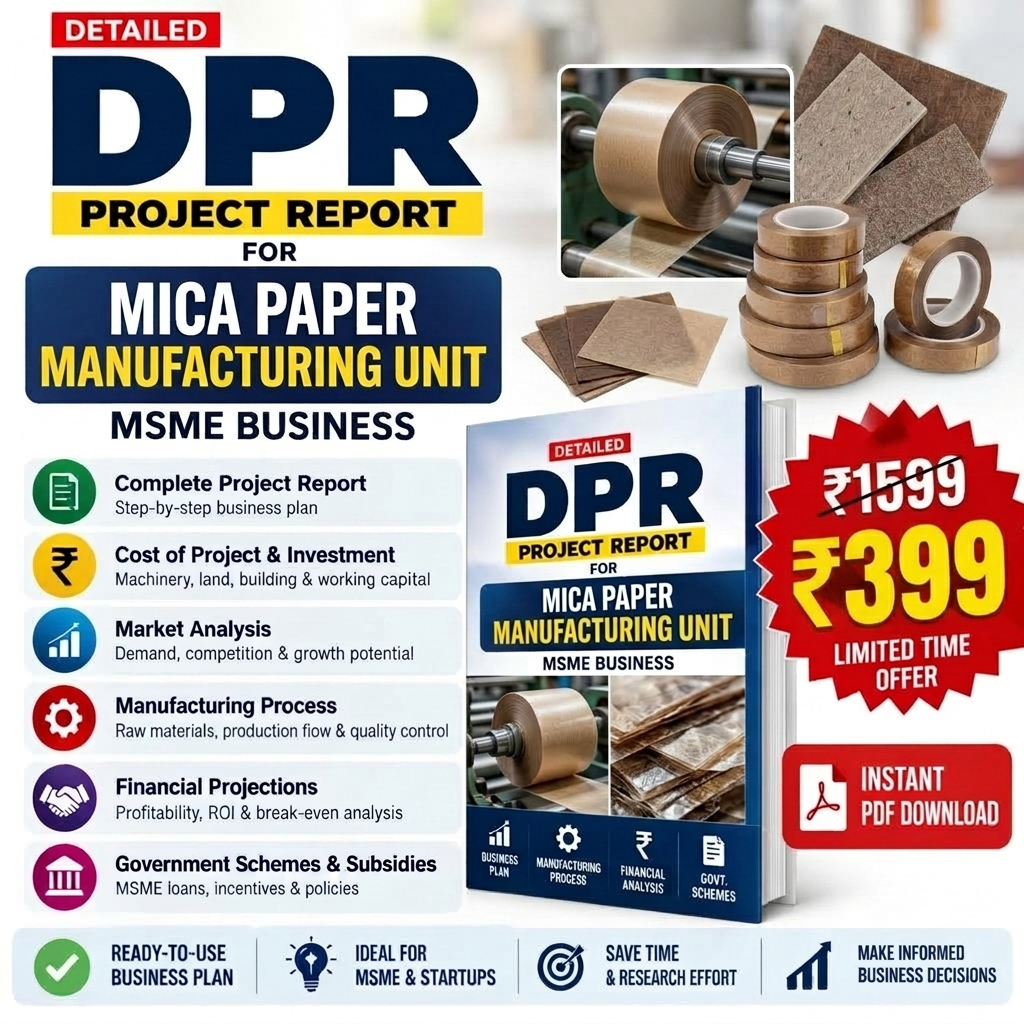

MICA PAPER MANUFACTURING UNIT DETAILED PROJECT REPORT(DPR)
MICA PAPER MANUFACTURING UNIT DETAILED PROJECT REPORT(DPR)
⭐️⭐️⭐️⭐️⭐️ 4.9/5 1445 Reviews
People's Choice
500+ bought in past month
Couldn't load pickup availability
MICA PAPER MANUFACTURING UNIT — DETAILED PROJECT REPORT (DPR)
A structured, practical project-report resource for entrepreneurs, investors, consultants and businesses evaluating the establishment of a Mica Paper Manufacturing Unit. The report brings together product understanding, raw materials, manufacturing requirements, infrastructure, machinery, financial planning, compliance considerations and business execution.
Your Blueprint for Evaluating a Mica Paper Manufacturing Project
This Detailed Project Report (DPR) is designed as an end-to-end planning resource for setting up a Mica Paper Manufacturing Unit. It is intended to help you understand the technical, commercial, operational and financial considerations involved before committing capital to the project.
Whether you are a first-time entrepreneur, an existing SME exploring diversification, an investor assessing an industrial opportunity, or a consultant preparing a project proposal, the report provides a structured framework for studying the business.
Important: Financial figures, production assumptions, regulatory requirements, machinery quotations and project economics should be validated against current supplier quotations, local conditions, applicable standards and the final plant configuration before investment or financing decisions.
About Mica Paper
Mica Paper is a specialized insulating material manufactured from mica-based feedstock. Depending on the product specification and manufacturing route, mica paper can be produced from materials such as Muscovite, Phlogopite, synthetic mica and calcined mica.
Mica flakes are processed into a suitable suspension or pulp and formed into a continuous, paper-like material. The resulting product can be supplied as rolls or further converted, laminated or combined with resin, film, glass or other substrates for specialized insulation applications.
Thermal Performance
Mica-based insulation is valued for its ability to perform in demanding high-temperature environments, subject to grade and application-specific specifications.
Electrical Insulation
Mica paper is used as a base material for electrical insulation products and systems where dielectric and thermal performance are important.
Composite Compatibility
Selected mica-paper grades can be impregnated or combined with resins and backing materials to manufacture specialized insulation products.
Consistent Material Structure
Controlled particle characteristics, thickness, density and manufacturing conditions are important for achieving consistent finished-product performance.
Why Mica Paper Has Industrial Relevance
Mica paper occupies a specialized position within the electrical insulation and high-temperature materials ecosystem. Current industry research identifies applications across electric machinery, power systems, mica plates and tapes, household electrical appliances and other industrial applications. :contentReference[oaicite:1]{index=1}
| Demand Area | Potential Application |
|---|---|
| Electrical & Power Equipment | Electrical insulation systems, high-temperature insulation components and related mica-based products. |
| Electric Machinery | Insulation applications associated with motors, generators and other electrical machinery. |
| Household Electrical Appliances | Thermal and electrical insulation components in selected appliances and heating equipment. |
| Mica Tape & Composite Products | Mica paper can serve as a base material for downstream insulation products such as tapes and laminated materials. |
| Industrial Engineering | Specialized thermal and electrical insulation applications requiring mica-based materials. |
Market forecasts differ materially between research providers because methodologies, definitions, product categories and forecast periods vary. The DPR should therefore be used together with current market validation rather than relying on a single historical market-size estimate.
Where Is Mica Paper Used?
- Electrical Insulation: Used as a material in mica sheets, mica tapes, micanite products and other electrical insulation systems.
- Electric Machinery: Used in selected insulation applications for motors, generators and related equipment.
- Power Systems: Suitable mica-based insulation products are used in applications where thermal and dielectric performance are required.
- Household Appliances: Used in selected heating and electrical appliance insulation components.
- Industrial Equipment: Used for specialized high-temperature and electrical insulation requirements.
- Composite Insulation: Mica paper can be combined with resins, films, glass and other substrates for engineered insulation products.
What This DPR Covers
01. Raw Material Sourcing
Coverage of mica feedstock such as Muscovite, Phlogopite, synthetic and calcined mica, along with process water, binders and relevant additives or colloid-forming materials where applicable.
02. Infrastructure Planning
Guidance for planning manufacturing space, raw-material storage, finished-goods storage, utilities, processing areas, quality-control facilities and administrative space.
03. Manufacturing Process
Structured explanation of the mica preparation, hydraulic processing, suspension or pulp preparation, sheet formation, pressing, drying and finishing stages.
04. Machinery & Equipment
Identification of the principal equipment categories required for establishing and operating a mica paper manufacturing line.
05. Financial Planning
Project-costing framework covering investment assumptions, capacity planning, operating expenses, revenue assumptions, profitability analysis and financial evaluation.
06. Licensing & Compliance
Planning considerations for business registration, factory operations, environmental requirements, electrical safety, product standards and other applicable approvals.
Infrastructure & Space Requirement
The project report includes a framework for planning an industrial facility with dedicated areas for manufacturing, raw-material handling, inventory, utilities, finishing and office operations. A project configuration of approximately 2,000–2,500 sq. ft. may be considered as a planning reference for a suitable small-scale setup, subject to actual machinery layout, process flow, storage requirements, statutory conditions and planned production capacity.
| Area | Planning Purpose |
|---|---|
| Manufacturing Floor | Primary processing and paper-forming operations. |
| Raw Material Storage | Controlled storage of mica and supporting process materials. |
| Finished Goods Area | Inspection, packing and storage of completed rolls or products. |
| Utilities | Power, water, process-support systems and other utility requirements. |
| Quality / Finishing Area | Inspection, finishing, cutting, rolling and quality-control activities. |
| Office & Administration | Management, documentation, procurement, sales and administrative functions. |
Manufacturing Process — From Mica to Paper
The DPR explains the manufacturing workflow in a structured sequence so that entrepreneurs can understand how raw mica is converted into a controlled paper-like insulating material.
Step 1 — Raw Material Selection
Selection and inspection of the appropriate mica feedstock according to the target product grade and application.
Step 2 — Processing & Separation
Processing of mica into suitable flakes or particles and preparation for hydraulic or wet-processing operations.
Step 3 — Pulp / Suspension Preparation
Controlled preparation of the mica suspension with process water and relevant additives according to the selected manufacturing formulation.
Step 4 — Sheet Formation
Formation of a uniform mica-paper web from the prepared suspension using appropriate paper-forming equipment.
Step 5 — Pressing & Drying
Removal of excess moisture followed by controlled drying to achieve the desired product characteristics.
Step 6 — Finishing & Inspection
Rolling, cutting, inspection, packaging and quality verification according to the intended product specification.
Product Quality and Compliance Considerations
Quality requirements for mica paper depend on the intended application and product specification. Relevant technical parameters can include thickness, weight, density, tensile properties, moisture, dielectric strength, impregnation behaviour and roll quality. ASTM D1677, for example, covers sampling and testing methods for untreated mica paper intended for electrical insulation and related composite materials. :contentReference[oaicite:2]{index=2}
Indian standards also contain dedicated references for mica-based insulating materials. BIS material identifies IS/IEC 60371-3-2 as the specification for mica paper and provides a broader family of standards covering mica-based insulating materials and associated test methods. :contentReference[oaicite:3]{index=3}
Compliance note: Applicable standards, certifications, licences and testing requirements should be checked against the exact product, end use, customer specification and current regulatory position before commercial production. BIS provides a current standards-search facility for checking Indian Standards by product name or keyword. :contentReference[oaicite:4]{index=4}
Machinery, Investment & Project Economics
A manufacturing project should be evaluated through a complete project-costing exercise rather than machinery cost alone. The DPR provides a framework for studying the principal investment and operating components.
| Cost / Planning Component | What to Evaluate |
|---|---|
| Land & Building | Lease or purchase cost, civil work, industrial flooring and facility preparation. |
| Plant & Machinery | Processing, hydraulic separation, paper formation, pressing, drying, finishing and supporting equipment. |
| Utilities | Electricity, water, process utilities, ventilation and other operational requirements. |
| Raw Material | Initial inventory and recurring mica, binder, additive and packaging requirements. |
| Working Capital | Inventory, receivables, operating expenses and cash-flow requirements. |
| Pre-Operative Expenses | Installation, trials, professional fees, registrations, testing and commissioning-related costs. |
| Revenue & Profitability | Capacity utilisation, selling price, product mix, operating cost and contribution assumptions. |
Who Should Buy This Report?
- Entrepreneurs exploring specialized manufacturing opportunities.
- SME owners planning diversification into electrical or industrial insulation materials.
- Investors evaluating mica-based industrial product opportunities.
- Manufacturing consultants preparing feasibility studies and project proposals.
- Business advisors supporting industrial project planning.
- Students and researchers studying manufacturing, industrial engineering or business planning.
Why Consider Mica Paper Manufacturing?
Mica paper serves a specialized industrial purpose where thermal resistance, electrical insulation and application-specific material performance are important. The continued demand for electrical equipment, insulation systems and engineered materials creates a basis for studying the sector as a potential manufacturing opportunity.
The key is preparation. A viable manufacturing project depends on product specification, raw-material quality, machinery selection, process control, customer requirements, compliance, working capital and realistic financial assumptions.
This DPR is intended to help you move from a broad business idea toward a structured feasibility and implementation framework.
A Practical Project-Planning Resource
- Understanding of the Mica Paper manufacturing business.
- Raw-material and input requirement framework.
- Manufacturing process overview.
- Infrastructure and plant-layout planning considerations.
- Machinery and equipment requirement framework.
- Investment and working-capital planning structure.
- Production, revenue and profitability evaluation framework.
- Licensing, compliance and standards considerations.
- Industrial application and market-segment overview.
- Structured information for business planning, feasibility assessment and project discussions.
Start Planning Your Mica Paper Manufacturing Project
Get the Detailed Project Report and use a structured framework to study the technical, commercial, financial and operational aspects of establishing a Mica Paper Manufacturing Unit.
START TODAY!Need a Project Report for Another Business?
A customized project report can also be prepared for a manufacturing, processing, service or other business concept according to your specific requirements.
can also prepare project report on any subject as per your requirement.
FAQs
What is a Mica Paper Manufacturing Unit?
A Mica Paper Manufacturing Unit produces mica-based paper materials used primarily in specialized electrical insulation and high-temperature applications. The manufacturing process generally involves processing mica into a suitable suspension, forming a sheet, removing moisture, drying and finishing the material.
What raw materials are used for mica paper manufacturing?
Depending on the product formulation, raw materials can include Muscovite mica, Phlogopite mica, synthetic mica or calcined mica along with water, binders and selected processing additives.
Where is mica paper used?
Mica paper is used in specialized electrical insulation applications, electric machinery, power systems, household electrical equipment and downstream mica-based products such as tapes, sheets and composite insulation materials.
Does the DPR cover machinery requirements?
Yes. The report provides a structured framework for understanding the principal machinery and equipment categories required for mica processing, paper formation, pressing, drying, finishing and supporting operations.
Does the report include financial planning?
Yes. The DPR covers the framework for evaluating project investment, machinery, infrastructure, working capital, production capacity, revenue assumptions, operating expenses and profitability.
Does the report cover licensing and compliance?
Yes. It includes guidance and planning considerations relating to applicable registrations, industrial operations, product standards, testing and other compliance requirements. Exact requirements should be verified for the proposed location and product configuration.
Is this DPR suitable for a first-time entrepreneur?
Yes. The report is structured to help first-time entrepreneurs understand the major technical, infrastructure, financial and operational considerations before moving toward implementation.
Can a project report be prepared for another business idea?
Yes. A project report can also be prepared on another manufacturing, processing, service or business subject according to the required project scope.
Disclaimer: This report is a proprietary business intelligence and planning document intended for informational and project-planning purposes. Financial projections, market information, machinery costs, regulatory requirements, production assumptions and other project details may change over time and should be independently verified before investment, financing, procurement or commercial decisions are made.
What's included in the box
What's included in the box
📘 Ebook & Printed Book Information
Ebook: Available for instant download after purchase.
Printed Copy: Add a printed copy of the book for just ₹2,999 extra.
If you do not receive your ebook after completing your purchase, please email us at hello@lywire.com with the following details:
- Order Number
- Email Address
- WhatsApp Phone Number
Our team will verify your order and send the ebook to you as soon as possible.