

The Opportunity
Understand the market, revenue models and product-process depth. Learn the fundamentals of GSM, handle strength, SOS bags, luxury bags, kraft paper and art paper before investing.
⭐️⭐️⭐️⭐️⭐️ 4.9/5 1445 Reviews
500+ bought in past month
Couldn't load pickup availability
Your Complete Operating Manual to Build, Fund & Scale a Paper Bag Business in India
Single-use plastic restrictions, municipal regulations, e-commerce growth, food delivery, garment retail and buyers seeking fibre-based packaging have created an important market opportunity for paper bags across India.
A paper bag business is more than a sustainability concept. It is a manufacturing operation that requires the right combination of machinery, paper specifications, production discipline, quality control, sales execution, working-capital management and customer reliability.
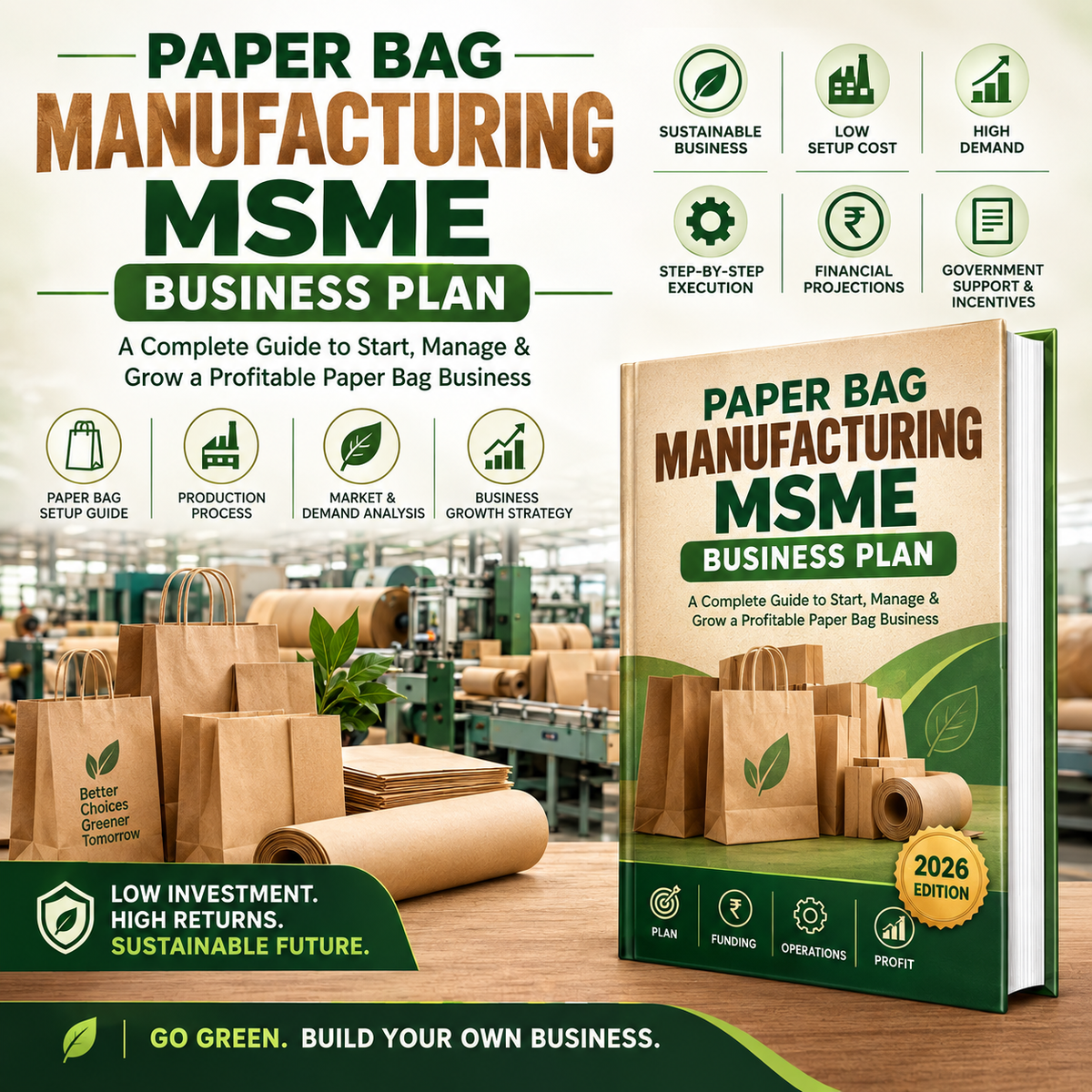
This eBook is designed as a structured reference for building a paper bag manufacturing business from the ground up — from initial opportunity assessment and setup to funding, launch, operations, sales, scaling and eventual exit planning.

Understand the market, revenue models and product-process depth. Learn the fundamentals of GSM, handle strength, SOS bags, luxury bags, kraft paper and art paper before investing.
Navigate business registration, Udyam, GST, Factory Act requirements, pollution-related permissions and other setup considerations.
Explore major financing routes and government-linked schemes relevant to eligible manufacturing businesses and founders.
A practical first-month framework covering machinery sourcing, raw material procurement, hiring and the path toward securing the first order.
Build repeatable processes for production, quality control, procurement and supply-chain management instead of relying on constant firefighting.
Cover cold outreach, WhatsApp catalogues, trade fairs, institutional buyers and customer acquisition approaches suited to paper packaging.
Work through hiring considerations, salary benchmarks, financial modelling, break-even analysis, margins and working-capital cycles.
Understand export documentation, buyer sourcing, branding strategy and practical technology tools for maintaining an efficient operation.
Plan the progression from a micro-unit to a small factory, multi-shift plant or export-ready operation, supported by risk and contingency planning.
Use practical checklists, formats and resource references to support implementation from the early stages of the business.
The guide maps important financing and support mechanisms so founders can understand where each route may fit into a paper bag manufacturing project. Eligibility, current limits, terms and application requirements must always be checked with the relevant official authority or financial institution.
The operating model takes a paper bag business beyond machinery purchase. It connects manufacturing, procurement, quality, sales, finance and growth into one structured business framework.
Build consistent production systems and quality checkpoints.
Plan paper, handles, consumables and supplier relationships.
Target retailers, food businesses, institutions and packaging buyers.
Understand margins, break-even and working-capital requirements.

The plan uses Gujarat as its primary plant-state reference because of its industrial ecosystem, GIDC estates, manufacturing base and access to packaging and paper-related business networks.
The underlying business principles can be adapted to Rajasthan, Maharashtra, Tamil Nadu, Uttar Pradesh and other Indian states. State-specific permissions, incentives and local requirements must be independently verified.
“Paper bags are not simply a niche sustainability product. They sit at the intersection of packaging demand, plastic restrictions and changing buyer preferences. The businesses that get the fundamentals right — GSM control, handle strength, credit discipline and delivery reliability — can build a stronger manufacturing operation.”
The purpose of this plan is to put those fundamentals into a structured, practical operating framework.Receive the eBook digitally after completing your purchase.
Keep access to your purchased digital resource for future reference.
Use the guide on your computer, tablet or smartphone.
Use it as a working reference alongside your CA, advisors or bank discussions.
Whether you are evaluating your first manufacturing unit or planning to expand an existing packaging operation, this business plan gives you a structured framework covering setup, funding, production, sales, finance, exports, risk and growth.
The eBook covers market opportunity, product and process fundamentals, setup and compliance, funding schemes, a 30-day launch framework, operations and SOPs, marketing and sales, people and finance, exports, technology, growth, risk management, exit planning, templates and references.
Yes. It is structured as an operating manual for first-time founders while also providing useful frameworks for existing paper and packaging businesses.
Yes. It discusses funding routes including PMEGP, CGTMSE, MUDRA, Stand-Up India, SIDBI and Gujarat industrial incentives. Current scheme rules, eligibility and financial limits should always be verified through the relevant official portals before application.
Gujarat is used as the primary plant-state reference, including its industrial ecosystem and GIDC considerations. The broader operating principles are designed to be adaptable across India, subject to each state's regulations and incentives.
Yes. The operating framework addresses production, quality control, procurement, supply chain, machinery sourcing and other operational considerations required to run a structured manufacturing unit.
No. Business performance depends on factors such as investment, capacity utilisation, pricing, raw-material costs, customer acquisition, working capital, competition and execution. Government schemes and loan approvals are subject to the applicable rules and the decision of the relevant authority or financial institution.
This is a digital product. The download link will be shared after the purchase is completed. No physical book will be provided.