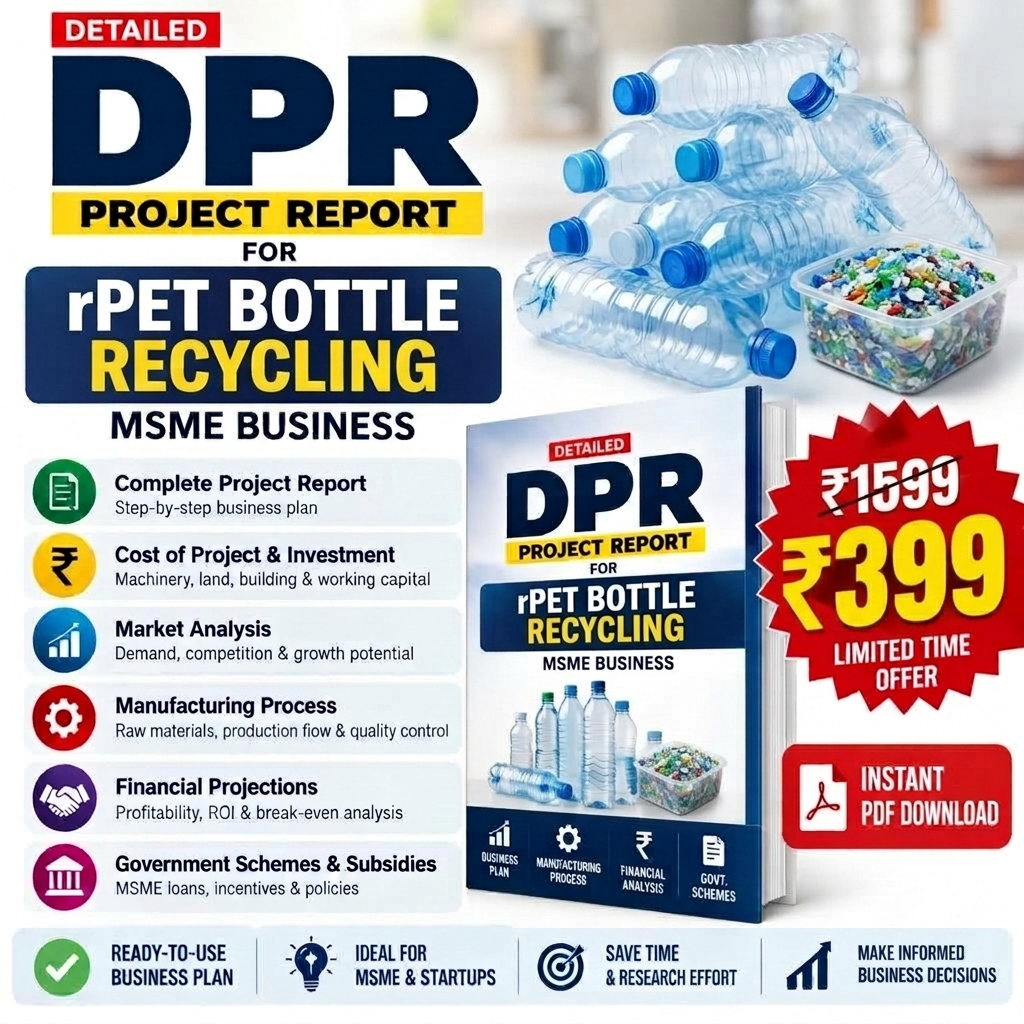

rPET BOTTLE RECYCLING Detailed Project Report(DPR)
rPET BOTTLE RECYCLING Detailed Project Report(DPR)
⭐️⭐️⭐️⭐️⭐️ 4.9/5 1445 Reviews
People's Choice
500+ bought in past month
Couldn't load pickup availability
rPET BOTTLE RECYCLING — Detailed Project Report (DPR)
Turn Plastic Waste Into Profit — The Complete Business Blueprint
This comprehensive Detailed Project Report (DPR) is designed as an end-to-end business planning resource for setting up an rPET (Recycled Polyethylene Terephthalate) Bottle Recycling Unit in India.
Whether you are a first-time entrepreneur, an investor evaluating the recycling sector, or an existing plastic-industry operator considering capacity expansion, the report provides a structured framework for understanding the project concept, plant requirements, raw materials, processing, market, financial planning, risks and business operations.
Project at a Glance
| Feature | Project Details |
|---|---|
| Project Type | rPET Plastic Bottle Recycling Unit |
| Production Capacity | 1,600 kg plastic chips/granules per day |
| Shift Basis | Single Shift |
| Legal Status | Sole Proprietorship / Partnership / Private Limited Company |
| Ideal Location | Near major cities and industrial markets with reliable access to post-consumer PET feedstock |
Why rPET Recycling?
PET bottles are widely used across beverage, water, food and personal-care packaging applications. After use, these bottles can enter organized collection and recycling channels, creating a feedstock opportunity for recyclers.
The commercial opportunity depends on factors such as feedstock availability, purchase price, contamination levels, processing yield, utilities, labour, logistics, product quality and the selling price achievable for the finished material.
What This DPR Covers
- Project Concept & Identification — Understanding the rPET recycling opportunity and project structure.
- Plant Setup & Infrastructure — Space planning, plant requirements, machinery and operational infrastructure.
- Market Analysis — Demand considerations, end-user segments and competitive factors.
- Financial Projections — Capital investment, operating costs, revenue assumptions, profitability and break-even analysis.
- Risk Assessment — Identification of commercial, operational, sourcing and market risks.
- Raw Material Sourcing — Approaches for procuring post-consumer PET bottles and managing supply continuity.
- Marketing & Sales Strategy — Positioning and selling recycled PET chips/granules to relevant buyers.
- Management Framework — Organizational structure, manpower planning and key operational responsibilities.
Key Business Factors Highlighted in the Report
- Production of consistent-quality recycled PET chips or granules.
- Development of reliable domestic buyer and trader networks.
- Evaluation of locally available machinery, tools and processing equipment.
- Reliable sourcing systems for post-consumer PET bottles.
- Capacity planning that can support future expansion.
- Quality control systems for sorting, washing, processing and finished-product handling.
Understanding the rPET Value Chain
A recycling unit operates within a broader collection, aggregation, processing and downstream manufacturing ecosystem. Understanding each link is important when evaluating the project's raw-material security and sales strategy.
Depending on the specifications of the recycled material, downstream applications may include polyester fibre, textile-related products, filling materials, packaging-related applications and other plastic products.
Market Opportunity
PET bottles are used extensively across drinking water, soft drinks, juices, personal-care products and other consumer applications. This creates a recurring stream of post-consumer PET that can potentially enter recycling channels.
For a recycling entrepreneur, the central commercial question is not simply the availability of plastic waste. The project must evaluate whether suitable PET feedstock can be procured consistently, processed efficiently and converted into a finished product that meets buyer specifications at a commercially viable cost.
Risks Addressed in This Report
A practical DPR should evaluate both opportunity and risk. This report addresses important areas that can influence project economics and operating stability.
- Raw Material Risk — Feedstock availability, quality variations and backup sourcing strategies.
- Pricing Risk — Changes in PET scrap purchase prices and recycled-material selling prices.
- Logistics Risk — Freight costs and the importance of proximity to collection and buyer markets.
- Sales Risk — Dependence on specific customers, traders or market segments.
- Capacity Risk — Balancing plant capacity with realistic feedstock availability and sales volumes.
- Quality Risk — Contamination and inconsistent processing affecting finished-product specifications.
Regulatory & Quality Considerations
Regulatory requirements can vary according to the recycling process, product, intended application and location. Businesses should identify applicable environmental, factory, labour, taxation and waste-management requirements before commissioning a plant.
Therefore, a general PET recycling project should not automatically be represented as a food-grade or food-contact rPET facility. The intended end use, recycling technology, testing, documentation and applicable approvals should be evaluated separately.
Fully Customizable for Your Requirements
Whether you want to evaluate a smaller recycling operation, a larger-capacity plant or a project adapted to a particular location, the DPR can be customized around your required capacity, project assumptions, geography and investment structure.
Who Should Buy This Report?
For individuals evaluating plastic recycling as a manufacturing opportunity.
For investors studying the sustainability and recycling sector.
For project evaluation and understanding the structure of a proposed recycling unit.
For businesses considering recycling as an additional operating segment.
For academic and research work involving recycling and circular-economy models.
For professionals preparing or reviewing project-planning documents.
Why Choose This DPR?
- Research-Oriented — Structured around the major commercial and operational factors involved in PET recycling.
- Actionable — Designed to help organize project planning, cost assumptions and operating requirements.
- Comprehensive — Covers project setup, raw materials, machinery, market, finance and risk.
- Customizable — Can be adapted for different capacities, locations and project assumptions.
- Sustainability-Focused — Built around plastic recovery, recycling and circular-economy principles.
Invest in the Future. Recycle Today. Build for Tomorrow.
Plastic waste can become an industrial resource when collection, processing, quality control and downstream demand are connected effectively.
This Detailed Project Report provides a structured starting point for entrepreneurs and investors who want to understand the business model, evaluate project requirements and plan an rPET bottle recycling venture in India.
For customization requests or project-specific reports, contact us today.
Frequently Asked Questions
What is an rPET bottle recycling unit?
An rPET bottle recycling unit processes post-consumer PET bottles into recycled PET materials such as flakes, chips or granules, depending on the plant configuration and intended end use.
What production capacity is covered in this DPR?
The project described in this DPR is based on a production capacity of 1,600 kg of plastic chips or granules per day on a single-shift basis. The project can also be customized for a different capacity.
What raw material is required for PET recycling?
The principal feedstock is post-consumer PET bottles. Depending on the project design, material can be sourced through waste collectors, kabadiwallas, aggregators, traders and organized collection networks.
Can this DPR be customized?
Yes. The project capacity, project cost, location assumptions and other project parameters can be modified according to the customer's requirements.
Does the DPR cover financial projections?
Yes. The report is structured to cover capital investment, operating costs, revenue assumptions, profitability and break-even considerations required for project evaluation.
Can recycled PET be used for food packaging?
Certain recycled PET applications intended for food contact are subject to specific regulatory and technical requirements. FSSAI has issued guidelines for acceptance of recycled PET as a Food Contact Material, including requirements concerning process controls, quality assurance, traceability, documentation and authorization. :contentReference[oaicite:2]{index=2}
Can you prepare a project report for another business?
Yes. We can prepare a project report on another subject as per your requirement, including customization of project capacity and project cost where applicable.
What's included in the box
What's included in the box
📘 Ebook & Printed Book Information
Ebook: Available for instant download after purchase.
Printed Copy: Add a printed copy of the book for just ₹2,999 extra.
If you do not receive your ebook after completing your purchase, please email us at hello@lywire.com with the following details:
- Order Number
- Email Address
- WhatsApp Phone Number
Our team will verify your order and send the ebook to you as soon as possible.