The Science, Simplified
Explore the idea that intelligence is not simply a pre-installed object, but can arise through patterns, connections, learning, interaction, and experience.
Sitewide Flat 20% discount at Checkout for above 599 INR orders.Valid till next 24 hours for E-Books Download


⭐️⭐️⭐️⭐️⭐️ 4.9/5 1445 Reviews
People's Choice
500+ bought in past month
Couldn't load pickup availability
How Intelligence Arises in People and Machines
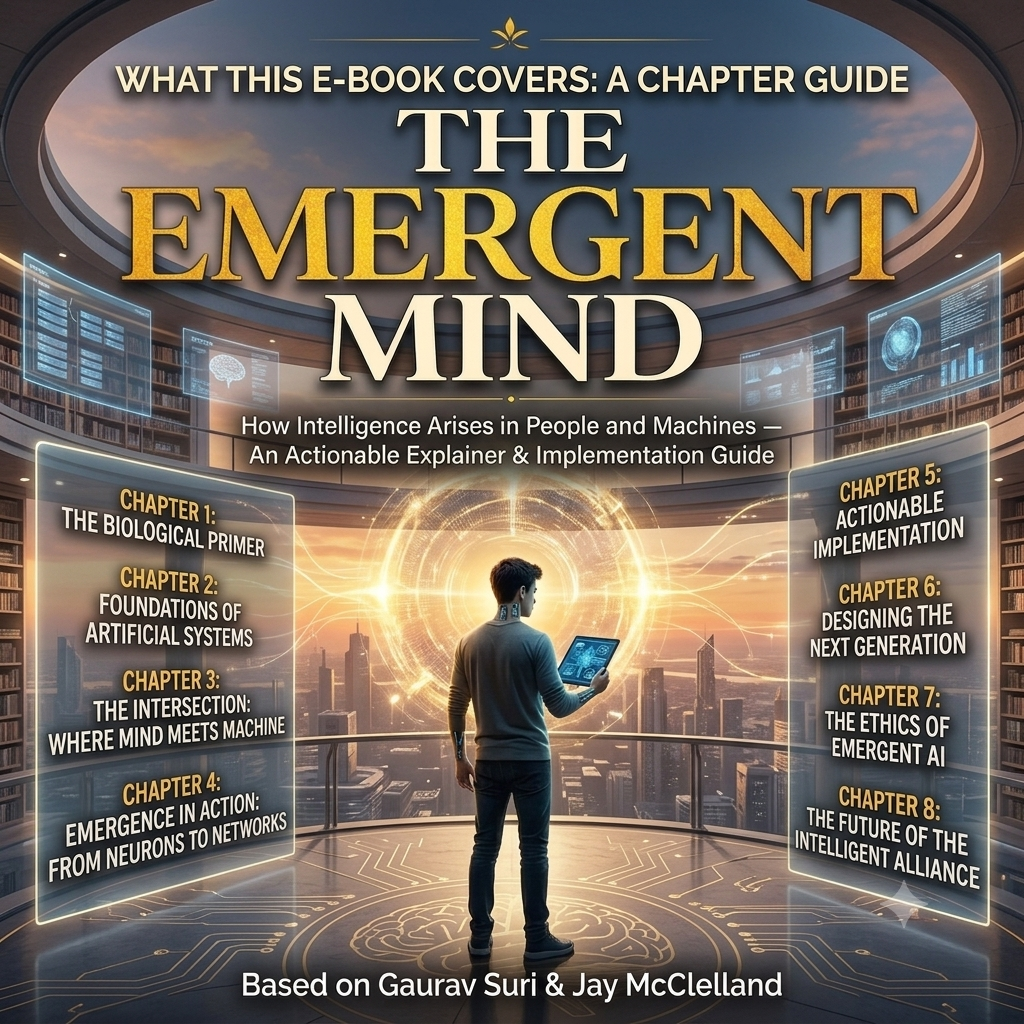
Forget dry textbooks and jargon-heavy explanations. The Emergent Mind is designed as an accessible journey into one of the most fascinating questions in cognitive science and artificial intelligence: how does intelligence actually emerge?
Drawing on ideas explored by Gaurav Suri and Jay McClelland, this digital guide helps unpack the relationship between human cognition and artificial neural networks. Instead of leaving the subject buried beneath technical language, it focuses on the core concepts, mental models, and practical ways to understand them.
Whether you are interested in AI, neuroscience, psychology, education, technology, or the future of intelligent systems, this guide gives you a structured way to explore how patterns, connections, learning, context, and experience contribute to intelligent behaviour.
The guide moves beyond definitions to help you understand the mechanisms and ideas behind intelligence in people and machines.
Explore the idea that intelligence is not simply a pre-installed object, but can arise through patterns, connections, learning, interaction, and experience.
Move from abstract theory toward practical understanding with clear implementation angles that can be useful for developers, educators, researchers, and curious learners.
Examine the parallels and differences between human cognition and artificial systems, including how neural networks can model aspects of learning and intelligent behaviour.
Build useful conceptual models around distributed cognition, parallel processing, pattern recognition, learning, context, and emergent behaviour.
A useful resource for readers who want to explore intelligence without needing to begin with advanced mathematical or technical material.
Many introductions to artificial intelligence and cognition either remain highly simplified or move quickly into technical mathematics. The Emergent Mind occupies the space between those extremes — intellectually serious while remaining approachable.
The result is a framework for thinking about intelligence across disciplines rather than treating human cognition and artificial intelligence as completely separate subjects.
The guide encourages you to look beneath the surface of intelligent behaviour and examine the systems that produce it.
Understand how complex capabilities can arise from interactions among simpler components rather than from one central controlling element.
Explore the connection between models inspired by biological systems and the artificial neural networks used in modern AI.
Examine how learning, context, and accumulated experience can influence behaviour, decisions, and the development of useful representations.
Consider what human and artificial systems have in common, where important differences remain, and what these comparisons reveal about intelligence.
The goal is not simply to collect definitions. It is to change the way you approach the question of intelligence.
Intelligence feels mysterious — difficult to define, difficult to explain, and disconnected from the systems that produce intelligent behaviour.
You have a clearer framework for thinking about how biological and artificial systems build representations, learn from experience, make decisions, and produce mind-like capabilities.
Because understanding intelligence starts with understanding how intelligent behaviour emerges.
The Emergent Mind explores how intelligence and mind-like capabilities can arise in humans and machines, connecting ideas from cognitive science, artificial intelligence, neural networks, learning, and emergence.
The book is written by Gaurav Suri and Jay McClelland, researchers working across psychology, cognitive science, neuroscience, and artificial intelligence.
Yes. The material is presented to make complex ideas around intelligence, cognition, neural networks, and AI more accessible to readers without requiring an advanced technical background.
Yes. A central theme is the relationship between human cognition and artificial neural systems, including similarities, differences, learning, decision-making, and intelligent behaviour.
No. This is primarily an explanatory and conceptual guide. It focuses on understanding intelligence, cognition, neural networks, and emergence rather than teaching a specific programming language or software framework.
This product is a digital eBook. After the purchase is completed, the download link will be shared digitally.
AI enthusiasts, developers, engineers, educators, researchers, entrepreneurs, leaders, psychology and cognitive-science readers, and anyone interested in how minds and intelligent systems work can benefit from the concepts covered.
This product is intended for educational and informational purposes. It is designed to help readers understand concepts relating to cognition, intelligence, artificial intelligence, neural networks, and emergent behaviour.
📘 Ebook & Printed Book Information
Ebook: Available for instant download after purchase.
Printed Copy: Add a printed copy of the book for just ₹2,999 extra.
If you do not receive your ebook after completing your purchase, please email us at hello@lywire.com with the following details:
Our team will verify your order and send the ebook to you as soon as possible.