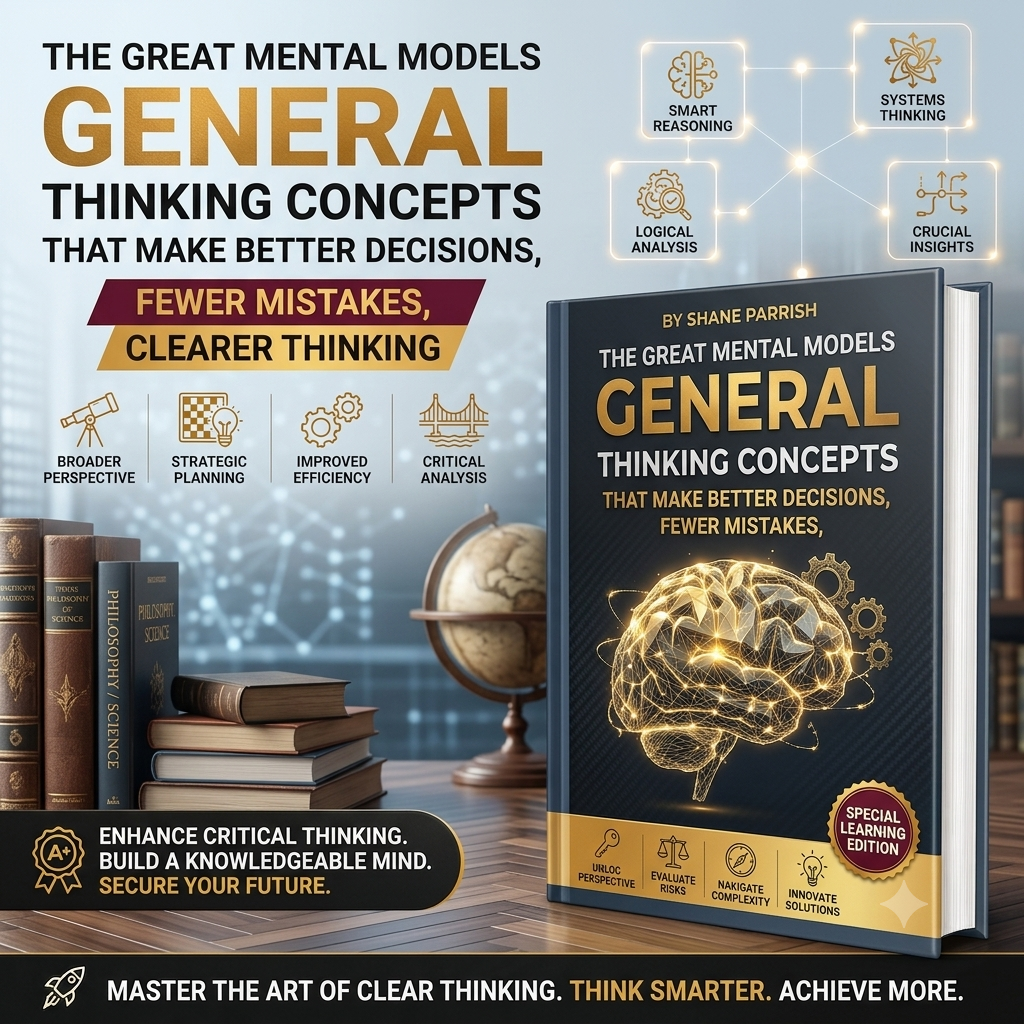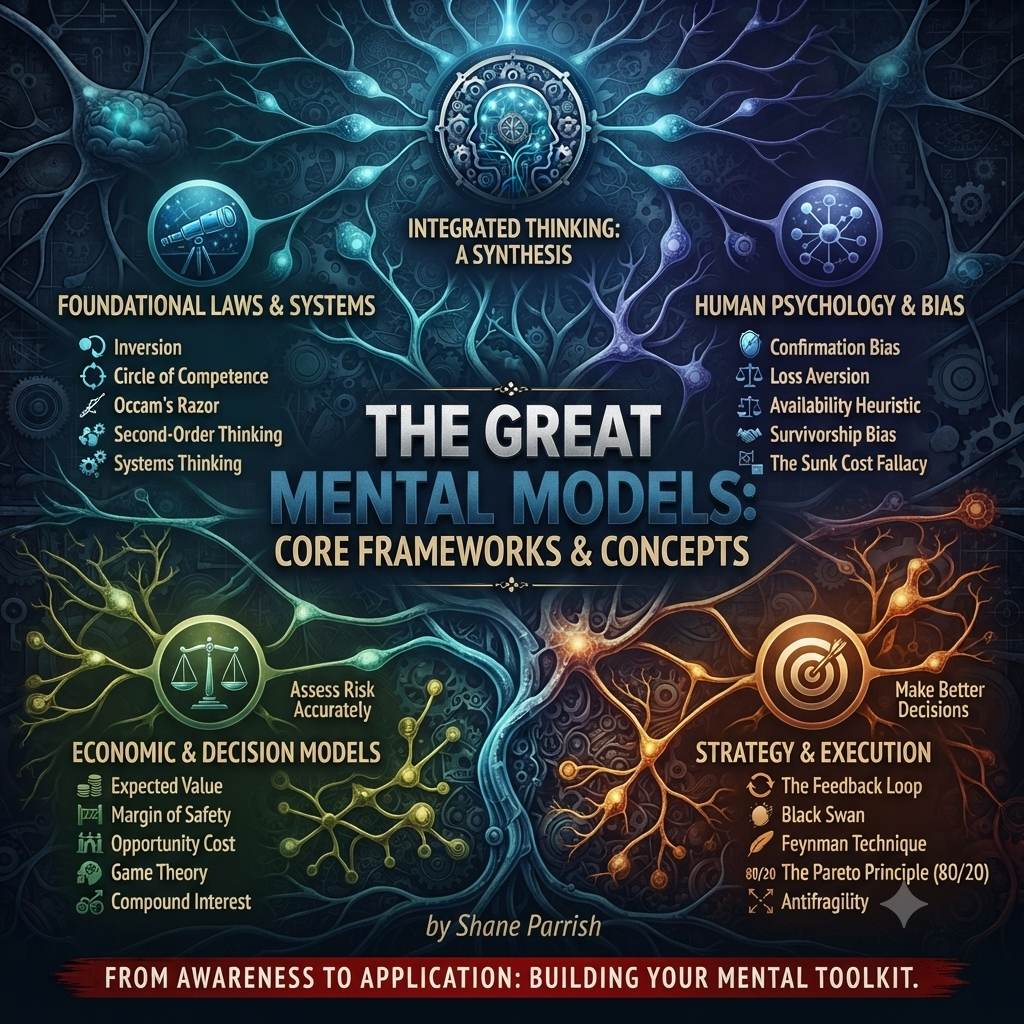


The Great Mental Models
The Great Mental Models
⭐️⭐️⭐️⭐️⭐️ 4.9/5 1445 Reviews
500+ bought in past month
Couldn't load pickup availability
The Great Mental Models
Transform the Way You Think
What if you could approach difficult problems using a collection of powerful thinking tools drawn from different areas of knowledge?
The Great Mental Models introduces practical mental models designed to help you understand problems from multiple perspectives, identify patterns, question assumptions, and make more deliberate decisions.
Rather than relying on a single way of thinking, the book develops a broader mental toolkit by drawing on ideas that can be applied across business, learning, problem-solving, personal decisions, and everyday life.
What You'll Explore
Volume 1, General Thinking Concepts, focuses on nine versatile mental models that can be used across different situations. The publisher describes the book as a guide to essential thinking tools for understanding the world, solving problems, and improving decision-making.

The Map Is Not the Territory
Learn to distinguish between a representation of reality and reality itself.
Circle of Competence
Recognize the boundaries of what you genuinely understand and where uncertainty begins.
First Principles Thinking
Break complex problems down to fundamental elements instead of accepting assumptions automatically.
Thought Experiment
Explore possibilities by deliberately imagining scenarios and testing ideas mentally.
Second-Order Thinking
Look beyond immediate effects and consider what may happen next.
Probabilistic Thinking
Think in terms of probabilities, uncertainty, evidence, and changing information.
Inversion
Approach problems from the opposite direction by considering what you should avoid or prevent.
Occam's Razor
Use simplicity as a useful principle when evaluating competing explanations.
Hanlon's Razor
Consider ordinary explanations before automatically attributing negative outcomes to malicious intent.
Why Mental Models Matter

A mental model is a representation of how something works. Building a broad collection of useful models can help you approach unfamiliar situations with more than one lens.
Instead of asking only, "What should I do?", mental models encourage questions such as: What assumptions am I making? What happens next? What evidence would change my view? What am I overlooking? What happens if I look at the problem in reverse?
- Approach decisions with greater structure and clarity.
- Identify assumptions and potential blind spots.
- Break complicated problems into more fundamental elements.
- Consider consequences beyond the immediate outcome.
- Reason more effectively when information is incomplete.
- Look for patterns across different fields of knowledge.
- Develop a broader toolkit for solving unfamiliar problems.
- Apply useful thinking frameworks to everyday situations.
Who Is This For?
The ideas in this book can be relevant to anyone who regularly needs to understand problems, evaluate information, or make decisions.
| Readers | How Mental Models Can Be Relevant |
|---|---|
| Entrepreneurs & Business Owners | Use structured thinking when evaluating opportunities, risks, strategies, and business problems. |
| Investors & Analysts | Develop frameworks for thinking about uncertainty, evidence, assumptions, and consequences. |
| Leaders & Managers | Consider different perspectives and second-order effects when making decisions. |
| Students & Lifelong Learners | Build transferable ways of approaching unfamiliar subjects and complex questions. |
| Writers & Creatives | Use thought experiments, first principles, and alternative perspectives to explore ideas. |
| Problem Solvers | Develop a broader set of approaches for breaking down and examining difficult problems. |
What Makes This Book Different?
Cross-Disciplinary Thinking
The book focuses on general thinking concepts rather than limiting itself to one professional field. Its models can be considered across business, science, history, personal decisions, and other areas.
Practical Mental Frameworks
Each model is presented as a thinking tool that can be understood and applied to real situations rather than treated as abstract theory alone.
Focus on Fundamentals
The central idea is to develop durable concepts that remain useful across different problems instead of relying only on information that becomes outdated.
Built Around Real-World Application
Farnam Street explains that the volume defines each model, explores real-world examples, and discusses how the ideas can be applied in everyday life.
A Thinking Toolkit You Can Revisit
The value of mental models comes from knowing when and how to use them. As you encounter new problems, the same situation can look different when examined through different frameworks.
Build a broader mental toolkit, question your assumptions, and learn to examine problems from more than one angle.
Whether you are making a business decision, learning a new subject, solving a difficult problem, or trying to understand a complicated situation, these concepts provide a structured way to think about what is in front of you.
Start Building Your Mental Toolkit
Explore the general thinking concepts behind The Great Mental Models and discover practical frameworks for clearer reasoning, problem-solving, and decision-making.
Get Your Copy TodayFrequently Asked Questions
What is The Great Mental Models about?
The Great Mental Models, Volume 1: General Thinking Concepts is a book by Shane Parrish that introduces nine versatile mental models designed to help readers understand problems, evaluate information, and approach decisions more effectively.
Who wrote The Great Mental Models?
The book is associated with Shane Parrish and Farnam Street. The 2024 Penguin edition lists Shane Parrish and Rhiannon Beaubien as authors.
What mental models are covered in Volume 1?
Volume 1 covers The Map Is Not the Territory, Circle of Competence, First Principles Thinking, Thought Experiment, Second-Order Thinking, Probabilistic Thinking, Inversion, Occam's Razor, and Hanlon's Razor.
Is this book useful for business and decision-making?
The book is categorized around decision-making and problem-solving and presents general thinking concepts that can be applied across business and other real-world situations.
Can students benefit from mental models?
Yes. The concepts are general-purpose thinking frameworks and can be used when learning unfamiliar subjects, evaluating information, solving problems, and examining assumptions.
Is this a physical book?
No. This product is offered as a digital eBook. No physical book will be provided.
What's included in the box
What's included in the box