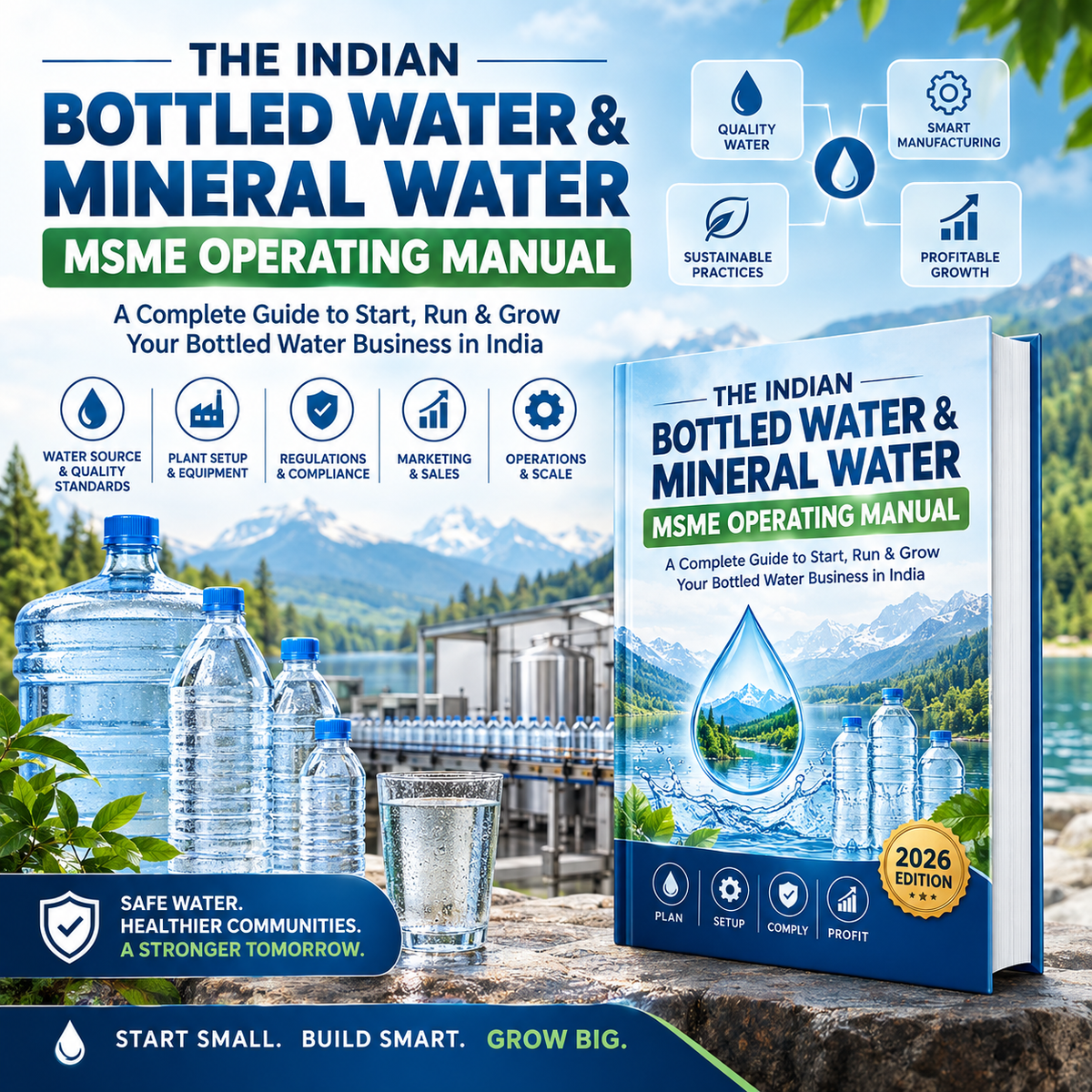


The Opportunity
Understand the market, revenue models, product specifications and manufacturing-engineering fundamentals before committing capital.
⭐️⭐️⭐️⭐️⭐️ 4.9/5 1445 Reviews
500+ bought in past month
Couldn't load pickup availability
From ₹1 Lakh Investment to ₹1 Crore Monthly Profit — Your Complete Factory-to-Fortune Blueprint
India's packaged drinking water industry represents a major FMCG opportunity for entrepreneurs. But entering the sector involves far more than purchasing a bottling machine and filling bottles.
BIS certifications, water-source permissions, FSSAI requirements, plant engineering, quality control, packaging, distribution, working capital and local-market competition can make the difference between a functioning plant and an expensive setup that struggles to operate.
This is not a theory textbook. It is not simply a government brochure or a collection of disconnected business tips. The Indian Bottled Water & Mineral Water MSME Operating Manual is designed as a practical reference for entrepreneurs, plant managers, investors and professionals evaluating or operating a packaged water business in India.
The manual takes you through the major decisions involved in moving from an initial business idea toward a functioning water plant — including setup, compliance, commissioning, operations, quality, procurement, sales, financial planning and long-term growth.
Whether you're scouting your first venture, managing an existing facility, or evaluating the sector from an investment or consulting perspective, the manual is structured to help you understand the complete operating picture before making critical decisions.

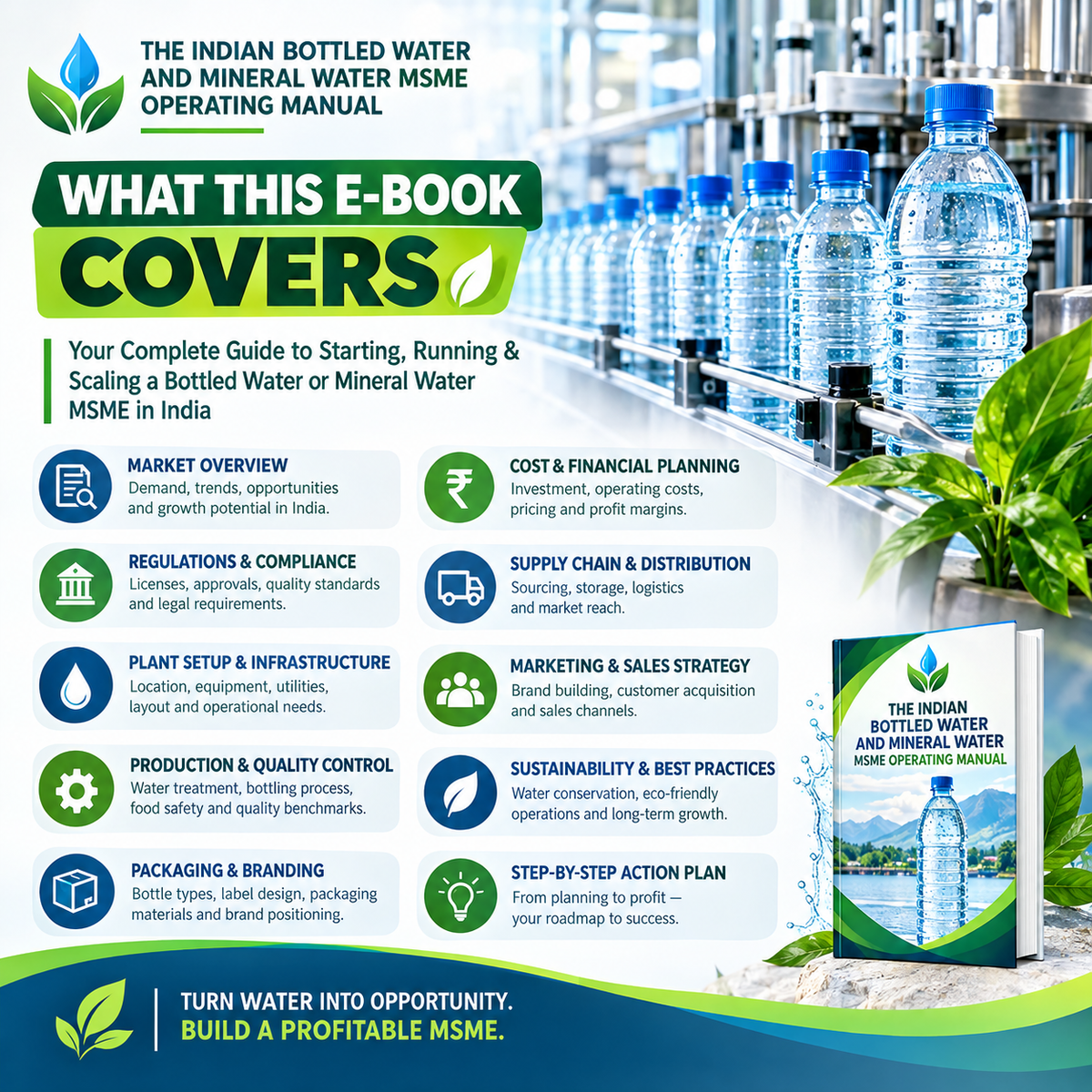
Understand the market, revenue models, product specifications and manufacturing-engineering fundamentals before committing capital.
Navigate BIS IS:14543 and IS:13428 requirements, factory licensing, CGWA permissions, FSSAI approvals and pollution-related clearances.
Follow a structured Day 0 to Day 30 commissioning framework covering the activities required to prepare the plant for commercial operations.
Explore SOPs for water treatment, bottling lines, quality control and machinery maintenance, together with procurement and supply-chain practices.
Work through B2B sales scripts, distributor strategies, pricing considerations and local-market penetration approaches.
Understand staffing structures, unit economics, financial models, compensation planning and business-stage profit milestones.
Explore packaging, competitive positioning, export considerations, automation and software systems for plant monitoring and control.
Cover OEM co-packing, strategic exit planning, plant sustainability and contingency planning for operational risks.
Access master checklists, bank project-report outlines, review templates and a statutory portal directory for registrations and renewals.
Financing a water plant involves understanding available government schemes, lending structures, project documentation and state-specific incentives. This manual brings these areas together so entrepreneurs can investigate relevant funding routes systematically.

| Typical Information | This Manual |
|---|---|
| Vague business overviews | Structured step-by-step action plans |
| Scattered regulatory information | BIS, FSSAI, CGWA and compliance-focused guidance |
| No financial framework | Unit economics and financial-model templates |
| Generic business advice | Water-industry-specific SOPs, sales approaches and operational references |
| Piecemeal information | One integrated operating reference covering the business lifecycle |
By the time you finish this manual, you should have a structured understanding of the major components involved in establishing and operating a packaged water business in India.
Understand plant planning, engineering considerations, equipment, utilities and commissioning requirements before starting operations.
Organize the major certification, licensing, water-source, food-safety and environmental considerations relevant to the business.
Build structured processes for treatment, bottling, quality control, preventive maintenance, procurement and supply-chain management.
Develop practical approaches for institutional customers, distributors, pricing and local-market expansion.
Stop relying on scattered information. Use one structured operating manual to research, plan and organize the major decisions involved in building a packaged water business.
The manual includes 22 chapters covering opportunity assessment, plant setup, compliance, commissioning, operations, quality control, procurement, sales, staffing, financial planning, technology, risk management and reference resources.
Yes. The manual includes guidance related to BIS requirements and references IS:14543 and IS:13428, along with other important compliance considerations for packaged water businesses.
Yes. The manual addresses FSSAI requirements and Central Ground Water Authority (CGWA) considerations as part of its setup and compliance coverage.
Yes. It includes financial-model templates, unit economics frameworks and profit-milestone planning concepts that can be adapted to individual project assumptions.
No. The ₹1 Crore figure is a business-growth target referenced in the product positioning, not a guaranteed financial outcome. Actual investment requirements, revenue, margins and profitability depend on plant capacity, location, pricing, demand, competition, operating efficiency, financing costs and many other factors.
No. Government subsidies, loans, approvals and incentives depend on the applicable scheme, eligibility criteria, documentation and assessment by the relevant authority or lender.
No. This is a digital eBook. After the purchase is completed, the download link will be shared digitally. No physical book will be provided.
It is designed for first-time entrepreneurs, existing plant owners, factory managers, investors, consultants and CA/MBA professionals working on packaged drinking water or mineral water projects.
Yes. The manual includes a bank project report outline and financial planning references that can help organize information for a project report. Final reports should be customized to the specific project and lender requirements.
Research the opportunity. Understand the compliance. Plan the plant. Build the operation.