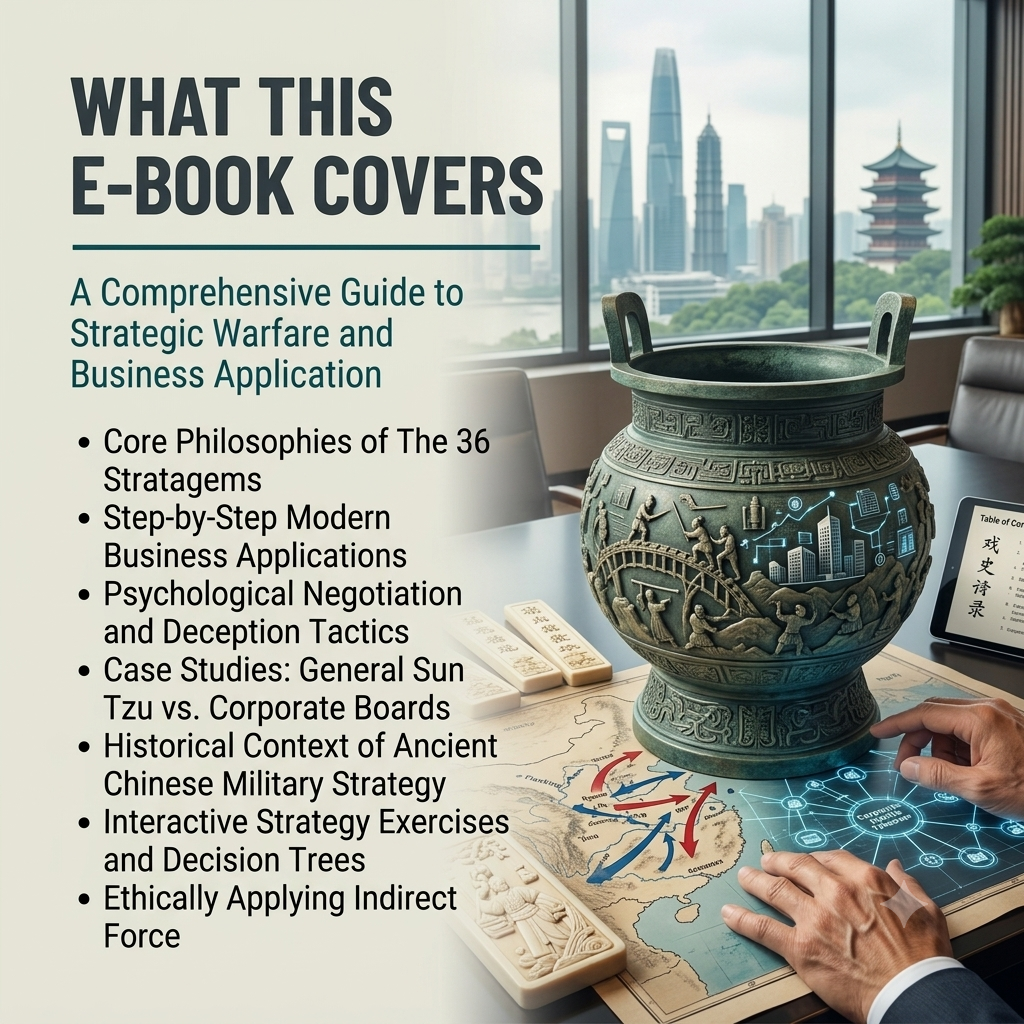


All 36 Stratagems — Fully Decoded
Explore all thirty-six strategic concepts through accessible explanations that connect their traditional meaning with modern situations.
⭐️⭐️⭐️⭐️⭐️ 4.9/5 1445 Reviews
500+ bought in past month
Couldn't load pickup availability
What if some of the most enduring lessons in strategy came not from a modern business school, but from centuries of Chinese military thought, historical examples, and strategic storytelling?
The Thirty-Six Stratagems — A Power Summary translates this influential collection of strategic ideas into a concise, modern guide for readers interested in strategy, negotiation, leadership, competition, and decision-making.
From Ancient China • A Practical Guide to Strategy, Deception, Leadership & Decision-Making
This isn't simply a history lesson. It is a practical exploration of strategic thinking.
The Thirty-Six Stratagems is a famous collection of Chinese strategic maxims associated with warfare, competition, deception, positioning, and overcoming difficult situations. The received collection is organized into six groups of six stratagems, covering circumstances ranging from positions of advantage to situations where survival and withdrawal become important strategic considerations.
This modern interpretation takes those traditional concepts and examines them through a contemporary lens — making them easier to understand and consider in business, negotiations, leadership, entrepreneurship, and everyday decision-making.
The central idea?
Strategy is not only about having more resources. It is also about positioning, timing, information, perception, flexibility, and understanding the situation before deciding how to act.
Built for readers who want to understand strategic thinking and apply its principles to modern situations.

If you operate in an environment where strategy, influence, competition, timing, and decision-making matter, the Thirty-Six Stratagems offers a distinctive framework for examining how people and organizations respond to changing circumstances.
A concise, modern interpretation designed to turn ancient strategic concepts into understandable lessons.

Explore all thirty-six strategic concepts through accessible explanations that connect their traditional meaning with modern situations.
Examine how perception, concealment, misdirection, and indirect action appear throughout strategic thinking — and why recognizing these patterns matters.
Discover strategic lessons relevant to difficult decisions, competitive pressure, negotiations, and moments when conventional approaches may fail.
Learn to examine timing, positioning, strengths, weaknesses, uncertainty, and available alternatives before committing to a course of action.
See how strategic concepts can be interpreted through contemporary business, negotiation, entrepreneurship, competition, and leadership scenarios.
Develop a more deliberate approach to understanding consequences, anticipating reactions, and identifying alternative paths before acting.
“All warfare is based on deception.” — Sun Tzu, commonly translated from The Art of War
Deception is only one part of strategic thinking. The Thirty-Six Stratagems explores a broader collection of ideas involving indirect action, resourcefulness, timing, positioning, opportunity, alliances, misdirection, adaptation, and retreat.
These concepts can be examined beyond military history. They provide useful vocabulary for thinking about competitive environments, negotiations, organizational decisions, entrepreneurship, and situations where people must act with incomplete information.
The value of studying these ideas does not necessarily come from copying historical tactics literally. It comes from understanding the patterns of thinking behind them and recognizing when similar dynamics appear in modern situations.
The traditional collection is divided into six groups of six stratagems each.
| Category | Strategic Theme |
|---|---|
| Stratagems 1–6 | Winning from a position of strength |
| Stratagems 7–12 | Confrontation, positioning, and creating advantage |
| Stratagems 13–18 | The art of attack and offensive positioning |
| Stratagems 19–24 | Confusion, misdirection, and exploiting disorder |
| Stratagems 25–30 | Combined approaches, alliances, and gaining ground |
| Stratagems 31–36 | Desperate situations, adaptation, and strategic escape |
Many decisions are made under pressure, uncertainty, incomplete information, and competing interests.
Studying the Thirty-Six Stratagems encourages a different approach: pause, understand the situation, identify the relationships between the players, examine available resources, anticipate possible reactions, and consider whether direct action is actually the most effective route.
The result is not a promise of guaranteed success. It is a framework for thinking more deliberately about strategy.
The question is not simply what action you should take. The better strategic question is: what is the situation really asking you to understand before you act?
Ancient Chinese strategic thought, decoded and modernized for readers interested in business, negotiation, leadership, competition, and decision-making.
Strategy is not simply about acting first. It is about understanding the situation before you act.Common questions about this Thirty-Six Stratagems Power Summary.
The Thirty-Six Stratagems is a well-known collection of Chinese strategic maxims and historical examples associated with warfare, competition, deception, positioning, and difficult situations. The received collection contains thirty-six stratagems divided into six groups of six.
No. Although the collection is rooted in Chinese strategic and military traditions, this Power Summary interprets its concepts for modern contexts such as business, negotiation, entrepreneurship, leadership, competition, and decision-making.
Yes. The guide is designed around all thirty-six stratagems and presents them through a concise, modern interpretation.
The concepts can be studied as strategic thinking tools for situations involving competition, negotiation, positioning, limited resources, uncertainty, and decision-making. Their application should always be adapted to the specific context and ethical considerations involved.
No. This is a concise practical interpretation intended to make strategic concepts easier to understand and connect with modern situations.
No. This product is a digital eBook. No physical book will be shipped.