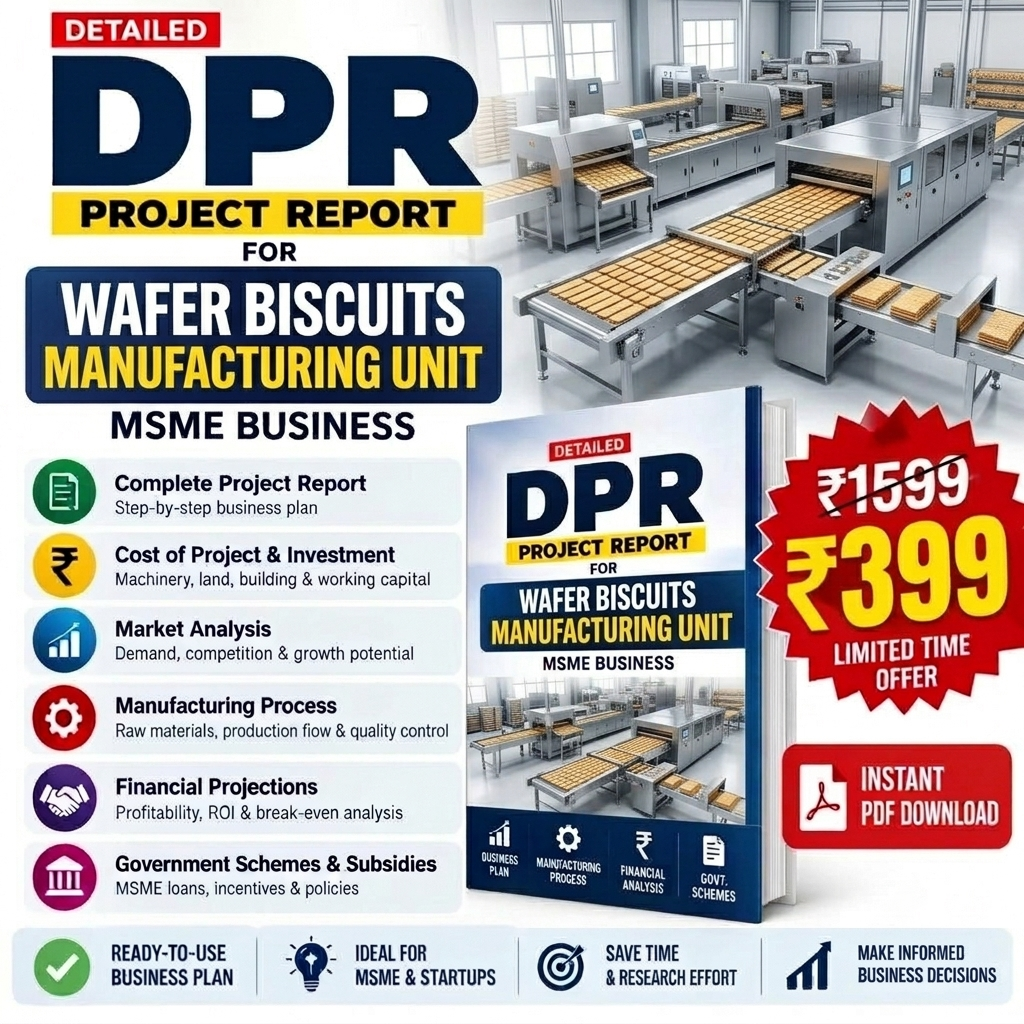

WAFER BISCUITS MANUFACTURING UNIT DETAILED PROJECT REPORT(DPR)
WAFER BISCUITS MANUFACTURING UNIT DETAILED PROJECT REPORT(DPR)
⭐️⭐️⭐️⭐️⭐️ 4.9/5 1445 Reviews
People's Choice
500+ bought in past month
Couldn't load pickup availability
WAFER BISCUITS MANUFACTURING UNIT - Detailed Project Report (DPR)
The Indian biscuit and bakery sector offers opportunities across mass-market, regional and value-added product categories. This Detailed Project Report (DPR) is designed for entrepreneurs who want to evaluate and plan a Wafer Biscuits Manufacturing Unit with a structured understanding of the project concept, manufacturing basis, capacity assumptions, investment requirements and financial projections.
Instead of approaching a manufacturing project without a structured plan, this report provides a practical starting framework for understanding the business, assessing project requirements and preparing for further customization according to your proposed location, capacity and financing structure.
Why Consider a Wafer Biscuits Manufacturing Business?
Biscuits are an established packaged-food category in India, supported by broad consumer familiarity, extensive retail distribution and demand across different price segments. Current industry research also points to continued expansion of India's biscuit, cookies and crackers market.
Industry Context
Current Indian industry data places the biscuit, cookies and crackers market at a substantial scale, with IBEF reporting estimated 2025 revenue of approximately ₹1,16,706 crore and forecasting continued growth through 2030. These figures describe the broader category and should not be interpreted as the projected revenue of an individual manufacturing unit.
Wafer biscuits are also specifically recognised within India's food standards framework. FSSAI's bakery-product standards include wafer biscuits and coated wafers among biscuit products.
What Does This DPR Cover?
This pre-feasibility-oriented report is structured to help aspiring entrepreneurs, investors and project evaluators understand the principal components involved in setting up a Wafer Biscuits Manufacturing Unit.
| Section | Highlights |
|---|---|
| Project Concept | Vision, product scope and industry overview. |
| Manufacturing Basis | 8-hour single-shift operating assumption and 25 working days per month. |
| Capacity Ramp-Up | Capacity utilisation assumptions progressing from 70% to 80% and 100% over the projected period. |
| Financial Projections | Capital investment, operating assumptions, margins and interest-related assumptions. |
| Payback Period | Indicative payback calculation based on the assumptions used in the report. |
| Gestation Timeline | Indicative 6–9 month setup period covering project preparation, surveys and business tie-ups. |
Understanding the Wafer Biscuits Manufacturing Unit
A wafer biscuits manufacturing project requires more than simply purchasing machinery. Entrepreneurs need to consider product formulation, raw-material sourcing, production capacity, utilities, quality control, packaging, manpower, storage, distribution and working capital.
Capacity & Operating Assumptions
The DPR uses a defined operating framework so that the financial model can be evaluated against a consistent set of assumptions.
- 8-hour single-shift operating basis
- 25 working days per month
- Capacity utilisation assumptions of 70%, 80% and 100% across the projected period
- Indicative 6–9 month project gestation period
- Financial calculations based on the assumptions and rates applicable at the time of report preparation
Financial Planning & Project Evaluation
One of the primary purposes of a Detailed Project Report is to provide a structured financial framework for evaluating the proposed manufacturing project.
Your DPR Can Be Customized
A standard DPR provides a structured starting point, but every manufacturing project has different requirements. Your actual project may involve a different capacity, location, investment level, machinery configuration or financing structure.
After purchasing this report, you can request a customized version tailored around your proposed business requirements.
- Your specific production capacity
- Your target geography and market
- Your investment size and financing plan
- Your preferred machinery configuration and supplier region
- Your proposed product range or manufacturing specification
- Other relevant project-specific requirements
Who Should Buy This DPR?
Why This DPR Can Help You Plan the Project
Starting a manufacturing unit involves multiple interconnected decisions. A project report helps bring these decisions together into one structured framework, making it easier to examine the proposed plant, capacity, investment and financial assumptions before moving toward implementation.
Purchase the Wafer Biscuits Manufacturing DPR
Get a structured project reference covering the business concept, manufacturing basis, capacity assumptions, financial projections and key project considerations for a Wafer Biscuits Manufacturing Unit.
Need the report customized to your exact capacity, location or product line? Reach out after purchase to discuss your project-specific requirements.
A tailor-made DPR can incorporate updated and location-specific information based on your proposed capacity, geography, machinery configuration and financing requirements.
Important Project Note
Figures in this report are based on prevailing rates and assumptions at the time of preparation. Actual project costs, machinery prices, raw-material prices, operating expenses, market conditions, financing costs and regulatory requirements may change over time and may vary by location.
A tailor-made project report should incorporate updated, project-specific and location-specific data before being used for investment, financing or implementation decisions.
Frequently Asked Questions
What is included in the Wafer Biscuits Manufacturing DPR?
The DPR covers the project concept, manufacturing basis, capacity utilisation assumptions, financial projections, investment considerations, operating assumptions, project timeline and other key aspects involved in evaluating a Wafer Biscuits Manufacturing Unit.
Is this DPR suitable for a new entrepreneur?
Yes. The report is designed as a structured starting point for first-time entrepreneurs, investors and existing food businesses evaluating a wafer biscuits manufacturing project.
Can the DPR be customized according to my project?
Yes. A customized version can be developed around requirements such as production capacity, location, investment size, financing structure, machinery preferences and other project-specific parameters.
Does the report include financial projections?
Yes. The DPR includes financial projections based on the operating, capacity and cost assumptions used in the report.
What operating assumptions are used in the DPR?
The supplied framework uses an 8-hour single-shift basis, 25 working days per month and capacity utilisation assumptions progressing from 70% to 80% and 100% over the projected period.
How long is the project gestation period?
The supplied project framework uses an indicative 6–9 month gestation period for setup, surveys, preparation and business tie-ups. Actual implementation time can vary according to location, approvals, construction, machinery procurement and other project-specific factors.
Is a physical book provided?
No. This is a digital eBook/Detailed Project Report. The download link will be shared after the purchase is completed.
This report is intended as a project-planning and informational resource. Actual project viability, costs, returns, approvals, financing and implementation requirements should be independently evaluated using current quotations, local regulations and project-specific information.
What's included in the box
What's included in the box
📘 Ebook & Printed Book Information
Ebook: Available for instant download after purchase.
Printed Copy: Add a printed copy of the book for just ₹2,999 extra.
If you do not receive your ebook after completing your purchase, please email us at hello@lywire.com with the following details:
- Order Number
- Email Address
- WhatsApp Phone Number
Our team will verify your order and send the ebook to you as soon as possible.