

Panchasiddhantika Explained
Panchasiddhantika Explained
⭐️⭐️⭐️⭐️⭐️ 4.9/5 1445 Reviews
500+ bought in past month
Couldn't load pickup availability
Panchasiddhantika Explained
Varahamihira's Compendium of Five Astronomies, Decoded
What if the sky of the 6th century could still teach us something today?
One author. Five astronomical systems. One Sanskrit compendium that preserved knowledge that would otherwise survive only as names in later footnotes.
This independent educational explainer opens up one of the most significant surviving records of early Indian mathematical astronomy, exploring the calculations, procedures, mathematical ideas and historical context behind Varahamihira's work.
Beyond the Names: Understanding the Astronomy
The Pañcasiddhāntikā is not simply a collection of ancient astronomical names. It is a window into a world where astronomers developed computational procedures for working with celestial movements, time, eclipses and mathematical relationships.
Varahamihira's compendium brings together material associated with five astronomical traditions. Understanding what these systems actually did requires more than reading their descriptions. It requires following their calculations, examining their assumptions and evaluating their results.
What Makes This Explainer Special

Watch the Gears Turn
Explore how pre-telescopic astronomers approached calculations step by step, working through mathematical procedures rather than simply memorising historical claims.
Honest Grading
Which computational procedures hold up against astronomical reality, and which fall short? Explore the results using analytical comparisons rather than predetermined conclusions.
An Early Table of Sines
Examine the mathematical techniques and sine-related tables that form part of the historical development of Indian mathematical astronomy.
Eclipses: The Great Success Story
Explore eclipse computation, the underlying mathematical procedures and the astronomical reasoning that makes this subject especially fascinating.
Spreadsheet-Ready Learning
Follow worked procedures clearly enough to reconstruct the methods yourself, organise calculations and test the mathematics using your own spreadsheet.
Five Systems, Comparative Thinking
Study different astronomical traditions through common analytical criteria, helping you understand how historical methods can be compared and evaluated.
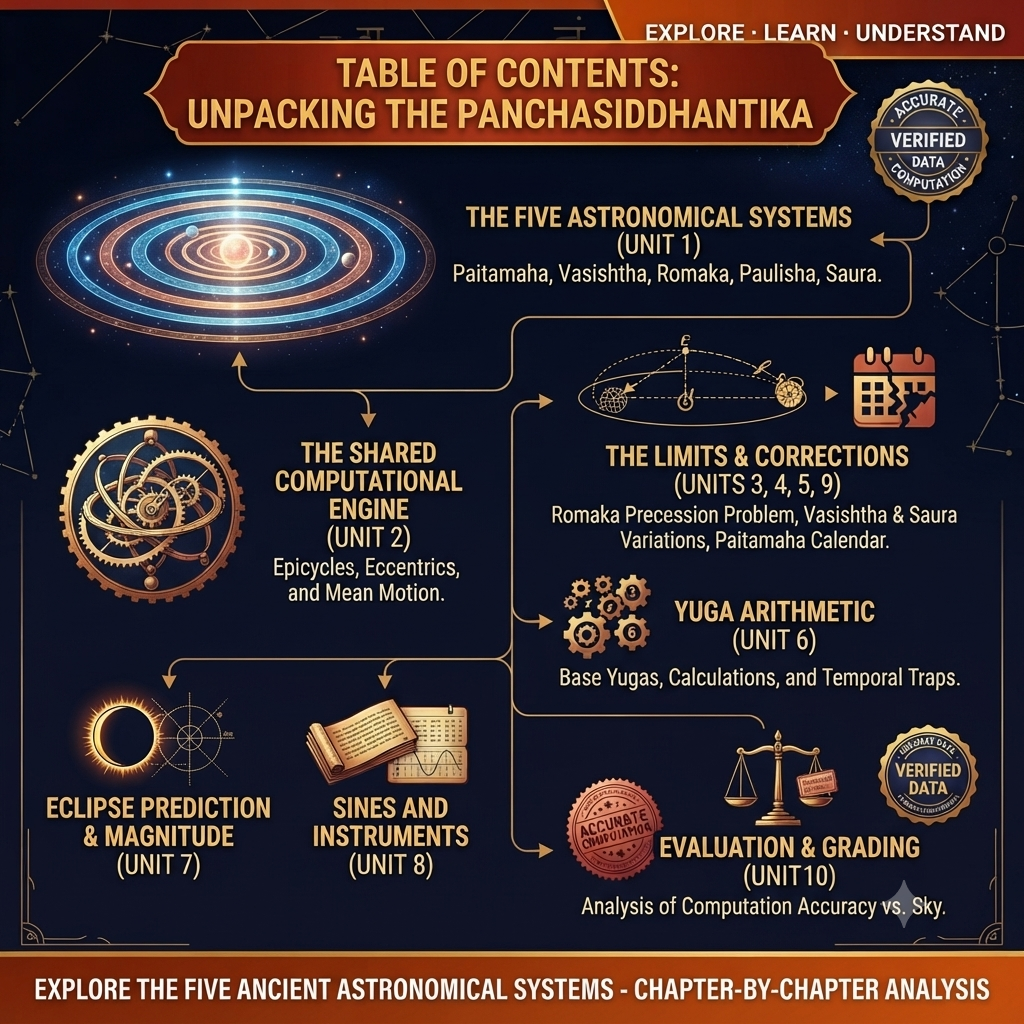
A Clear 10-Unit Learning Journey
Move from historical context to the computational engine of ancient astronomy, then explore time, mathematical techniques, eclipses and the evidence behind a balanced assessment.
Five Astronomical Systems
Discover the historical setting and the five traditions represented in Varahamihira's compendium.
The Shared Computational Engine
Understand the recurring mathematical structures and procedures behind astronomical calculations.
Time and Astronomical Reckoning
Explore the concepts and calculations used to work with astronomical time and celestial positions.
Mathematical Foundations
Examine the mathematical techniques, relationships and numerical procedures used in the astronomical systems.
Tables and Sine Mathematics
Explore sine-related methods and the use of numerical tables in astronomical computation.
Planetary Computation
Study computational approaches to celestial positions and the underlying mathematical reasoning.
Solar and Lunar Phenomena
Explore astronomical procedures associated with the Sun, Moon and their changing positions.
Eclipse Calculations
Examine the mathematical steps involved in predicting and analysing eclipse-related phenomena.
Rebuilding the Methods
Work through the procedures, organise the numbers and explore how the calculations can be reconstructed.
A Fair, Evidence-Based Verdict
Bring together the methods, comparisons and historical evidence to assess the systems without exaggeration or dismissal.
Who Should Read This?
Students of Astronomy History
For readers exploring the history of astronomy, mathematical traditions and the development of astronomical knowledge.
Readers of Classical Astrology
For readers of traditional astrological texts who are curious about the actual mathematical and astronomical computations beneath them.
Mathematics Teachers
For educators looking for historical mathematical problems, numerical procedures and examples that connect mathematics with real applications.
Curious History and Science Readers
For anyone fascinated by how skilled professionals of another century worked, reasoned, calculated and developed technical methods.
Read This First: An Honest Approach
This is not a book designed to prove that ancient India possessed modern astronomy, nor is it designed to dismiss historical astronomical work as mere luck.
Its approach is analytical. It focuses on mechanics, methods, calculations, assumptions and evidence.
It does not attempt to turn historical cosmology into a modern scientific description of the universe. Cosmological and geographical ideas found in the historical material are treated as part of the context in which these systems developed.
Bring curiosity, mathematical patience and an open mind. The objective is understanding, not mythology or sensationalism.
Why You'll Love This Explainer

- Comparative method: Five astronomical systems examined through a structured approach.
- Computational focus: Learn how the methods worked rather than relying on vague descriptions.
- Critical perspective: Evaluate historical computations using clear analytical criteria.
- Mathematical exploration: Follow procedures, numerical examples and computational logic.
- Independent educational approach: A learning resource focused on explanation and analysis, not sensational historical claims.
- Self-paced learning: Read, revisit and reconstruct the methods at your own pace.
Decode the Ancient Sky
Step into the mathematical world of Varahamihira and explore the computational methods, astronomical reasoning and historical evidence behind the five systems.
Get your copy of Panchasiddhantika Explained and begin your journey through the mechanics of ancient astronomy.
A digital educational eBook designed for independent reading and exploration.
Frequently Asked Questions
What is Panchasiddhantika Explained?
Panchasiddhantika Explained is an independent educational explainer exploring the historical astronomical work associated with Varahamihira. It focuses on understanding the mathematical procedures, computational methods and historical context of the five astronomical traditions.
What is the Panchasiddhantika?
The Pañcasiddhāntikā is a historical astronomical compendium associated with the sixth-century astronomer Varahamihira. It summarises material from five astronomical traditions: Paitāmaha, Vāsiṣṭha, Romaka, Pauliśa and Saura.
Does this eBook explain the mathematics used in ancient astronomy?
Yes. Its educational focus includes computational procedures, mathematical techniques, astronomical calculations and the reasoning behind historical methods.
Does it cover eclipse calculations?
Yes. Eclipse computation is one of the central subjects explored, including the mathematical methods and procedures used in historical astronomical systems.
Is this a translation of Varahamihira's original text?
No. It is an independent educational explainer. It is not a translation or reproduction of the original Sanskrit text.
Is this book suitable for beginners?
It is intended for curious learners, students of history and astronomy, mathematics enthusiasts and readers interested in classical astronomical methods. Readers who are comfortable taking their time with mathematical concepts may find it particularly rewarding.
Does this book claim ancient astronomy was equivalent to modern astronomy?
No. It takes an evidence-based approach to historical computations and methods. The purpose is to understand and evaluate the techniques rather than make exaggerated claims about their equivalence to modern astronomical science.
How will I receive this book?
This is a digital eBook. The download link will be shared after the purchase is completed. No physical book will be shipped.
Can I read this eBook at my own pace?
Yes. As a digital educational resource, it can be read at your own pace, allowing you to revisit mathematical procedures, historical concepts and explanations as needed.
Editorial note: An independent educational explainer. Not a translation or reproduction of the original text.
What's included in the box
What's included in the box