

Time, Counted in Cycles
Understand how vast cosmic time cycles connect with practical systems of astronomical time-reckoning and everyday calculations.
⭐️⭐️⭐️⭐️⭐️ 4.9/5 1445 Reviews
500+ bought in past month
Couldn't load pickup availability
The Sun's Own Treatise, Read the Way a Modern Mind Reads It
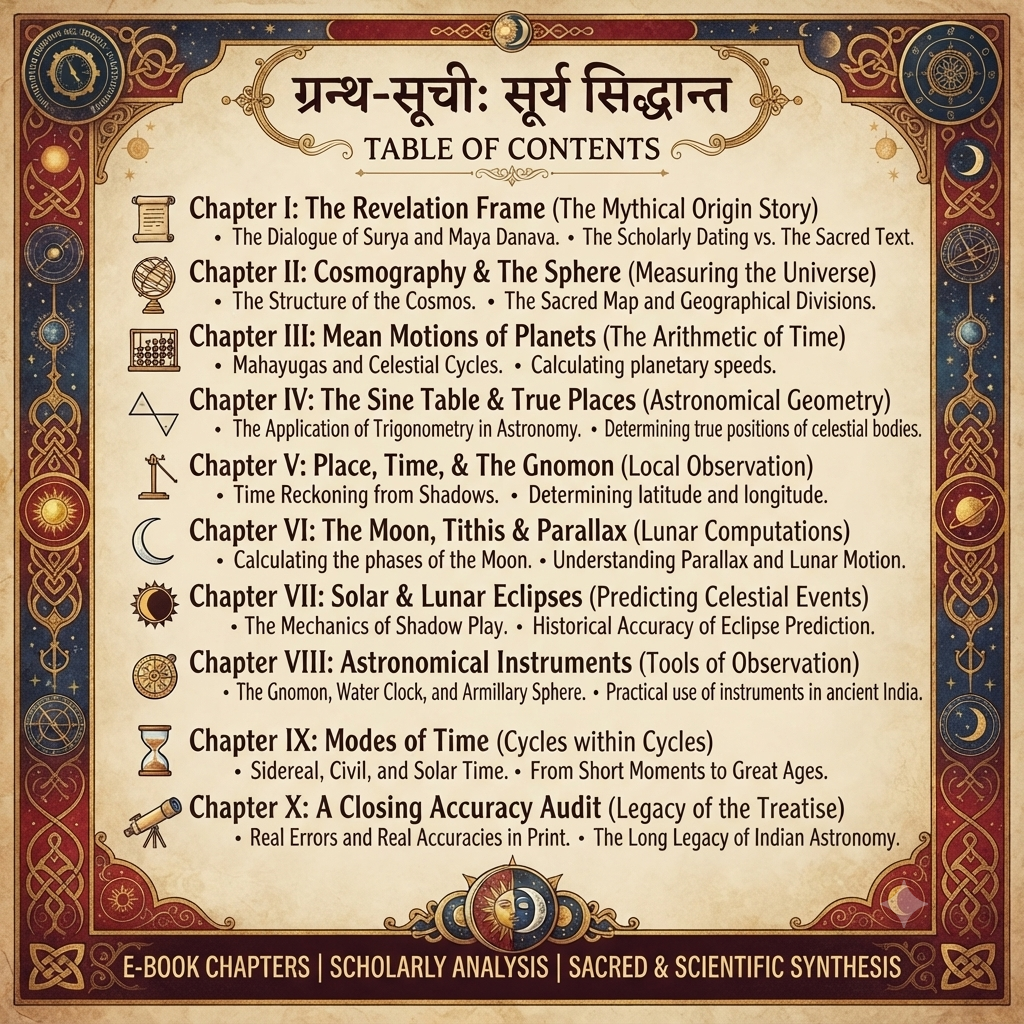
What if an ancient book of the sky could be examined with nothing more than a stick and a shadow? The Sūrya Siddhānta offers a remarkable window into traditional Indian mathematical astronomy: its models of celestial motion, methods of calculation, treatment of eclipses, and ways of measuring time.
Traditionally presented as knowledge revealed by the Sun to Maya Danava, the text is commonly encountered in a recension of approximately 500 verses across 14 chapters. It became an influential reference in the history of Indian astronomical computation and calendrical practice.
The Sūrya Siddhānta is more than a collection of stories about the heavens. It contains a structured computational approach to celestial phenomena, including mean planetary motions, corrections for apparent positions, angular relationships, eclipses, and time-reckoning.
This book helps readers understand what the text actually attempts to calculate, how its methods work, and where its models should be treated with caution.

Explore the ideas, calculations, and observational methods that make this classical astronomy text worth studying.
Understand how vast cosmic time cycles connect with practical systems of astronomical time-reckoning and everyday calculations.
Discover how trigonometric ideas and sine tables help correct average celestial motions to estimate more specific positions.
Explore the text's eclipse calculations, the geometry behind them, and the importance of comparing computed predictions with observable events.
Learn how a gnomon, or shadow-casting instrument, can help explain solar position, direction, altitude, and aspects of time measurement.
Examine how astronomical calculations coexist with traditional cosmological ideas, and why these different layers should not be treated as interchangeable.
Explore multiple ways of reckoning time, followed by a critical review of the text's computational strengths, limitations, and long historical legacy.
Ancient scientific texts deserve careful reading. This explainer focuses on specific claims, methods, and historical context instead of broad statements about an entire civilisation.

“Grade the gears by the striking. This book kept its receipts.”
Examine the method. Check the result. Understand the limits.
Open the Sun's treatise and explore what its calculations, observations, and historical influence reveal. Surya Siddhanta Explained offers a clear, balanced introduction to one of the most remarkable works in the history of Indian mathematical astronomy.
The Sūrya Siddhānta is a classical Sanskrit treatise on Indian mathematical astronomy. It discusses subjects such as planetary motions, time-reckoning, celestial calculations, eclipses, and methods for understanding the positions of heavenly bodies.
The commonly encountered recension is organised into 14 chapters and is generally presented as containing approximately 500 verses. Textual history and variations between editions should be kept in mind.
Yes. It includes mathematical procedures relating to celestial motions, trigonometric calculations, time systems, and eclipse computation. The book explains these subjects in their historical context.
Yes. It explores the role of sine values and geometrical corrections in traditional astronomical calculations, helping readers understand how average motions are adjusted to estimate celestial positions.
Yes. Eclipse calculations form an important part of its astronomical subject matter. This explainer looks at the computational ideas and encourages a critical comparison between historical methods and observable results.
It contains traditional cosmological and sacred framing alongside mathematical astronomical procedures. A careful reading distinguishes its cultural and religious context from the methods that can be examined as historical mathematical astronomy.
No. It is an explanatory guide to a historical astronomical text and its computational ideas. It is not designed to provide personal horoscopes, birth-chart readings, or individual predictions.
It is suited to students of astronomy history, mathematics enthusiasts, Jyotiṣa learners interested in computational foundations, and curious readers exploring classical Indian knowledge traditions.
No. This is a digital eBook. The download link will be shared after the purchase is completed. No physical book will be shipped.