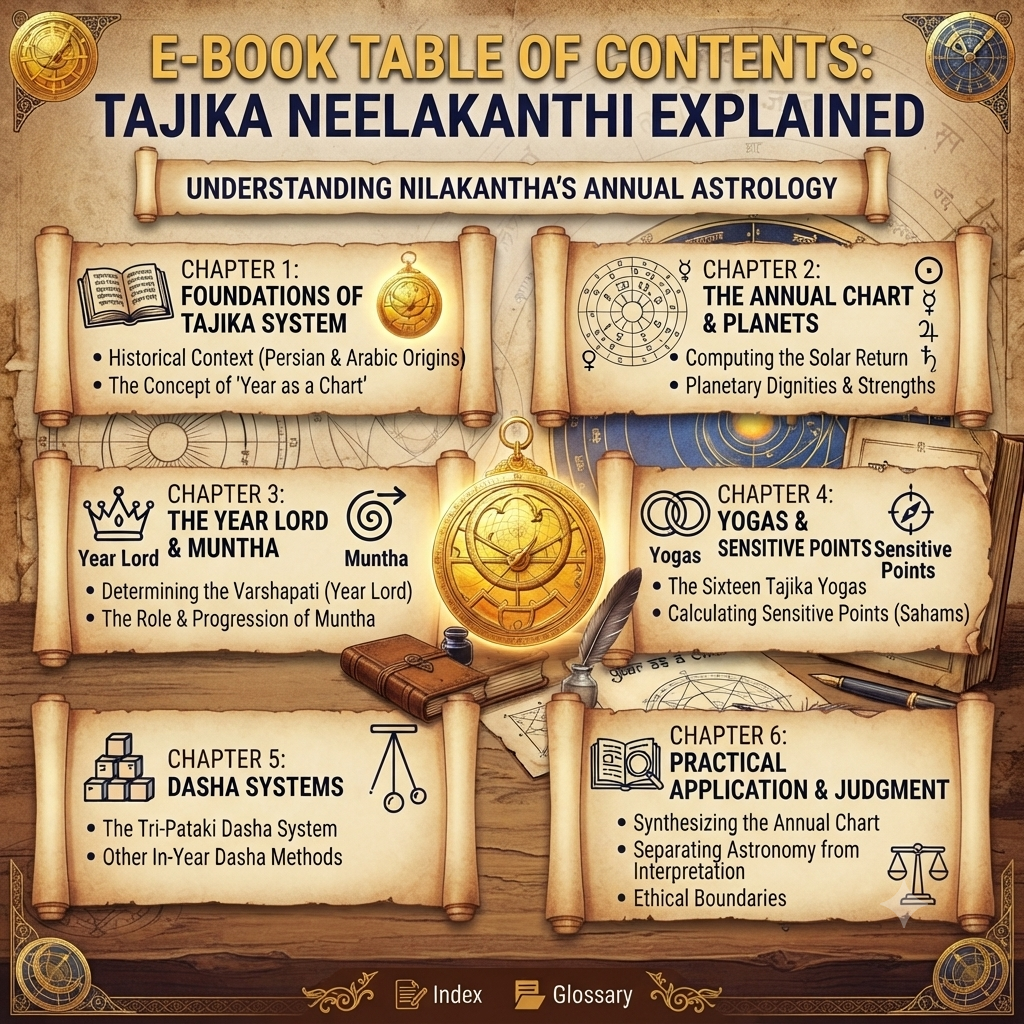


The Architecture of the Text
Understand how the classic is organised, what its principal sections address and how its different technical elements fit together as a system.
⭐️⭐️⭐️⭐️⭐️ 4.9/5 1445 Reviews
500+ bought in past month
Couldn't load pickup availability
Read a single year of a chart. Know exactly what you're reading.
The classic text behind an influential tradition of annual chart interpretation deserves more than mystery, exaggerated claims or simplified summaries. This independent educational explainer examines Tajika Neelakanthi with historical context, clear explanations and a careful distinction between traditional rules and claims that can be independently tested.
Completed in 1587 CE and attributed to Nilakantha Daivajna, Tajika Neelakanthi became a major Sanskrit work associated with the Tajika tradition of astrology. Its subject is especially significant: the interpretation of an individual year through an annual horoscope.
The work belongs to a wider history of intellectual exchange. Tajika astrology brought Perso-Arabic astrological concepts and terminology into Sanskrit scholarly literature, where they were adapted, organised and developed within an Indian intellectual setting.
The story is not simply one of an isolated, unchanged tradition. It involves transmission, adaptation and debate across languages and cultures. This guide explores that history without reducing it to a slogan or treating every historical claim as settled fact.

Explore the text as a structured body of ideas: its historical setting, technical vocabulary, annual-chart method and the questions that arise when traditional interpretations are examined critically.
Understand how the classic is organised, what its principal sections address and how its different technical elements fit together as a system.
Examine the Perso-Arabic connections behind Tajika astrology, the movement of ideas into Sanskrit and the wider history of Indo-Islamic intellectual exchange.
Separate historical evidence, mathematical procedures, traditional conventions and predictive claims. Learn what can be checked, what must be interpreted and what requires independent testing.
Follow the logic of reading an annual chart within its traditional framework, while keeping its scope and limitations in perspective.
Discover why editions, translations and commentarial traditions may differ, and why those differences should be acknowledged rather than quietly harmonised.
Develop a more disciplined way to approach historical astrological material, question unsupported statements and distinguish a source's actual contents from later interpretations.
The aim is not to encourage blind acceptance. It is to help readers understand what the traditional method says, how its parts relate and where interpretation begins.
Begin with the historical context, terminology and purpose of annual horoscopy in the Tajika tradition.
Learn how the text describes the elements and relationships used in its annual-chart approach.
Recognise the difference between a procedure that can be recalculated and a traditional meaning that depends on an interpretive framework.
Consider the evidence, assumptions and limitations behind predictive statements instead of treating them as established facts.
The scope of this product is deliberately educational. It is important to be clear about what you are—and are not—receiving.

For students who want to move beyond surface-level descriptions and understand the historical and technical foundations of Tajika astrology.
For readers interested in the history of Indian astronomy, astrology, Sanskrit scholarship and cross-cultural transmission of ideas.
For practitioners seeking a more careful, source-aware and intellectually grounded understanding of the annual-chart tradition.
For anyone who values clear explanations, historical context and critical thinking over exaggerated claims.
It borrowed carefully, systematised well, and then lost the receipt.
Explore the history, follow the evidence and decide what the sources actually support.Go beyond simplified summaries. Explore the ideas, historical connections and interpretive framework behind Tajika Neelakanthi through an independent educational explainer designed for thoughtful readers.
It is an independent educational explainer about the historical Sanskrit work Tajika Neelakanthi, attributed to Nilakantha Daivajna and completed in 1587 CE. It introduces the text's background, structure, annual-chart tradition and interpretive framework.
Nilakantha Daivajna was a sixteenth-century Indian astrologer and scholar associated with the Tajika tradition. He is known for the influential work Tajika Neelakanthi, completed in 1587 CE.
Tajika is a tradition of astrology expressed in Sanskrit literature that incorporates concepts and techniques associated with Perso-Arabic astrology. It is particularly associated with annual horoscopy, commonly known as Varshaphala.
Varshaphala refers to the traditional practice of interpreting a horoscope for a particular year, commonly based on the Sun's return to its natal position. This guide explains the method as a historical and traditional system; it does not provide an individual annual forecast.
No. This is an educational explainer. It does not prepare a personal horoscope, calculate an individual's annual chart or provide predictions about anyone's future.
Yes. It explores the historical relationship between Sanskrit astrological literature and Perso-Arabic ideas, including how concepts and terminology were adapted within the Indian scholarly tradition.
No. The explainer distinguishes historical facts and calculational procedures from traditional interpretations and predictive claims. It does not present astrological prediction as scientifically established.
It is intended for astrology students, practitioners, readers interested in the history of Indian astronomy and astrology, and anyone who prefers careful explanations over unsupported claims.
No. It is an independent educational explainer and is not affiliated with the original publisher, authorial lineage or any astrological organisation or tradition.