

The Selfish Gene Explained
The Selfish Gene Explained
⭐️⭐️⭐️⭐️⭐️ 4.9/5 1445 Reviews
500+ bought in past month
Couldn't load pickup availability
The Selfish Gene Explained
A Gene-Centred View of Evolution: Explained, Examined and Challenged
What if evolution looks different when you examine it from the perspective of genes?
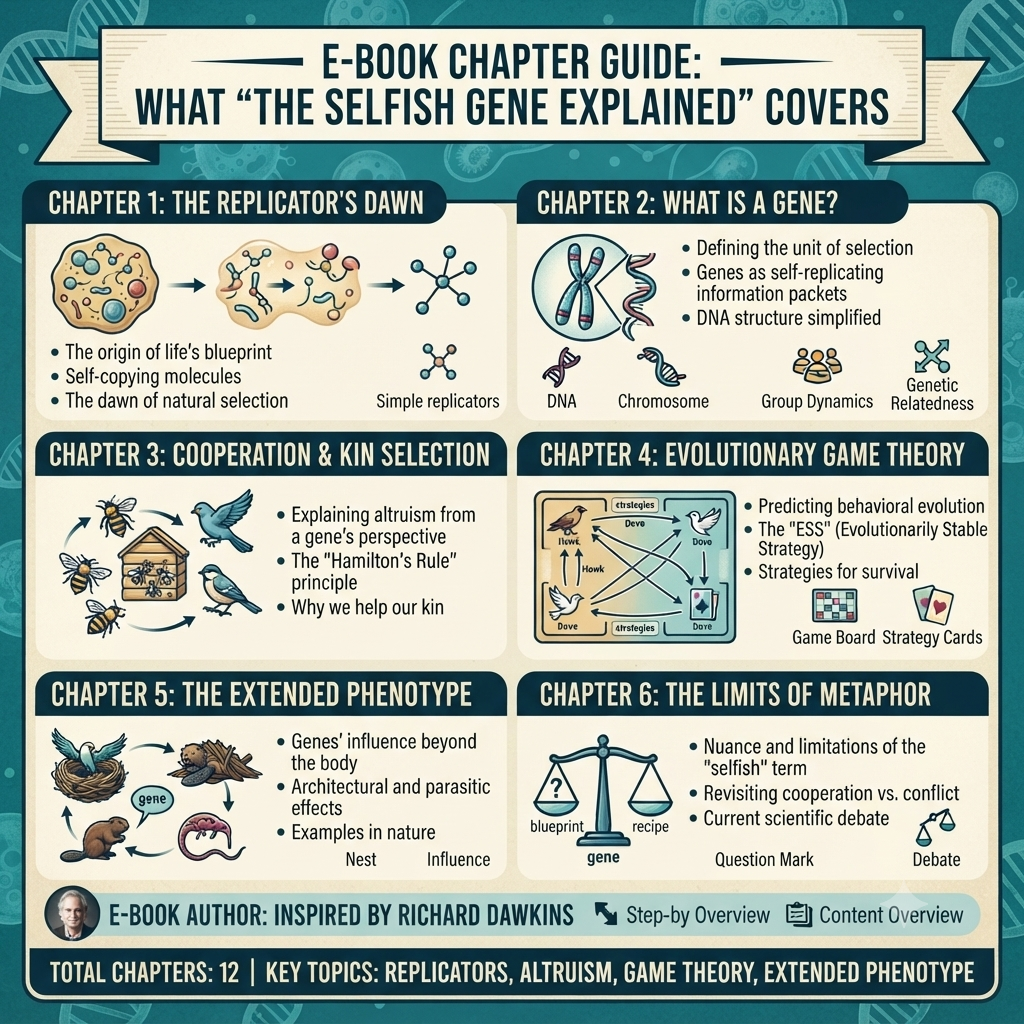
One influential way of understanding evolution places genes at the centre of the explanation. It explores how replicators persist across generations, how natural selection shapes living organisms, and why behaviours such as cooperation and kin-directed support can evolve.
The Selfish Gene Explained turns these challenging ideas into a clear, accessible and thoughtfully structured learning experience. Explore the gene-centred perspective, understand the meaning behind the term "selfish gene", and examine the scientific discussions surrounding this influential approach to evolutionary thought.
What You'll Discover Inside

Replicators and Natural Selection
Understand replicators, genes and the role of natural selection in explaining how inherited information persists and changes across generations.
Cooperation and Kinship
Explore why organisms may cooperate, help relatives or engage in behaviours that appear costly to themselves, and how evolutionary theories attempt to explain these patterns.
Beyond the Selfish Gene Metaphor
Examine what "selfish" means in an evolutionary context, why it is a metaphor, and why genes should not be understood as conscious or intentional actors.
Scientific Examination and Criticism
Go beyond a simple overview by exploring questions, debates and alternative perspectives surrounding gene-centred explanations of evolution.
Understand the Big Ideas Behind Evolution
The gene-centred perspective offers one way to interpret evolutionary change. This handbook helps readers explore important concepts and the relationships between them, including:
- Genes, inheritance and replication across generations.
- Natural selection and the evolution of adaptations.
- Replicators and the organisms that carry them.
- Kin selection, relatedness and inclusive fitness.
- Cooperation, reciprocal interactions and social behaviour.
- The relationship between genes, organisms and evolutionary explanations.
- Scientific criticism and the limitations of gene-centred interpretations.
Who Is This Guide For?

- Biology students: Build a clearer understanding of evolutionary theory, genetics and natural selection.
- Psychology and philosophy students: Explore how evolutionary explanations connect with behaviour, human nature and scientific reasoning.
- Curious readers: Make sense of an influential scientific idea without getting lost in unnecessary jargon.
- Science and book enthusiasts: Examine a major debate in evolutionary thought and develop your own perspective.
Why You'll Appreciate This Handbook
- Clear explanations: Complex evolutionary concepts are presented in accessible language.
- Structured learning: Follow connected ideas in an organized sequence.
- Critical perspective: Explore both the influence and the limitations of gene-centred explanations.
- Conceptual understanding: Connect ideas such as replication, cooperation, kinship and natural selection.
- Useful for discussion and study: Build a foundation for further reading, classroom discussion and independent exploration.
Ready to Rethink Evolution?
Explore how genes, organisms, cooperation and natural selection fit into one of biology's most thought-provoking perspectives.
Get The Selfish Gene Explained and start exploring the ideas that continue to shape debates about evolution and life.
Digital eBook | Accessible explanations | Read at your own pace
Frequently Asked Questions
1. What is The Selfish Gene Explained about?
It is an explanatory guide to the gene-centred perspective on evolution. It explores replicators, natural selection, cooperation, kinship and the scientific debates surrounding the selfish gene concept.
2. What does the term "selfish gene" mean?
It is an evolutionary metaphor describing how genes associated with successful replication can become more common across generations. It does not mean that genes have thoughts, intentions or conscious desires.
3. Does the guide explain cooperation and kin selection?
Yes. It introduces the evolutionary ideas used to understand cooperation, relatedness, kin selection and behaviours that may benefit genetically related individuals.
4. Is this guide suitable for beginners?
Yes. It is designed for curious readers and students who want accessible explanations of important evolutionary concepts without needing to begin with highly technical scientific literature.
5. Does the handbook discuss criticisms of the gene-centred view?
Yes. It introduces critical perspectives and scientific debates, helping readers understand that gene-centred explanations are an influential way of interpreting evolution, not the only level or framework used in evolutionary biology.
6. Is this Richard Dawkins' original book?
No. This is a separate explanatory eBook about the ideas associated with the gene-centred view of evolution. It is not the original book by Richard Dawkins, nor an official publication or endorsed companion to it.
7. Is this a physical book or a digital product?
This is a digital eBook. No physical book will be shipped. The download link will be shared after the purchase is completed.
What's included in the box
What's included in the box