

Ultralearning by Scott H Young Explained
Ultralearning by Scott H Young Explained
⭐️⭐️⭐️⭐️⭐️ 4.9/5 1445 Reviews
500+ bought in past month
Couldn't load pickup availability
Ultralearning by Scott H. Young, Explained
Understand the Principles of Learning Difficult Skills Faster, Deeper, and More Effectively
Stop studying passively. Start learning with purpose.
Have you ever spent hours reading, watching tutorials, and highlighting notes, only to struggle when it is time to apply what you learned? The problem may not be your ability to learn. It may be the way you approach learning.
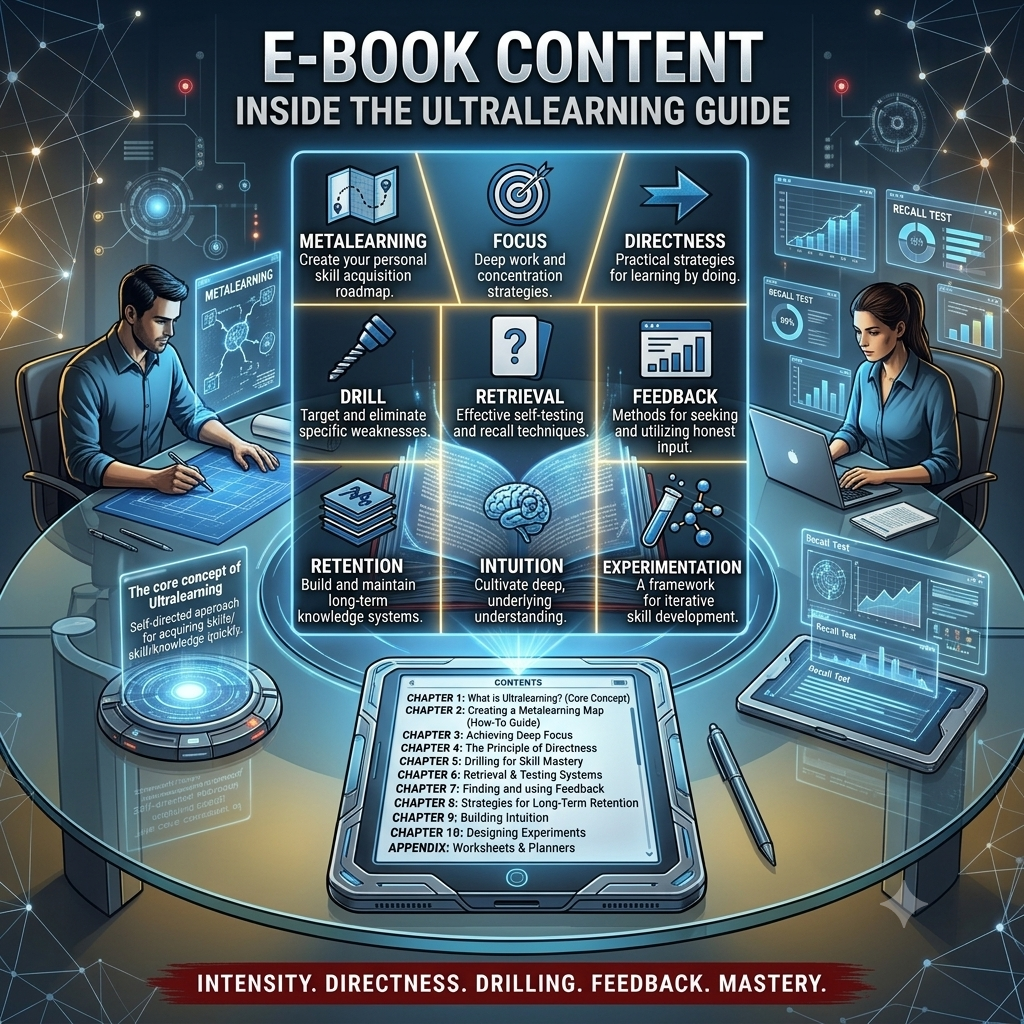
Ultralearning by Scott H. Young, Explained is a focused digital explainer that breaks down the central ideas behind the ultralearning approach: a self-directed method for developing challenging skills through deliberate practice, focused effort, and practical application.
Explore the book's key concepts in a clear, accessible format and discover how to think more strategically about the skills and subjects you want to master.
Is This Explainer For You?
- Students who want to make their study sessions more active and effective.
- Career changers building new professional skills and capabilities.
- Self-taught learners looking for a more structured approach to independent learning.
- Professionals learning new tools, technologies, or areas of expertise.
- Anyone interested in learning languages, academic subjects, creative skills, or practical abilities.
The Problem With Passive Learning
Reading, watching, and highlighting can create a feeling of familiarity without necessarily building the ability to recall or use information. Learning becomes more meaningful when you actively practise, test your understanding, identify weaknesses, and apply knowledge in realistic situations.
This explainer introduces the reasoning behind a more deliberate approach to learning and shows why simply spending more time consuming information may not be enough.
Explore the Nine Principles of Ultralearning

Understand the nine principles presented in Scott H. Young's book and how they contribute to a self-directed learning project.
1. Metalearning — Learn How to Learn
Understand the skill you want to develop, identify what it involves, and map out the resources, methods, and knowledge areas needed to begin.
2. Focus — Build Concentration
Explore how dedicated attention, planned learning sessions, and reducing distractions can support more productive practice.
3. Directness — Practise the Real Skill
Connect learning activities to the actual situations in which you want to use a skill instead of relying only on indirect preparation.
4. Drill — Improve Your Weakest Areas
Identify specific gaps in your performance and work on targeted exercises that help strengthen those areas.
5. Retrieval — Test What You Know
Explore active recall and self-testing as ways to check understanding instead of depending entirely on repeated reading or reviewing notes.
6. Feedback — Learn From Honest Evaluation
Understand the value of useful criticism, performance feedback, and making adjustments based on what your results reveal.
7. Retention — Make Learning Last
Explore approaches to maintaining knowledge and skills over time, including review, practice, and strategies for reducing forgetting.
8. Intuition — Develop Deeper Understanding
Discover how working through examples, exploring underlying ideas, and building experience can help develop a stronger grasp of complex subjects.
9. Experimentation — Find Your Own Approach
Learn why testing different methods, adjusting techniques, and exploring unfamiliar approaches can help you improve as your skills develop.
What You Can Take Away

Build a Metalearning Map
Break down a learning goal and identify the knowledge, resources, and practice areas involved.
Practise More Directly
Connect your learning activities with the real tasks and situations where you want to use your skills.
Use Retrieval and Drills
Move beyond passive review by testing your knowledge and targeting areas that need improvement.
Use Feedback Constructively
Learn to evaluate your progress, identify mistakes, and adjust your practice methods.
Strengthen Retention
Explore ways to revisit and practise important knowledge so it remains useful over time.
Experiment With Learning Methods
Develop a more flexible approach by testing techniques and adapting them to your learning goals.
Why Choose This Book Explainer?
- Focused and easy to follow: Explore the central concepts without having to work through the entire original book first.
- Clear explanations: Understand key learning ideas in an accessible, structured format.
- Practical perspective: Connect the principles with your own study, career, and skill-development goals.
- Useful for different learners: Apply the ideas to academic subjects, professional development, languages, and independent projects.
- A convenient reference: Revisit the concepts as you plan and evaluate your learning activities.
Ready to Learn With Greater Intention?
Better learning is not simply about collecting more information. It is about understanding what you need to learn, practising deliberately, testing your knowledge, and improving through feedback.
Get Ultralearning by Scott H. Young, Explained and explore a smarter approach to building the skills that matter to you.
Digital eBook | Focused book explainer | Easy-to-follow format
Frequently Asked Questions
1. What is Ultralearning about?
Ultralearning by Scott H. Young explores a self-directed approach to acquiring challenging skills and knowledge. It presents nine principles covering metalearning, focus, directness, drill, retrieval, feedback, retention, intuition, and experimentation.
2. What is included in this Ultralearning explainer?
This explainer presents the central ideas and nine principles of the book in a focused, accessible format, with an emphasis on understanding and applying the concepts to personal learning goals.
3. Is this suitable for students and beginners?
Yes. The explainer is intended for students, independent learners, professionals, and beginners interested in improving the way they approach learning and skill development.
4. What are the nine principles of Ultralearning?
The nine principles are Metalearning, Focus, Directness, Drill, Retrieval, Feedback, Retention, Intuition, and Experimentation.
5. Can these ideas be used for learning practical skills?
The principles can be considered for a wide range of learning goals, including languages, programming, academic subjects, professional capabilities, and creative or practical skills. The learning plan should be adapted to the particular skill.
6. Is this the original Ultralearning book?
No. This product is an explainer of key ideas associated with Scott H. Young's Ultralearning. It is not the original 304-page book or a substitute for the author's complete work.
7. Is this a physical book or a digital product?
This is a digital eBook. No physical book will be shipped. The download link will be shared after the purchase is completed.
What's included in the box
What's included in the box