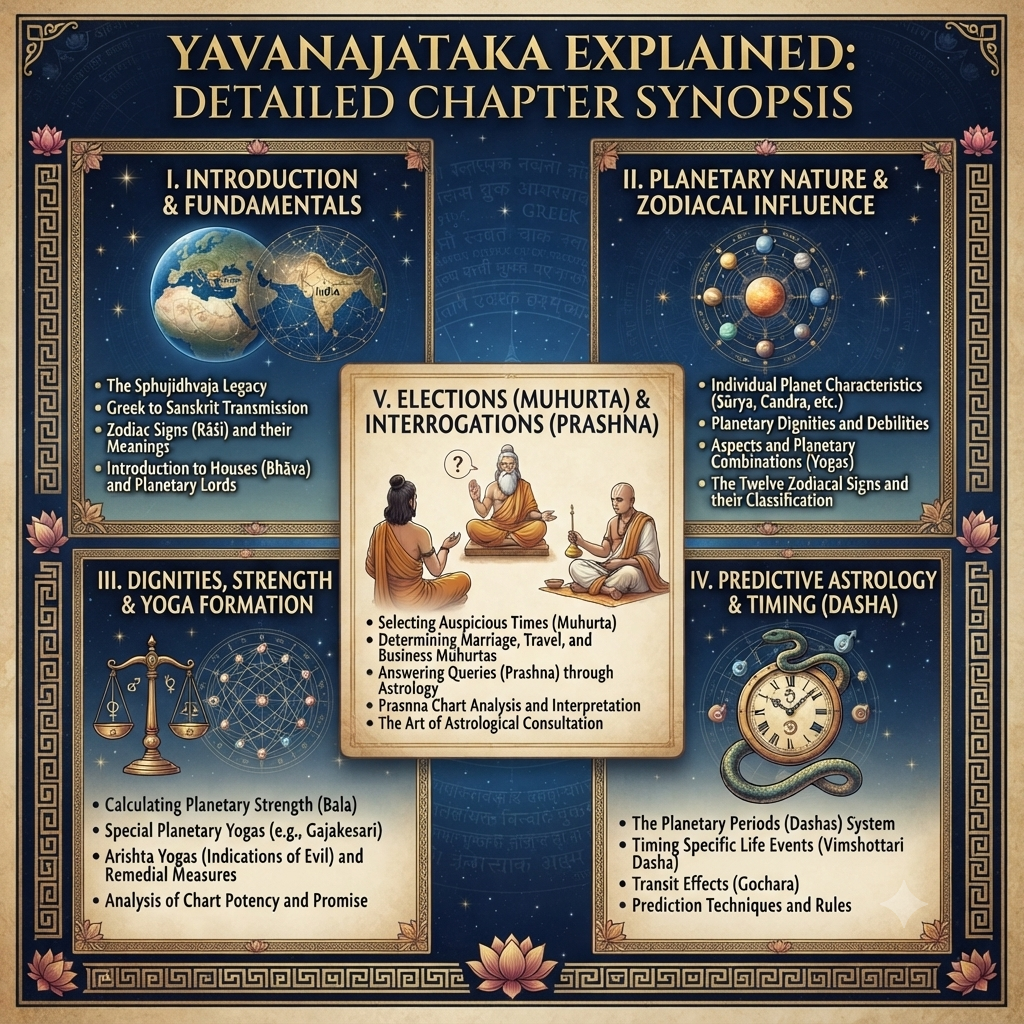


Yavanajataka Explained
Yavanajataka Explained
⭐️⭐️⭐️⭐️⭐️ 4.9/5 1445 Reviews
500+ bought in past month
Couldn't load pickup availability
Yavanajataka Explained
The Greek Stars That Became Indian Astrology
What if the history of Indian astrology holds a remarkable story of ideas travelling between Greece and India? Explore the Yavanajataka, an ancient Sanskrit astrological text that offers a fascinating window into the meeting of two intellectual traditions.
What If the Horoscope You Know Today Began Somewhere Else?
Around the early centuries of the Common Era, astronomical and astrological ideas travelled across cultures, languages and trading routes. Among the most intriguing records of this exchange is the Yavanajataka — a Sanskrit work whose very name connects the Greek world with Indian horoscopy.
The title combines Yavana, a Sanskrit term historically associated with Greeks or people from the Greek-speaking world, and Jataka, a term connected with birth and horoscopy.
Traditionally associated with Sphujidhvaja, the text is an extraordinary example of how astrological concepts were interpreted, adapted and expressed within the Indian intellectual world.
The story is more than a simple account of one civilisation borrowing from another. It raises deeper questions about cultural exchange, the movement of scientific ideas and the evolution of astrology in the Indian subcontinent.
What You'll Explore Inside

Go beyond a basic introduction and discover the concepts, chart principles and historical questions associated with this remarkable astrological tradition.
The Text and Its Structure
Discover the Yavanajataka as a substantial Sanskrit work, commonly described in modern scholarship as comprising approximately 2,270 verses across 79 chapters.
Zodiac Signs and Houses
Explore the zodiac framework, horoscopic principles and the ways celestial positions are interpreted within the text's astrological tradition.
Cardines and Key Positions
Understand important chart positions and angular relationships that help form the framework of traditional horoscopic interpretation.
Planetary Combinations and Yogas
Examine planetary relationships and combinations, and learn how these ideas fit into the wider development of Indian astrological thought.
Interrogations and Elections
Explore the historical ideas behind asking astrological questions and selecting suitable moments for particular actions.
Greek and Indian Connections
Follow the exchange of concepts between traditions and consider how foreign ideas were adapted to Indian cultural and intellectual settings.
A Story With Two Sides
One of the most fascinating aspects of the Yavanajataka is the scholarly debate surrounding its origins and transmission. Rather than treating one interpretation as settled fact, this guide introduces the discussion from more than one perspective.
David Pingree's Interpretation
Historian of science David Pingree argued that the work reflects the transmission of Greek astrological material into Sanskrit, and proposed a specific earlier Greek source and chronology for the text.
Later Scholarly Reassessment
Later research, including Bill M. Mak's reassessment, questioned important parts of Pingree's reconstruction. It highlighted the mixed Greek and Indian elements of the work and argued that its exact origins and transmission remain open to debate.
The result is a richer historical question: how did Greek and Indian astral sciences interact, and what can the surviving text actually tell us?
Who Is This Guide For?

Whether your interest is astrological, historical or cultural, the Yavanajataka offers an unusual opportunity to explore the connections between ancient knowledge systems.
- Readers curious about Indian astrology and Hellenistic astrology
- Students of Sanskrit, Indology and ancient intellectual history
- Astrologers interested in the historical development of their tradition
- Readers exploring cultural exchange between Greece and India
- Anyone fascinated by the history of astronomy, horoscopy and ancient ideas
Why Explore Yavanajataka Explained?
Accessible Explanations
Approach a specialised historical subject through clear, reader-friendly explanations.
Historical Context
Understand the wider setting in which Greek and Indian astrological ideas encountered one another.
More Than One Perspective
Consider influential interpretations alongside later scholarly questions and reassessments.
A Cross-Cultural View
Discover how knowledge can travel, change and develop when different traditions meet.
Some ancient texts do more than preserve knowledge. They reveal the journeys ideas take between worlds.
Explore the Crossroads of Greece and India
Step into the history of the Yavanajataka and discover one of the most intriguing chapters in the development of Indian astrological thought.
Get your digital copy today and begin exploring this remarkable ancient connection.
Frequently Asked Questions
What is the Yavanajataka?
The Yavanajataka is an ancient Sanskrit astrological text associated with Sphujidhvaja. Its title is commonly understood as referring to horoscopy connected with the Greeks, and the work is an important source for studying the interaction of Greek and Indian astral traditions.
Who composed the Yavanajataka?
The text is traditionally associated with Sphujidhvaja. Questions about its composition, sources and transmission have been examined by scholars, and some aspects of its history remain debated.
Why is the Yavanajataka important in the history of Indian astrology?
It provides evidence of the interaction between Greek-associated astrological concepts and Indian traditions. It is therefore valuable for understanding the historical development of horoscopy and the movement of ideas across cultures.
Was the Yavanajataka translated directly from a Greek text?
This is a matter of scholarly debate. David Pingree proposed a Greek prose source behind the Sanskrit work, while later research by Bill M. Mak challenged important parts of that reconstruction. The precise nature of the text's sources and transmission should not be treated as conclusively settled.
What subjects does the Yavanajataka cover?
The work is associated with horoscopic astrology and includes subjects such as zodiac signs, planetary positions, chart interpretation, astrological combinations and astronomical calculations.
Who should read Yavanajataka Explained?
It is intended for readers interested in Indian astrology, Hellenistic astrology, Sanskrit literature, ancient history, astronomy and the cultural exchange between Greece and India.
Do I receive a physical book?
No. This is a digital eBook. The download link will be shared after your purchase is completed. No physical book will be shipped.
⚠️ Please note: It is an eBook that will be provided digitally, and the download link will be shared after the purchase is completed. No physical book will be provided.
What's included in the box
What's included in the box