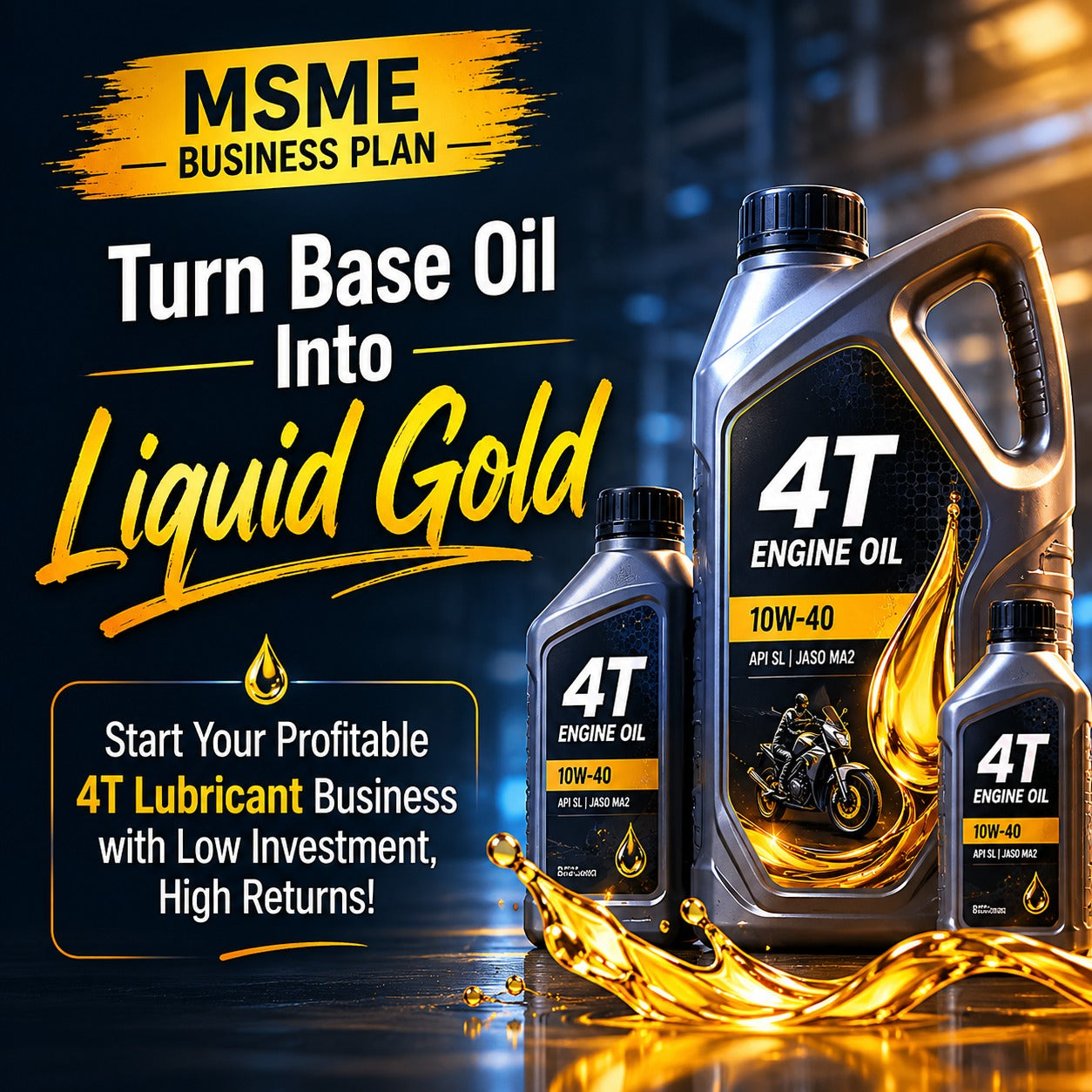


4T Oil Blending Plant Complete MSME Business Guide 2026
4T Oil Blending Plant Complete MSME Business Guide 2026
⭐️⭐️⭐️⭐️⭐️ 4.9/5 1445 Reviews
500+ bought in past month
Couldn't load pickup availability
A Practical Guide to Setting Up and Planning a Four-Stroke Engine Oil Blending Unit in India
Planning to start a 4T oil blending plant in India? Understand the business, technical, financial and regulatory considerations before investing in your manufacturing project.
The 4T Oil Blending Plant Complete MSME Business Guide 2026 is a structured digital business resource for entrepreneurs exploring the establishment of a four-stroke engine oil blending and manufacturing unit.
It brings together important aspects of plant setup, machinery selection, base oil and additive sourcing, production planning, quality control, project costing, financial assessment, registrations, financing options, packaging and marketing.
Whether you are a first-time entrepreneur, an existing MSME owner or an investor evaluating the lubricant manufacturing sector, this guide provides a starting point for organising your research and project planning.
What You Receive With This Digital Guide
- 100+ page comprehensive PDF business guide.
- Excel-based project cost and ROI planning sheet.
- Project report format for business planning.
- Loan-application documentation checklist.
- Access to 2026 revised editions as described in the offer.
Format: Digital eBook with supporting planning resources.

Why Explore the 4T Oil Blending Business?
Four-stroke engine oils are used in a range of automotive applications, including motorcycles, scooters and other compatible four-stroke engines. This creates an established product category within India's automotive lubricant market.
A 4T engine oil blending business involves sourcing suitable base oils and additive packages, developing products to the required specifications, arranging blending and testing infrastructure, and establishing packaging and distribution operations.
However, purchasing blending equipment alone does not make a manufacturing project commercially viable. Entrepreneurs must also evaluate raw material quality, production capacity, investment requirements, regulatory compliance, working capital, competition and market access.
This guide helps bring these important considerations together before you move towards implementation.
What Is Covered in the 4T Oil Blending Business Guide?
The guide covers ten important areas involved in planning a four-stroke engine oil blending unit.
Complete Plant Setup Blueprint
Understand the stages involved in establishing a 4T oil blending unit, including plant layout, production sections, machinery selection, storage arrangements and utility requirements.
Base Oil and Additive Sourcing
Explore the role of base oils, additive packages, blending inputs and packaging materials. Understand what to evaluate when comparing supplier specifications and procurement options.
MSME Registration and Compliance
Understand Udyam Registration, GST considerations, applicable factory and local permissions, pollution-control requirements, product standards and BIS certification considerations.
Project Cost and Financial Planning
Explore machinery investment, project-cost components, working capital, operating expenses, break-even concepts and financial projections for assessing project feasibility.
Loans and Government Scheme Overview
Learn about financing routes worth evaluating, including MUDRA, PMEGP, SIDBI finance and relevant state-level MSME support, subject to scheme eligibility and lender assessment.
Blending Process and Quality Control
Understand the blending workflow, process controls, viscosity requirements, product testing considerations and laboratory planning.
Packaging, Branding and Labelling
Explore product-range planning, container selection, label information, packaging considerations, brand positioning and applicable marking requirements.
Marketing and Distribution Strategy
Examine potential channels such as automobile workshops, spare-parts dealers, distributors, fleet operators and regional lubricant retailers.
Competitor and Market Analysis
Understand how to study the Indian lubricant market, compare competing brands, assess product positioning and identify potential opportunities in your target geography.
Project Documents and Templates
Use structured reference formats and checklists for business planning, project-report preparation and loan-application documentation, subject to project-specific customisation.

4T Oil Blending Plant Machinery and Infrastructure Planning
Establishing an engine oil blending unit requires appropriate production infrastructure, storage arrangements, material handling systems and quality-control facilities.
The machinery and infrastructure planning areas covered in the guide include:
- Blending equipment: Understand the role of blending tanks and associated mixing arrangements.
- Storage infrastructure: Consider storage arrangements for base oils, additives and finished products.
- Material handling: Evaluate transfer pumps, pipelines and other material-handling requirements.
- Production layout: Plan production sections, storage areas, packaging arrangements and movement of materials.
- Quality-control facilities: Understand product testing considerations and laboratory requirements.
- Packaging arrangements: Consider filling, sealing, labelling and finished-product storage.
- Utilities: Evaluate the utility requirements relevant to the proposed production process.

Raw Materials Required for 4T Engine Oil Blending
Raw material selection is an important part of lubricant manufacturing. The finished product must meet its intended viscosity, performance and quality specifications.
Important sourcing considerations include:
- Base oils: Evaluate suitable base oil grades and their specifications.
- Additive packages: Assess additive compatibility and suitability for the intended 4T engine oil formulation.
- Packaging materials: Consider containers, caps, labels, seals and cartons.
- Supplier evaluation: Compare technical specifications, consistency, documentation and commercial terms.
- Procurement planning: Consider sourcing lead times, inventory requirements and working capital.
Read more about raw materials required for lubricant oil manufacturing in India for additional sourcing-related information.
Project Cost and Investment Planning
Before setting up a 4T oil blending plant, entrepreneurs should prepare a project-cost assessment based on the proposed production capacity, location, infrastructure and operating model.
The guide covers important financial planning areas that should be considered when evaluating a proposed unit.
Fixed Capital Investment
Machinery, equipment, storage arrangements, facility preparation and other initial infrastructure requirements.
Raw Material Investment
Base oils, additive packages, packaging materials and initial procurement requirements.
Working Capital
Inventory, utilities, employee expenses, transportation, receivables and routine operational requirements.
Financial Feasibility
Operating expenses, projected revenue assumptions, break-even concepts and return-analysis considerations.
Why Financial Planning Matters
Two oil blending plants may have very different investment requirements depending on production capacity, machinery, automation, premises, raw material specifications and location.
The included Excel-based project cost and ROI planning sheet provides a structured starting point for evaluating the financial aspects of your proposed business.
Licences, Registrations and Regulatory Considerations
An oil blending business must assess the registrations, permissions and product-related requirements applicable to its actual activities and location.
- Udyam Registration: Review MSME registration requirements and eligibility.
- GST: Evaluate applicable GST registration and taxation requirements.
- Factory and local permissions: Check the requirements applicable to the premises, workforce and manufacturing activity.
- Pollution-control permissions: Verify the relevant State Pollution Control Board or Pollution Control Committee requirements.
- Indian Standards: Review IS 13656 and other product-specific standards relevant to the intended automotive lubricant.
- BIS certification: Verify whether mandatory certification or marking applies under the current Quality Control Orders or other notifications.
- Product testing: Evaluate viscosity, flash point, density and other applicable quality parameters.
For additional information, explore our oil blending MSME registration and licensing guide .
Bank Loans, DPR and Government Financing Options
Financing is an important consideration when establishing a manufacturing unit. Entrepreneurs may evaluate different bank and institutional financing options depending on their project requirements and eligibility.
- PMEGP: Explore the Prime Minister's Employment Generation Programme and its current eligibility and project conditions.
- MUDRA: Understand the applicable micro-enterprise lending categories and lender requirements.
- SIDBI: Evaluate relevant MSME financing products and institutional funding routes.
- State MSME schemes: Research applicable state-level assistance and industrial development policies.
- Project documentation: Understand the role of project reports, cost estimates and supporting documents in a financing application.
The guide includes project-report and loan-application reference resources to help organise business-planning documentation.
Remember that loan sanction, subsidy benefits and financial assistance depend on the applicable scheme guidelines, applicant eligibility, project appraisal and lender assessment.
Production Process and Quality Control
A lubricant blending unit must maintain suitable process controls and product-quality arrangements. The manufacturing process should be developed around the intended product formulation and applicable specifications.
Important areas covered include:
- Base oil and additive selection.
- Blending workflow and process controls.
- Product formulation considerations.
- Viscosity and other product-specific quality parameters.
- Laboratory planning and testing arrangements.
- Finished-product storage and packaging considerations.
Marketing and Distribution of 4T Engine Oil
Manufacturing a lubricant product is only one part of the business. Establishing distribution relationships and developing customer confidence are also important.
Potential market channels include:
- Automobile workshops and service centres.
- Two-wheeler repair and maintenance shops.
- Automotive spare-parts retailers.
- Regional lubricant distributors and dealers.
- Fleet operators and institutional buyers.
- Regional lubricant retail networks.
The guide covers market research, competitor assessment, product positioning, packaging, branding and distribution planning to help entrepreneurs evaluate their market-entry approach.
Who Should Purchase This 4T Oil Blending Guide?
- First-time entrepreneurs: Individuals exploring a four-stroke engine oil blending or manufacturing business.
- Existing MSME owners: Business owners considering diversification into the automotive lubricant sector.
- Manufacturing investors: Investors assessing plant setup, machinery, investment requirements and business feasibility.
- Business consultants: Professionals researching lubricant manufacturing projects and preparing business documentation.
- MBA and engineering students: Students researching lubricant manufacturing and industrial project planning.
- NRIs and other investors: Individuals evaluating manufacturing opportunities in the Indian MSME sector.
Why Choose the Lywire 4T Oil Blending Business Guide?
India-Focused Guidance
Covers business planning and regulatory considerations relevant to an Indian manufacturing project.
Structured Information
Brings plant setup, sourcing, production, compliance and marketing considerations together.
Financial Planning Resources
Includes an Excel-based project cost and ROI planning sheet to support financial assessment.
Supporting Documentation
Includes a project report format and loan-application checklist as reference resources.
Practical Business Reference
Helps organise research and identify important considerations before investing.
Accessible Presentation
Designed for entrepreneurs and readers with both business and technical backgrounds.
What You Get After Purchasing
The product includes the following digital resources:
| Included Resource | Details |
|---|---|
| Main Business Guide | Comprehensive PDF eBook of 100+ pages. |
| Financial Model | Excel-based project cost and ROI planning sheet. |
| Project Documentation | Project report format. |
| Loan Documentation | Loan-application checklist. |
| Revised Edition Access | Access to 2026 revised editions as described in the product offer. |
Digital Product and Delivery Information
This product is supplied as a digital business guide. After successful purchase, the download link will be shared for accessing the purchased resources.
No physical book is included in the digital product purchase.
If you experience a delivery issue after completing your order, contact Lywire customer support with your order details.
Related Lubricant Manufacturing Resources
If you are researching the wider lubricant manufacturing sector, these additional Lywire resources may also be useful:
Frequently Asked Questions
Find answers to common questions about starting a 4T oil blending business and using this MSME business guide.
1. What is a 4T oil blending plant?
A 4T oil blending plant is a manufacturing facility where suitable base oils and additive components are blended under controlled conditions to produce four-stroke engine lubricants that meet the intended product specifications.
2. What does the 4T Oil Blending Plant Business Guide include?
It covers plant setup, machinery and layout planning, raw material sourcing, MSME registrations, regulatory considerations, project costing, financing options, production, quality control, packaging, branding, marketing and project documentation.
3. Is this guide suitable for beginners?
Yes. The guide is intended for first-time entrepreneurs, existing MSME owners, investors, consultants and students researching four-stroke engine oil blending. Readers should also obtain appropriate technical and regulatory advice before implementing a manufacturing project.
4. What machinery is required for a 4T oil blending plant?
Machinery and infrastructure requirements depend on the proposed production capacity, formulation and operating arrangement. Relevant planning areas include blending tanks, mixing arrangements, storage facilities, transfer systems, filling and packaging equipment, and quality-testing facilities.
5. Does the guide cover the investment and project cost of an oil blending plant?
Yes. It covers project-cost components, machinery investment, raw material requirements, working capital, operating expenses, break-even concepts and financial projections. It also includes an Excel-based project cost and ROI planning sheet.
Actual investment requirements depend on capacity, location, equipment selection, infrastructure, raw material specifications and market conditions.
6. Which registrations and licences may be required?
Depending on the business structure, location and activities, requirements may include Udyam Registration, GST registration, applicable factory and local permissions, pollution-control approvals and product-specific compliance requirements.
Verify the current requirements with the relevant authorities before starting operations.
7. Is BIS certification required for 4T engine oil?
The applicable requirements depend on the specific product, relevant Indian Standard and current Quality Control Orders or other notifications. IS 13656 is relevant to automotive crankcase oils. Manufacturers should verify the current mandatory certification and marking position with BIS before production or sale.
8. Can I apply for a PMEGP or MUDRA loan for an oil blending unit?
PMEGP, MUDRA and other bank or institutional finance options may be worth evaluating, depending on the proposed project and applicable scheme conditions. Eligibility, funding and subsidy benefits are subject to the current guidelines and lender assessment. Approval is not guaranteed.
9. Does this product include a DPR format and financial model?
Yes. The product inclusions specify a comprehensive PDF guide, an Excel-based project cost and ROI planning sheet, a project report format and a loan-application checklist.
The project report format is a reference resource and may require customisation to match your actual project, financial assumptions and lender requirements.
10. Is this a physical book or a digital eBook?
This product is offered as a digital eBook with supporting planning resources. No physical book is included in the digital product purchase. The download link is shared after successful completion of the purchase.
Important Information and Disclaimer
Business planning: This guide is an educational and business-planning resource. It does not replace independent technical, legal, financial or regulatory advice.
Financial projections: Cost estimates, financial models and projected returns depend on assumptions. Actual investment, operating expenses and commercial outcomes may vary.
Loans and subsidies: Financing and government scheme benefits are subject to independent eligibility conditions, current guidelines, project appraisal and lender decisions. No loan, grant or subsidy is guaranteed.
Regulatory compliance: Registrations, licences, standards and approvals may change. Verify applicable requirements with the relevant authorities and qualified professionals.
Product limitations: The guide is intended to support research and planning. It does not constitute a government-approved project report, manufacturing licence, product certification or assurance of business profitability.
Digital delivery: The product is supplied digitally. No physical book is included in the digital purchase.
Plan Your 4T Oil Blending Business with Better Clarity
Explore the key considerations involved in setting up a four-stroke engine oil blending unit, from machinery and raw materials to project costing, compliance, production and marketing.
Get the 4T Oil Blending Plant Complete MSME Business Guide 2026 and use its supporting planning resources to organise your next steps.
A structured starting point for researching your lubricant manufacturing business idea.
Digital PDF eBook | Excel Financial Planning Sheet | Project Report Format | Loan Checklist
What's included in the box
What's included in the box